In Action
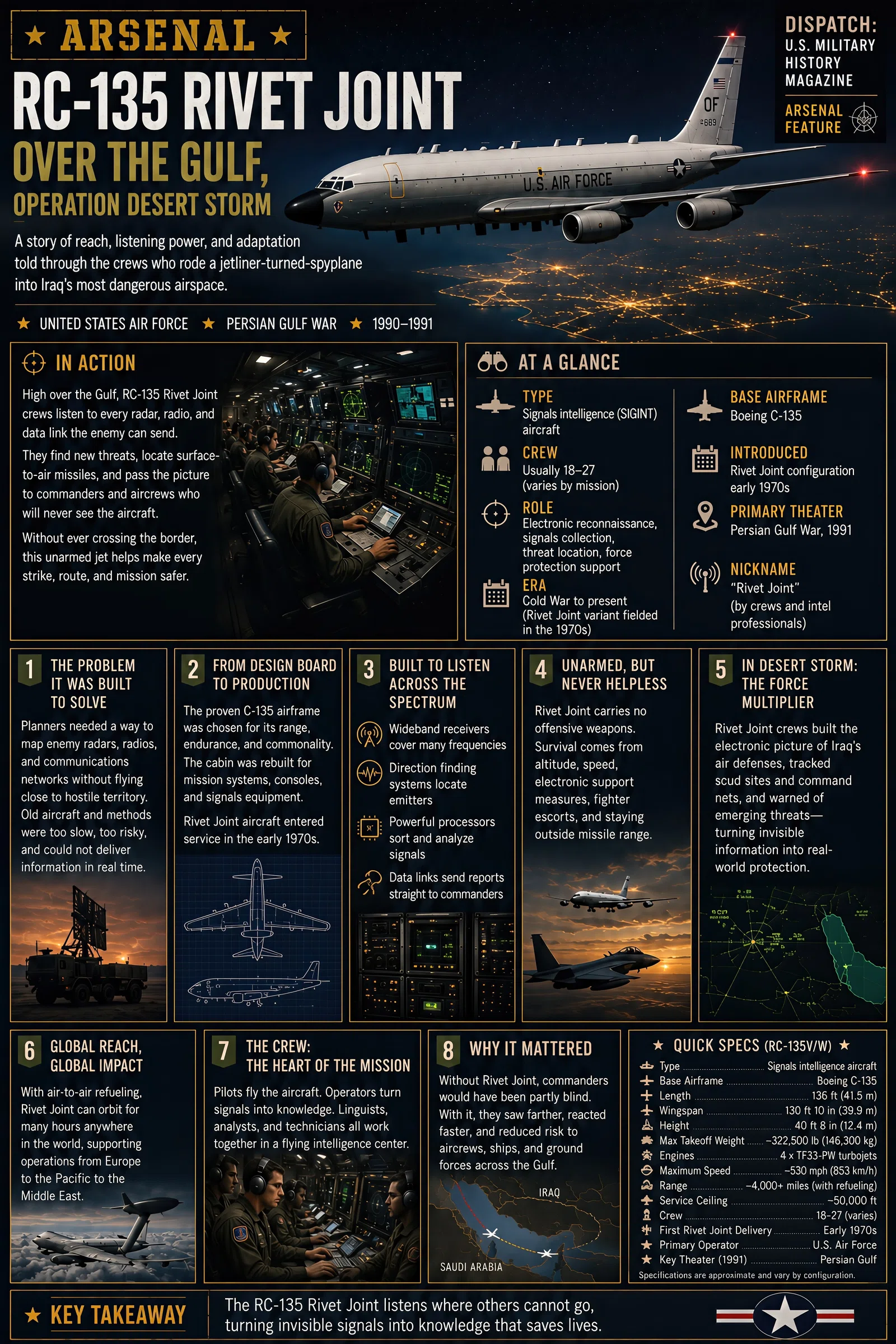
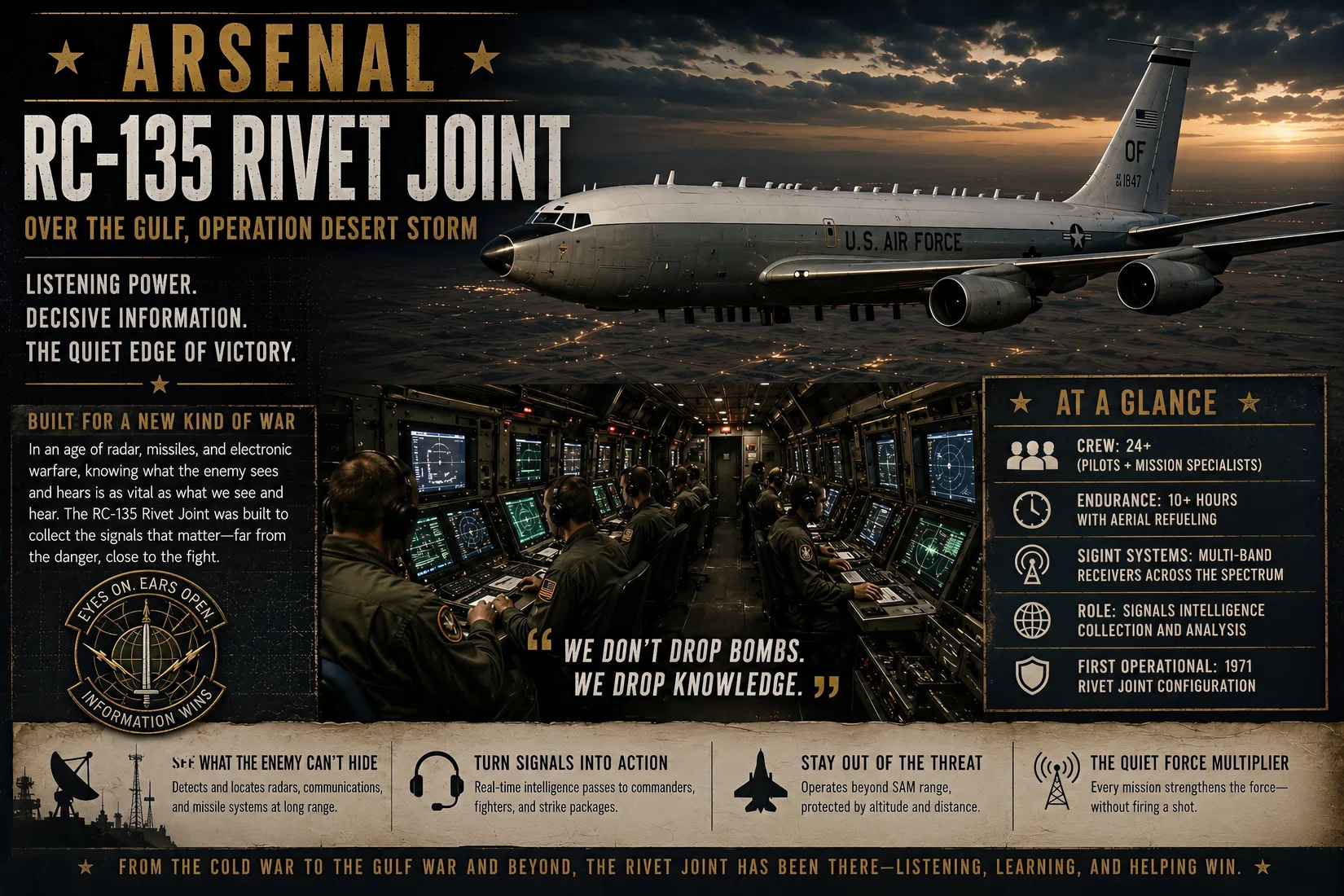
The cabin lights are dimmed to a red glow as the big four-engine jet settles into its orbit over the darkened Gulf. Outside, the night sky above Saudi Arabia is streaked with the faint arcs of tankers and strike packages, all flowing north toward Iraq. Inside this particular aircraft, no windows are needed. The crew of the RC-135 Rivet Joint is looking at the war through headsets and screens.
In the mission bay, rows of operators lean into their consoles. Headphones hiss with layered Arabic and clipped radio procedure. On the scopes, green symbols blossom and fade as Iraqi search radars sweep, lock, then blink out when they are jammed or destroyed. One operator calls out a new emitter coming alive near Basra. Another starts the process of pinning its location down within a few hundred meters. The aircraft banks slightly as it tightens its orbit, engines humming steadily.
Up front, the pilots and navigators keep the Rivet Joint exactly where the mission crew needs it: just outside the range rings of Iraqi surface-to-air missiles but close enough to drink in every watt of hostile energy. Far away, strike leaders and air defense commanders listen for the calm voice of a controller relaying what this aircraft hears. A quiet change of heading here, a warning about a radar there, and a crew that never sees the ground can still tilt the odds for those flying into the fire.
Tonight is only one sortie in a long campaign. For the people who fly and work Rivet Joint, this moment over the Gulf is the payoff for decades of design choices and doctrinal arguments about how best to listen to an enemy without ever crossing his border.
The Problem It Was Built To Solve
The RC-135 Rivet Joint exists because modern wars are decided as much in the invisible spectrum as in the visible sky. By the early Cold War, aircrews and planners in the United States knew that enemy radars, radios, and missile guidance links were as critical to a battle as tanks and bombers. They also knew that the existing ways of collecting that information were dangerously fragile. Slow propeller aircraft and early jet bombers had to fly close to hostile territory, sometimes right along the border or just inside it, to hear what they needed to hear. Losses were painful, and the information they brought back was sometimes out of date by the time it reached a planner’s desk.
At the same time, the threat picture was getting worse. Long-range surface-to-air missiles, high-performance interceptors, and dense radar networks meant that any reconnaissance aircraft hanging near the front line was at constant risk. Yet commanders still needed a detailed map of the enemy’s “electronic order of battle” – where radars were, what frequencies they used, how they talked to each other, and when they changed tactics. They needed to hear command nets, track fighter controllers, and understand which sectors were blind and which were lethal.
Signals intelligence, or SIGINT, had usually been done from the ground, from ships, or by small fleets of specialized aircraft built in tiny numbers. None of those solutions could offer global reach, long endurance, and real-time reporting to theater and national decision-makers. The needed something more: a jet that could stay in the air for many hours, refuel in flight, operate far from friendly bases, and carry an entire team of specialists and their equipment.
The answer was to take a proven jet transport and tanker airframe, the C-135 family, and turn it into a dedicated electronic reconnaissance platform. Over time, that idea would harden into a specific incarnation: the RC-135V/W Rivet Joint, the standard airborne SIGINT workhorse that could listen across the spectrum and push its findings straight to commanders in the middle of a fight. The decision to move from ad-hoc conversions to a purpose-built Rivet Joint fleet would reshape how the United States approached every major air campaign from the late Cold War into Operation Desert Storm and beyond.
From Design Board To Production
Turning the C-135 airframe into Rivet Joint was less about drawing a brand-new aircraft and more about deciding what to keep, what to change, and how far to push the design. The wanted something that could share parts, maintenance practices, and flying qualities with the KC-135 tanker and C-135 transport family, which were already proven in global service. Using that jetliner-derived fuselage, swept wing, and four-engine layout meant the new aircraft would have the altitude, speed, and range to stay on station for many hours, especially with air-to-air refueling. That commonality kept costs down and made it easier to base the aircraft alongside existing tanker and transport units.
Inside the familiar outline, though, almost everything changed. Where cargo or fuel once sat, designers planned rows of mission consoles, racks of receivers, recorders, processors, and a web of cabling that turned the jet into an airborne listening post. Companies specializing in electronic warfare and signals intelligence systems adapted their equipment to fit the constraints of a pressurized cabin that had to work at high altitude and in constant vibration. Antennas sprouted along the fuselage, chin, and wingtips, giving the aircraft its distinctive bristling look. Each new generation of sensors could hear farther across the spectrum, process more signals at once, and present a clearer picture to the operators on board.
By the early 1970s, earlier RC-135 variants that had cut their teeth in Cold War patrols and the Vietnam War began to converge into what would become the RC-135V/W Rivet Joint standard. Airframes originally built as transports or earlier reconnaissance models were cycled through heavy modification programs, emerging with updated engines, improved cockpits, and a common mission suite. The result was a theater asset that could be tasked at national level, deploy worldwide, plug into joint air campaigns, and deliver near real-time intelligence from directly overhead the fight. From its main home at Offutt Base with the 55th Wing, Rivet Joint rotated detachments to forward locations, gaining a reputation as a quiet constant in the background of almost every major United States air operation from the late Cold War through Desert Storm and beyond.
Inside The Weapon
Walking into a Rivet Joint feels less like boarding a transport aircraft and more like stepping into a cramped operations floor at a secure intelligence facility. Up front, the cockpit looks broadly familiar to any crew accustomed to large jets: two pilots with a clear view ahead, a navigator station, flight instruments, and controls for fuel, engines, and autopilot. Behind them, though, the environment shifts. The mission deck stretches down the fuselage, with consoles lining both sides and equipment racks filling the spaces between. Red or dimmable lighting keeps glare off screens and allows operators to work for long hours without eye strain, especially during night missions.
The human layout is as important as the electronics. A typical Rivet Joint sortie brings together a cockpit crew of pilots and navigators, plus a mission crew of electronic warfare officers, intelligence specialists, and airborne maintenance personnel. The pilots focus on flying a precise orbit in the right patch of sky, often for many hours at a stretch and sometimes while taking fuel from tankers to stay aloft. Meanwhile, mission crew members are grouped by specialty. Some focus on finding and classifying radar emissions, others on voice communications or data links, and still others on fusing all of that input into a coherent picture that can be pushed off the aircraft in real time.
Each console is a small world. Operators wear headsets tied into carefully controlled communications nets, allowing them to talk to one another, to supervisors on board, and to command and control aircraft or ground centers beyond line of sight. Their screens show frequency bands, signal traces, geolocation plots, and sometimes simplified maps with icons representing hostile emitters. One operator may be listening to a fragment of fighter controller chatter, another watching a hostile early-warning radar come on and off line in a steady rhythm, and a third tracking how those changes match incoming reports from strike packages. When the pieces line up, they can warn a formation about a new threat, highlight a gap in the enemy radar coverage, or confirm that a suppression mission has actually silenced a key site.
Around them, the airframe itself has been shaped to support this mission. Antenna arrays along the nose, cheeks, fuselage sides, and tail gather signals from across the electromagnetic spectrum, feeding them into receivers and processors that can sort, filter, and store a torrent of data. Cooling systems and power distribution gear hum in the background, keeping sensitive electronics within their operating limits even in hot, high-altitude conditions. The aircraft’s communications suite ties everything back into the wider force through secure voice circuits, data links, and satellite communications, allowing Rivet Joint to act as both a collector and a relay. In theory the jet is just another four-engine aircraft at altitude; in practice it is a flying nerve ending plugged directly into the command structure of a modern air war.
Training materials and unit histories emphasize the contrast between expectations on paper and the reality of life on board. Long missions mean long hours at a console, coping with headset fatigue, changing mission priorities, and the constant possibility that a quiet orbit may shift into a high-stakes moment if the enemy changes behavior. Veterans describe not only the technical challenge of keeping up with agile, adaptive opponents, but also the simple physical experience of spending many hours in a narrow cabin lined with equipment, where every movement and conversation has to be coordinated. The machine provides the reach and the ears; the way crews live and work inside it determines how clearly commanders can hear the war unfold.
Baptism Of Fire
By the time Rivet Joint crews took up their racetrack orbits over the Gulf in early 1991, the aircraft and its predecessors had already spent decades flying the long, quiet missions of the Cold War. They had skirted the borders of the Soviet Union and its allies, mapping radars, listening to command nets, and learning how hostile air defense systems spoke to one another. In Vietnam, earlier RC-135 variants had supported bombing campaigns and monitored North Vietnamese air defenses, proving the value of having a set of airborne ears tied directly into theater command. Those years built a deep library of signals and tactics, but they also showed how fast opponents could adapt, changing frequencies and procedures when they knew they were being watched.
Operation Desert Storm turned that background work into a live-fire exam for Rivet Joint. Before the first strikes crossed into Iraq and Kuwait, the aircraft had already helped chart the Iraqi integrated air defense system, identifying key early warning radars, fighter control nodes, and missile batteries. As the air campaign opened, Rivet Joint orbits over Saudi Arabia and the Gulf became permanent fixtures. Crews tracked when Iraqi radars lit up in response to decoys, when they stayed dark out of fear, and when operators tried new tactics to catch coalition aircraft off guard. Controllers on board relayed time-sensitive warnings and assessments to airborne command posts and strike leaders, often shaving seconds off reaction times that meant the difference between a clean escape and a missile launch.
The effect was not as visible as a laser-guided bomb hitting a hardened shelter, but it was just as real. By painting a detailed picture of the enemy’s electronic behavior in near real time, Rivet Joint gave planners and pilots the confidence to push deeper and repeat complex strike packages night after night. The aircraft’s “baptism of fire” in Desert Storm cemented its status as a central player in modern air campaigns, a role it would carry into later operations over the Balkans, Afghanistan, and Iraq.
Strengths And Weaknesses
From the perspective of the crews and commanders who depended on it, the Rivet Joint’s greatest strength has always been its ability to turn the chaos of the electromagnetic spectrum into something human beings can understand and act on. It brings endurance, with the C-135 airframe and aerial refueling allowing missions that last well into double-digit hours. It offers reach, able to deploy far from home bases and operate from forward locations when needed. Most importantly, it carries an integrated team: pilots, mission directors, linguists, and technical specialists who can spot patterns, cross-check interpretations, and send out clear, concise guidance rather than raw data.
There are tradeoffs. The aircraft’s size and value make it a high-profile asset; no one wants to risk an RC-135 inside heavily defended airspace, so it usually works from standoff distances. That means it relies on altitude, antenna positioning, and clever signal processing to hear into hostile territory. The high crew count and complex mission systems also demand intensive training and maintenance. Keeping operators current on changing enemy tactics, new signal types, and upgraded equipment is an ongoing effort rather than a box to be checked once.
Enemies have learned to adapt as well. Adversary forces practice emission control, turning radars on only briefly or using passive systems to reduce what Rivet Joint can hear. They experiment with deceptive techniques, false emitters, and rapidly changing communication methods. These countermeasures do not erase Rivet Joint’s value, but they force its crews to work harder to separate signal from noise. In that sense, one of the aircraft’s quieter strengths is the flexibility of the people inside it. The jet is a platform; the real edge comes from operators who know both their own systems and the habits of the opponents they are listening to.
Variants And Evolution
The RC-135V/W Rivet Joint is part of a larger family tree of specialized C-135 variants that have evolved alongside changes in technology and threat environments. Earlier members of the family included aircraft configured for photographic reconnaissance, radar tracking, and missile test support. Over time, some airframes were retired while others cycled through major modification programs that replaced older sensor suites with more capable, digital systems. The Rivet Joint standard emerged from that process as the primary airborne signals intelligence platform, optimized for theater-level support rather than narrow test roles.
Within the Rivet Joint community itself, upgrades have been continuous rather than dramatic. New generations of receivers, processors, and operator consoles have been installed in incremental blocks, each bringing better sensitivity, automation, and user interfaces. What began as racks of analog equipment feeding tape recorders has shifted into digital systems capable of handling many more signals simultaneously, sorting them faster, and presenting them in ways that help humans make decisions rather than simply stare at raw traces. Satellite communications and data links have likewise improved, allowing the aircraft to push more of its findings offboard in real time.
International cooperation has also shaped Rivet Joint’s evolution. The United States has worked with close allies to share capabilities, training, and in some cases aircraft themselves, extending the reach of this type of platform across multiple theaters. Lessons from each conflict and exercise feed back into software updates, equipment refreshes, and new tactics, techniques, and procedures. While the airframes themselves may show their age, the mission systems they carry have been repeatedly renewed, keeping the aircraft relevant in an era when both commercial and military communications technology are changing rapidly.
Legacy And Where To See It Today
Decades after the first C-135 airframes were pulled from the production line, the Rivet Joint remains a central pillar of how the United States approaches air operations in contested environments. Its legacy is visible not just in its own ongoing missions but in the way joint doctrine assumes that commanders will have a near real-time picture of enemy emitters, communications, and adaptations. Exercises, planning documents, and war stories from recent campaigns all reflect an expectation that someone, somewhere, is listening from altitude and feeding insights into the command network.
The aircraft’s influence extends into other designs and programs. Concepts for newer intelligence, surveillance, and reconnaissance platforms, whether crewed or uncrewed, often borrow the idea of combining wide-area sensing with on-board analysts and robust communications. At the same time, Rivet Joint’s long service life has underscored the importance of designing mission systems that can be upgraded in place, preserving airframes while refreshing the brains and ears inside them.
For those who want to see the lineage up close, preserved members of the broader C-135 family appear at air museums and on base flight lines as static displays, sometimes in reconnaissance or test configurations that hint at Rivet Joint’s relatives. Active Rivet Joint aircraft themselves are more elusive, still working from operational bases and forward locations rather than museum ramps. Photographs and video from exercises and deployments, including material shared through Dispatch and Trackpads, give a glimpse of the distinctive antenna arrays and mission markings that set them apart from tankers and transports. In the end, though, the most important part of the Rivet Joint story is not the silhouette of the aircraft but the crews who have spent long hours in its cabin, listening to distant conflicts and quietly shaping how those battles unfold.