In Action
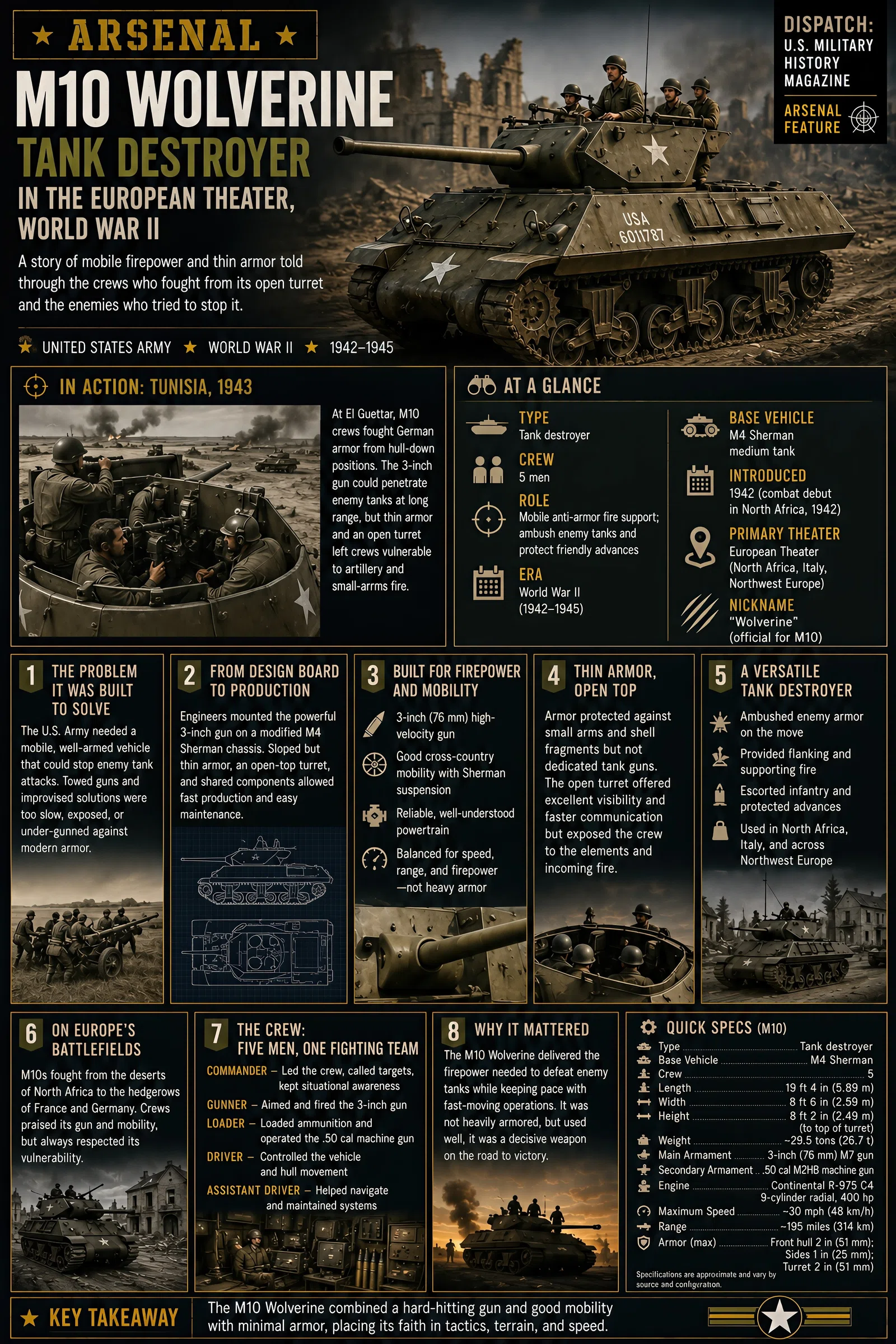
Dawn comes up dirty over the Tunisian hills, more dust than light. On a low ridgeline outside El Guettar in early 1943, a line of American tank destroyers sits nose-down in shallow scraped-out pits. They look awkward and tall at rest, open-topped turrets pointing toward a valley the crews have been staring into all night. Somewhere out there, German armor is forming up.
Inside one M10, five men wait in a steel box that is both cramped and exposed. The driver and assistant driver hunch low, watching the world through narrow vision slots. Above them in the turret, the gunner has one eye pressed to his sight, the loader leans against stacked three-inch shells, and the commander stands on a spent shell casing to see over the turret rim. The open top lets the cold morning air pour in along with the smells of fuel, dust, and nervous sweat.
Then someone calls out moving dots in the distance. Long, low shapes appear through the haze, German tanks and halftracks pushing forward in a broad line. Orders snap over the intercom. The driver kicks the M10 into gear to nudge it into just the right hull-down angle, showing as little armor as possible. The open turret suddenly feels very open as enemy artillery begins to walk up the ridge.
“Target, tank, eleven o’clock, range eight hundred!” the commander shouts. The gunner swings the heavy three-inch gun, fighting the hand-cranked traverse as the first shells land short, then closer. The loader slams armor-piercing into the breech. The gun barks, slamming the turret with recoil and hurling a glowing tracer into the valley.
Around them, other M10s join in, a ragged but growing line of muzzle flashes along the ridge. German armor keeps coming, but some of the shapes begin to burn and stop. For the crews, this is the moment their odd-looking vehicle proves whether the whole tank destroyer idea will work, or whether they are just thinly armored targets waiting to be outgunned.
The Problem It Was Built To Solve
The M10 did not begin as a clean-sheet design. It began as a problem. In the early years of the Second World War, American planners watched German armored forces carve through Europe with concentrated, fast-moving tank attacks. United States doctrine saw its own tanks primarily as tools for breaking through and exploiting, not as dedicated tank hunters. That left a gap: what would stop a massed enemy panzer thrust before it tore open an infantry front?
Early answers were improvised. Guns were bolted to halftracks, field pieces were dragged into exposed positions, and existing tanks were asked to do jobs they had not been designed for. These stopgaps were vulnerable, slow to redeploy, or simply under-gunned against newer enemy armor. Maneuver units in North Africa would soon learn that towed anti-tank guns could be deadly, but they were also hard to move once the battle shifted and painfully exposed under artillery fire or in a fast retreat.
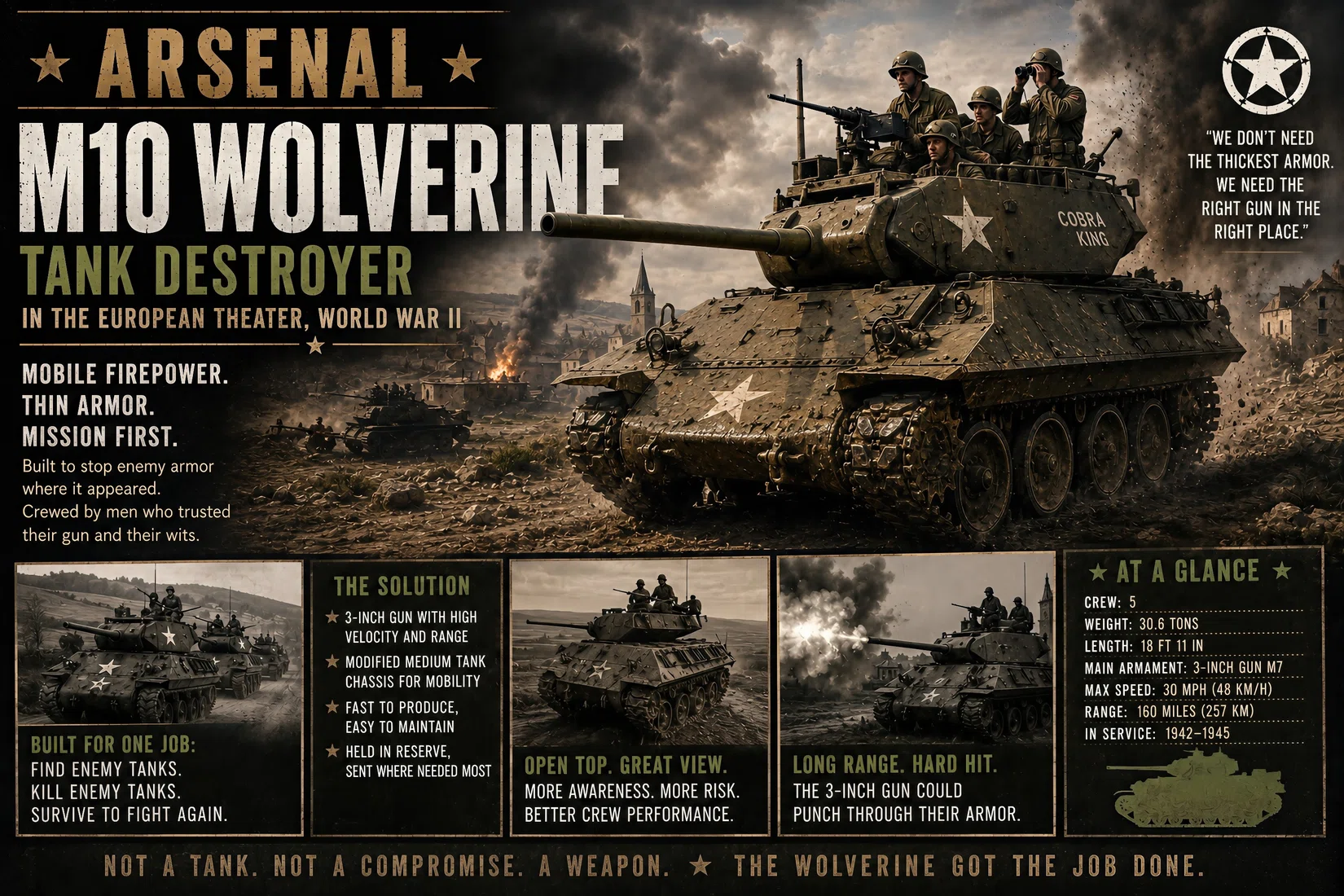
The solution the Army pursued was a new kind of unit and a new kind of vehicle. Dedicated tank destroyer battalions would be held back from the front lines, then rushed toward any major enemy armored attack. To do that, they needed a machine with a gun strong enough to defeat contemporary tanks, mobility to keep up with fast-moving operations, and just enough armor to survive as long as it stayed alert and used cover. Maximum armor was not the priority; speed, firepower, and ease of production were.
Designers responded by marrying a high-velocity three-inch gun to a modified medium tank chassis that American industry was already building in large numbers. The result was a vehicle with sloped but relatively thin armor and a tall, open-topped turret that traded overhead protection for visibility and weight savings. Later generations would call it the M10 Wolverine, though most wartime crews simply called it a “TD,” short for tank destroyer. It was conceived as a mobile answer to the panzer problem, and as the war widened from North Africa to Italy and Northwest Europe, commanders would find plenty of chances to test whether that answer was good enough.
From Design Board To Production
The story of the M10 Wolverine runs straight through the pressure cooker of early war lessons. After watching improvised tank destroyers made from halftracks and trucks struggle against newer enemy tanks, American planners pushed for a fully tracked gun motor carriage built on something the factories already understood. Medium tank production was ramping up fast, and the quickest way to field a new weapon was to adapt an existing chassis rather than demand a clean-sheet design. Engineers began experimenting with a three-inch anti-tank gun mounted on modified hulls that shared engines, suspensions, and many components with the standard Sherman family.
From the outset, the design team accepted that armor would not match a true tank. The concept was to stay mobile, fight from ambush or prepared positions, and let a powerful gun do the talking. That meant sloped but relatively modest armor plates, a tall superstructure, and an open-topped turret that saved weight while giving commanders wide visibility. The open top also made production simpler and allowed the big gun to recoil freely, at the cost of exposing crews to shell fragments and small-arms fire from above. It was a conscious trade: survivability would come from tactics and positioning more than from sheer thickness of steel.
At a glance, the M10 Wolverine was a tracked, turreted tank destroyer of United States origin, serving mainly with the United States Army in the European and Mediterranean theaters of the Second World War. It typically carried a five-man crew, centered on a high-velocity three-inch main gun for long-range armor killing, backed by a heavy machine gun for local defense. In performance, it could move at road speeds broadly comparable to the Sherman tanks it accompanied, with enough range to keep up on long road marches and enough mechanical commonality to be maintained by the same depots. American industry turned out thousands of these vehicles, enough to equip dedicated tank destroyer battalions that would see action in North Africa, Italy, and Northwest Europe, as well as to supply allies under wartime aid programs.
Inside The Weapon
Climbing into an M10 Wolverine meant stepping into a machine that was familiar in some ways to Sherman crews and startling in others. Up front in the hull sat the driver on the left and the assistant driver or bow gunner on the right, each behind small vision ports and hatches that folded open when the situation allowed. Their world was cramped, hot, and noisy, dominated by the rattle of tracks and the growl of the engine behind them. They steered and braked the thirty-ton vehicle with levers and pedals, feeling every rut and shell hole through the floor as they tried to keep the hull steady enough for the gunner to do his work.
Above them, mounted on a tall, angular superstructure, the open-topped turret formed the heart of the fighting compartment. The gunner sat on the left of the long three-inch gun, his eye fixed to the sight as he cranked traverse by hand. The loader worked to his right, surrounded by stacked ammunition that turned the turret walls into a ring of steel cylinders. The commander typically stood at the rear of the turret, half his body above the rim when enemy fire allowed, scanning with binoculars and calling out targets. The open roof gave all three men fresh air and a wide field of view, but it also left them exposed to rain, snow, and any shell bursts that showered the vehicle from above.
Around them, the Wolverine’s subsystems were stripped down and purposeful. The main gun was the centerpiece, firing solid armor-piercing rounds and other types of ammunition meant to crack open enemy armor or blast dug-in positions. Radios were tucked into the turret rear, linking the destroyer to its platoon and to supported units, while simple intercom gear let crewmen hear each other over the engine and gun blasts. Armor on the hull and turret was sloped to improve its ability to deflect incoming rounds, but it was relatively thin compared to a true heavy tank, reinforcing the idea that the M10 should avoid trading shots in the open. In training areas this balance of firepower, mobility, and visibility seemed like a clever solution; in combat, crews learned that the same open turret and tall silhouette that helped them see the enemy also made them vulnerable to artillery, mortars, and snipers if they lingered too long in the wrong place.
Baptism Of Fire
The M10’s baptism of fire came in the harsh light and broken ground of North Africa. At places like El Guettar, where our opening scene unfolded, American tank destroyer battalions tried to put new doctrine into practice under the eyes of an experienced enemy. The plan was simple to state and hard to execute: hold tank destroyers in reserve, let enemy armor reveal its intentions, then rush the Wolverines into flanking or hull-down positions where their guns could do maximum damage. In the dust and confusion of battle, that theory ran into clogged roads, uncertain reports, and the raw fact that German crews were also hunting for good ground.
On the ridges and wadis of Tunisia, M10s learned quickly that they were not invulnerable. Some battalions fought well from ambush, using the three-inch guns to wreck attacking tanks at respectable ranges. Others were caught in poor positions, exposed on skylines or funneled into kill zones where their thinner armor and open turrets invited trouble. Artillery and air bursts were especially cruel; a shell that a fully enclosed tank might shrug off could shower an open-topped Wolverine with deadly fragments. Yet when gun crews had time to dig in, camouflage their vehicles, and coordinate fields of fire, they proved that a tank destroyer line could stop a panzer attack cold.
As the war moved into Italy’s mountains and then the hedgerows and villages of Normandy, the M10’s role stretched beyond its original script. At Salerno, Anzio, and later in the bocage, Wolverines knocked out tanks, but they also fired high-explosive rounds to support infantry assaults, blasted strongpoints, and acted as ad hoc assault guns when no other armored support was close at hand. In the summer of 1944, M10s fought from sunken lanes and orchard edges, trying to get side shots on Panthers that were nearly immune from the front. During the German Ardennes offensive later that year, tank destroyer crews drove through snow and chaos to set up last-ditch defenses at key road junctions. Their performance in those confused battles showed both the strengths of a mobile, hard-hitting gun platform and the cost of sending a thinly armored vehicle into brawls it had not been designed to win.
Strengths And Weaknesses
Ask M10 veterans what they valued most, and many point first to the gun. When it entered service, the three-inch main gun gave American units a weapon that could reliably tackle common enemy tanks at medium ranges, especially with good ammunition and a well-trained crew. The Wolverine could move quickly into position, fire a few aimed shots, and then relocate before enemy artillery answered back. Its mechanical reliability, shared with the Sherman family, meant that units could keep a high percentage of vehicles running, an advantage in long campaigns where the real enemy was often wear and tear.
The open turret was another double-edged feature. Commanders liked the excellent visibility; they could see enemy movements, coordinate with infantry, and watch the fall of their own rounds without peering through tiny hatches. In hot climates it also improved ventilation in a vehicle that could otherwise become an oven. Infantry often appreciated that M10 crews were easier to talk to and signal, turning tank destroyers into more responsive partners at the front line. These were real strengths in fast-moving or confused fighting, where knowing what was happening beyond a narrow sight picture often meant survival.
Against these positives stood weaknesses that enemy forces learned to exploit. Armor on the M10 was thin for a vehicle expected to face enemy tanks, and its tall superstructure made it easier to spot and hit. The manually traversed turret could feel painfully slow when targets appeared unexpectedly at close range or when multiple enemies needed to be engaged in quick succession. The open top that crews loved for visibility left them frighteningly exposed to mortar fragments, artillery air bursts, and small-arms fire from elevated positions or nearby buildings. German forces learned to call for artillery on suspected tank destroyer positions and to shoot at visible silhouettes with anti-tank weapons that could punch through sloped but modest armor. Compared to heavier enemy designs, the M10 had to rely on tactics, terrain, and cooperation to stay alive, and commanders who forgot that tended to pay in burned-out hulls.
Variants And Evolution
As the war went on, the basic M10 design evolved in several directions driven by experience and by the changing threat. One major branch was the M10A1, which used a different powerplant while keeping the same basic hull and turret arrangement. To front-line crews, the differences showed up mainly in maintenance routines and driving behavior, while the overall silhouette and combat role remained the same. In some theaters, units added field modifications, welding extra armor plates to the hull and turret sides, stacking sandbags, or fitting makeshift overhead covers to reduce vulnerability from above. These add-ons made vehicles heavier and sometimes clumsier, but they reflected real battlefield fears.
On the industry and design side, the Wolverine’s service life overlapped with the development of more specialized tank destroyers. The lighter, faster M18 with its high speed and the more heavily armed M36 with a more powerful gun both represented attempts to sharpen the concept in response to tougher enemy armor. Units that received M36s often kept some M10s as well, using them in supporting roles or in secondary sectors. The M10 also served as a foundation for allied improvements. British forces, for example, took the basic chassis and fitted it with a different gun optimized for their own anti-tank doctrine, creating a variant that reflected how another army viewed the tank destroyer problem.
These evolutions showed that the M10 was not a dead end but a stepping stone. Combat reports from North Africa, Italy, and Northwest Europe fed back into design decisions, ammunition development, and tactical manuals. As German tanks gained heavier armor and longer-ranged guns, the Wolverine’s relative advantage shrank, reinforcing the push for vehicles with more penetrating firepower. Yet the sheer number of M10s built, and their mechanical kinship with other American armored vehicles, ensured they would remain in service through the end of the war, sometimes shifted into roles that looked more like assault guns or general fire support than pure tank destroyers.
Legacy And Where To See It Today
The M10 Wolverine’s legacy lies partly in what it did and partly in what it taught. In battle, it gave American forces and their allies a mobile, reasonably powerful anti-tank platform at a time when such tools were badly needed. It helped blunt armored thrusts in North Africa, supported hard fighting in Italy’s hills, and provided much-needed firepower in the hedgerows and towns of Northwest Europe. At the same time, its limitations fed into a broader rethinking of how best to counter enemy tanks, pressing armies toward better guns, better protection, and more flexible use of armored units rather than rigidly separate tank destroyer formations.
After the war, M10s did not disappear overnight. Some were retained in reserve or passed to allied nations rebuilding their armed forces, serving in training roles or in local conflicts where their guns and mobility were still formidable. Others found second lives as engineering vehicles or static defenses. Many, though, eventually met the scrapper’s torch. The surviving examples in museums and collections have become quiet teachers. Visitors can walk around their tall superstructures, peer into open turrets, and imagine what it felt like to fight with a powerful gun and a thin roof between them and incoming fire.
Today, Wolverines can be seen in armored museums and memorial parks in the United States and overseas, often displayed alongside Shermans, later tank destroyers, and the German armor they once faced. Photographs and film of these vehicles in wartime and in preservation appear regularly in Dispatch features and Trackpads coverage, connecting readers and viewers to the hardware they are reading about. An Arsenal story on the M10 pairs naturally with Beyond the Call accounts featuring units it supported and with Living History interviews in which veterans or curators discuss open-topped vehicles, improvised armor, and the realities of tank hunting. However one encounters it, the Wolverine stands as a reminder that behind every gun motor carriage designation and every piece of armor plate were crews who gambled their lives on speed, fire discipline, and a machine that was just good enough when used well.