In Action
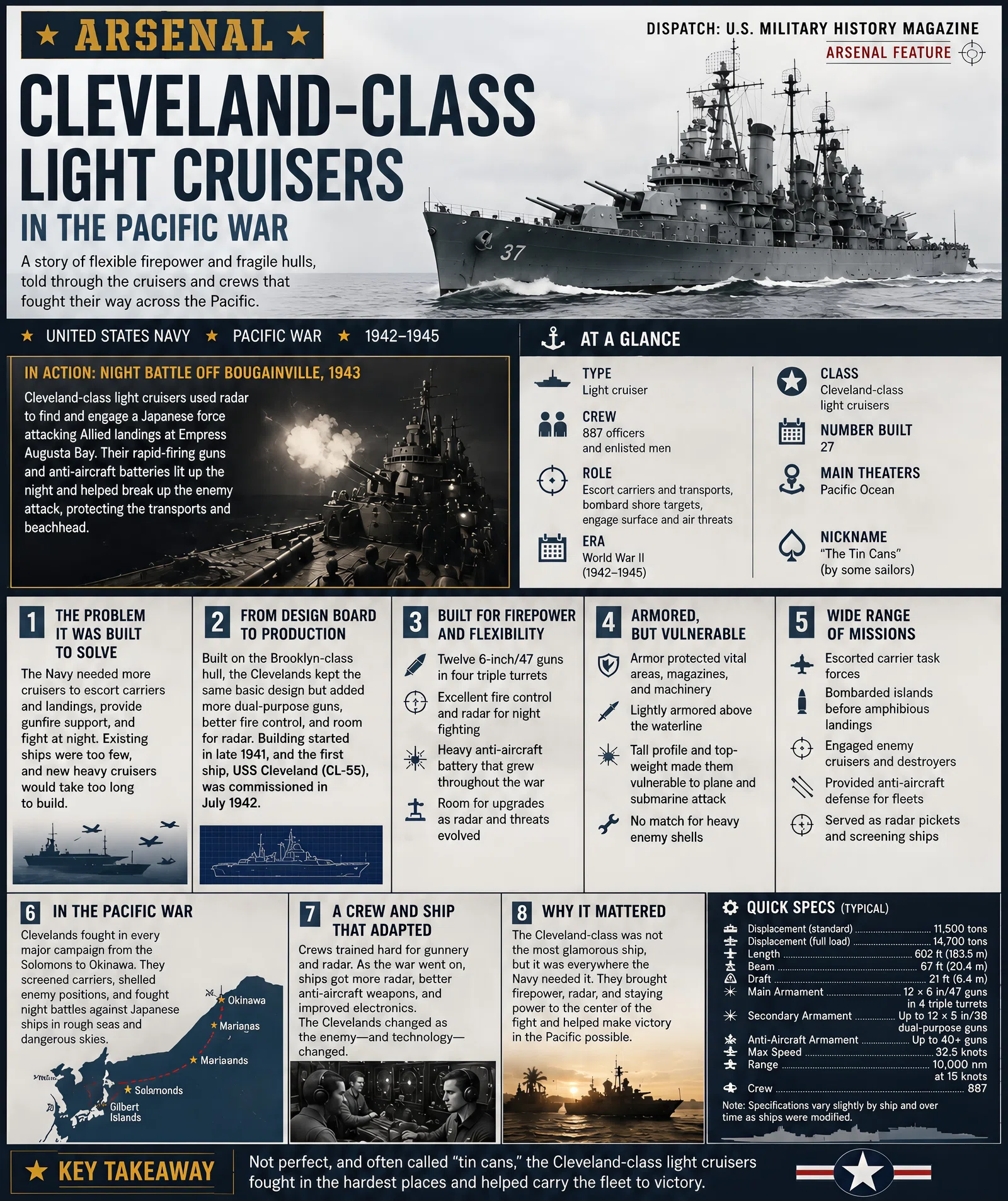
The sea off Bougainville is black and restless, broken only by the pale foam under Cleveland’s bow and the glow of exhausts from the cruiser column ahead. It is the early hours of a November night in 1943, in the opening stages of the Bougainville campaign, and somewhere beyond the dark horizon a Japanese force is racing in to smash the fragile Allied beachhead at Empress Augusta Bay. The men on the Cleveland-class light cruisers cannot see the enemy yet, but the radar scopes can, and ranges and bearings are already being called in calm, clipped voices.
On one of the Cleveland-class ships, the main battery director swings slowly as the gunnery officer watches the radar repeaters. Below him, deep in the armored citadel, turret crews wait in cramped steel compartments that stink of cordite and sweat. Shell handlers pass six-inch rounds and powder bags along well-practiced routes, ready to feed twelve rapid-firing guns. Up on the open decks, anti-aircraft crews stand by their medium and light weapons, eyes straining for the flash of incoming torpedoes or the streak of tracer from an enemy destroyer.
When the order to open fire comes, it is almost anticlimactic: one more command in a long chain of rehearsed actions. The main battery roars and the entire ship shudders as bright orange muzzle flashes tear the night, briefly turning the black water silver. Radar-controlled salvos walk toward unseen targets, and the crews imagine the impact far away, where Japanese cruisers and destroyers are trying to form up. The light cruisers throw up star shells that bloom overhead, revealing the enemy in harsh white light and robbing him of the night tactics that once gave him an edge.
In the confusion of wakes, smoke, and violent maneuvering, Cleveland-class captains try to keep their columns intact while avoiding torpedoes and friendly fire. They are here to protect transports and landing forces, to punch first in the darkness, and to show that American cruisers have mastered the new art of radar night fighting. This clash off Bougainville is only one moment in a long campaign, but it captures the essence of the Cleveland-class story: ships built in a hurry, pushed hard by war, and asked to do almost everything a cruiser can do.
The Problem It Was Built To Solve
The Cleveland-class light cruisers were born from a mix of treaty compromises, wartime urgency, and a very practical problem: the United States Navy needed more cruisers, fast, to control vast oceans and shield its growing carrier and amphibious forces. Before the Second World War, international naval treaties limited cruiser size and armament, forcing designers to squeeze as much firepower as possible into restricted tonnage. American light cruisers like the earlier Brooklyn class carried many six-inch guns to throw a heavy volume of fire, but they had been optimized under peacetime assumptions and tight treaty limits.
The attack on Pearl Harbor and the early Pacific fighting exposed gaps brutally. The Navy needed ships that could escort fast carrier task forces, bombard shore positions during amphibious landings, and stand in the line of battle during night actions against enemy surface forces. Existing cruisers were valuable but few, and new heavy cruiser designs would take too long to bring from drawing board to fleet. At the same time, carrier aviation and air-delivered torpedoes increased the threat from the sky, demanding far more anti-aircraft firepower than prewar designs had ever imagined.
Designers responded by taking the basic hull form of the Brooklyn-class and reworking it into something that could be built quickly in large numbers while carrying more dual-purpose guns, better fire control systems, and later, increasingly heavy radar and communications gear. The result was the Cleveland-class: officially light cruisers because they carried six-inch main guns, but in many ways general-purpose fleet escorts that blurred the line between old treaty categories. They were not the fastest or most elegant ships afloat, and they carried weight high on the hull that would worry naval architects in peacetime, but they could be built rapidly in multiple yards.
As the Pacific War expanded, the pressure on American industry only increased. Carriers, destroyers, transports, and submarines all competed for steel and skilled labor. Within that crowded production picture, the Cleveland-class represented a pragmatic choice: a cruiser that did not demand a completely new design, but could be turned out in quantity to fill urgent roles. The decision to accept certain compromises in stability and accommodation, in exchange for heavy gun batteries and dense anti-aircraft armament, set the basic character of the ships that would steam from the Solomons to Leyte Gulf and beyond.
From Design Board To Production
The Cleveland-class story starts not with a blank sheet of paper, but with an existing hull and a clock that was already ticking. American naval treaties had produced the earlier Brooklyn-class light cruisers, ships that crammed fifteen six-inch guns onto a relatively narrow hull and pushed the limits of stability and weight. When war fears grew in the late nineteen thirties, the Navy wanted more ships that could be built without reworking every frame and bulkhead, so designers took the Brooklyn hull and began reshaping it for a new kind of cruiser war. The priority shifted from pure surface gunnery toward a more flexible mix of surface firepower, long-range scouting, and dense anti-aircraft protection.
In design offices and shipyards, the tradeoffs were constant. Keeping the six-inch main battery meant the ships would still be classed as light cruisers under treaty language, but the number of guns dropped to twelve in four triple turrets to free weight and space for dual-purpose five-inch mounts. Protection had to balance against weight carried high in the superstructure, where radar, directors, and anti-aircraft weapons all demanded room. Range and speed needed to match fast carrier task forces, but machinery spaces were constrained by an inherited hull form. The final design accepted a tall, busy silhouette and a reputation for being somewhat top-heavy in exchange for rapid construction and formidable firepower.
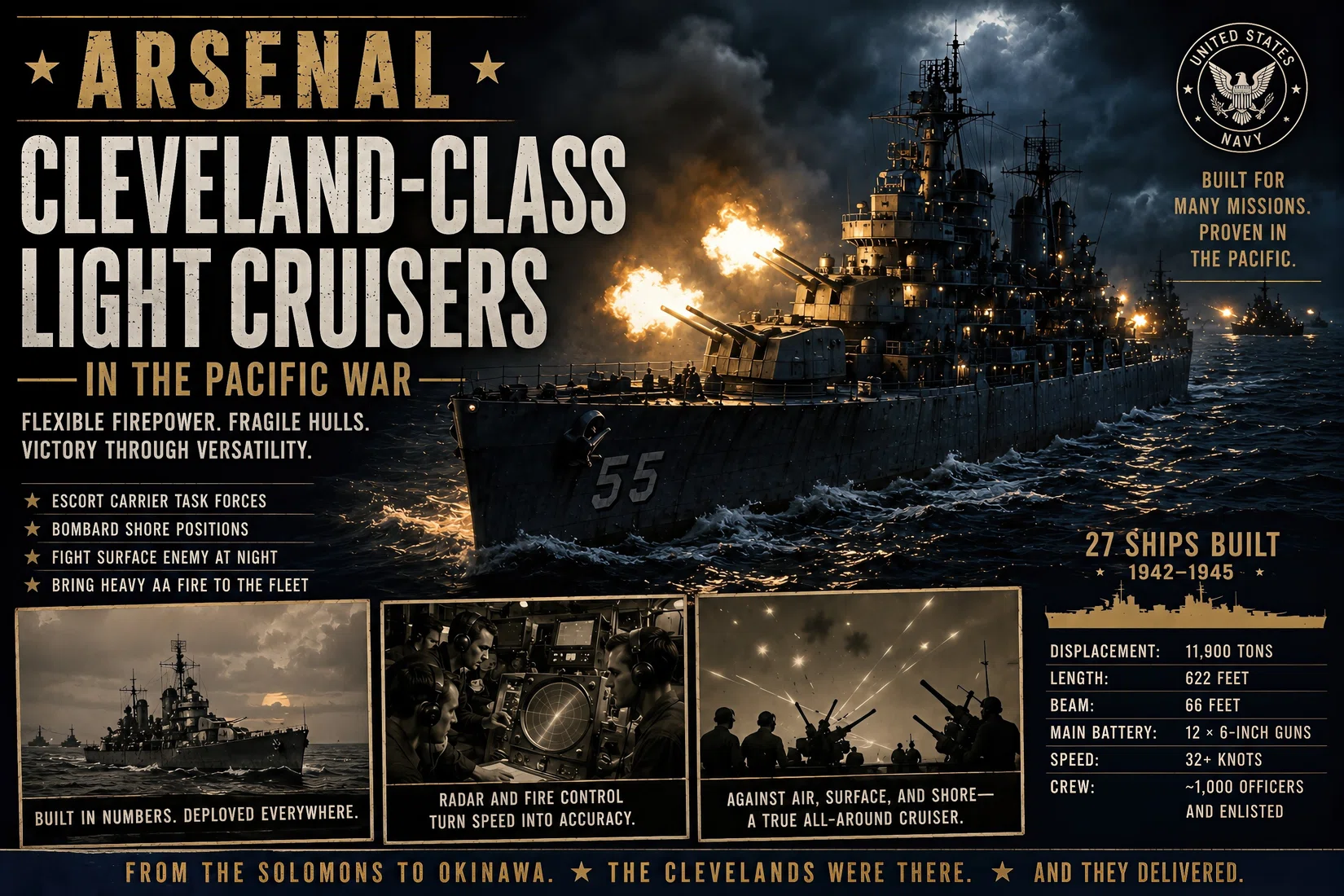
At a glance, the Cleveland-class were American light cruisers of the Second World War, built for the United States Navy and serving mainly in the Pacific. They displaced around eleven to fourteen thousand tons depending on load, carried a typical crew of around twelve hundred officers and sailors, and mounted twelve six-inch guns as their main battery. Their secondary armament centered on multiple five-inch dual-purpose guns able to engage aircraft or surface targets, backed by a thick ring of medium and light anti-aircraft weapons. In speed they could make the low thirty-knot range, fast enough to steam with the carrier groups and to pursue or evade most surface opponents short of destroyers.
Production was a story of scale as much as design. Once the type was approved, multiple American yards laid down Cleveland-class hulls in parallel, turning the basic design into more than two dozen completed ships with several more canceled as war priorities shifted. They appeared across the Pacific in cruiser divisions that screened carriers, bombarded beaches, and fought in night actions where radar, not searchlights, decided who fired first. Wartime modifications came quickly, adding more anti-aircraft guns, improving radar suites, and tweaking details of superstructure and fire control as each yard and refit incorporated lessons from the front.
Inside The Weapon
Walking along the pier beside a Cleveland-class light cruiser, the first impression is of a compact but crowded warship, all angles, turrets, and latticework masts. The hull has a fine, flared bow to cut through Pacific swells and a long, relatively lean profile that hints at speed. Four triple six-inch turrets dominate the silhouette, two forward and two aft in superfiring pairs, with boxy twin five-inch mounts and clusters of smaller anti-aircraft guns filling the spaces between. The superstructure rises in stepped blocks, carrying radar antennas, rangefinders, and directors that look almost delicate beside the heavy gun houses and armor belts. It is a ship that seems to bristle in every direction.
Inside, the spaces tighten quickly. Below the main deck, passageways are narrow and low, packed with piping, cables, and structural frames. Crew living spaces are functional rather than comfortable: rows of bunks stacked three high, lockers wedged where they fit, and mess decks that double as recreation areas when off watch. The heart of the ship’s fighting power lies in the armored citadel around the magazines, machinery, and plotting rooms. There, gunnery officers and radar operators stand at consoles and plotting tables, turning faint blips and bearing lines into firing solutions that feed the main and secondary batteries. Communication runs through sound-powered phones, voice tubes, and internal radio circuits, tying bridge, combat information centers, and gun mounts together.
The crew’s work is divided into specialized roles that mesh under pressure. On the bridge, the captain and officers of the deck handle navigation, maneuvering, and formation orders, often in tight company with other cruisers and destroyers. In the engine rooms, machinist’s mates and electricians keep boilers and turbines humming, watching gauges and valves that determine whether the ship can sprint or must throttle back to conserve fuel. Gun crews labor in turrets and handling rooms, hoisting shells and powder, ramming charges, and adjusting elevation and train under the direction of remote fire control. Anti-aircraft teams stand exposed on open decks, tracking aircraft with optical sights and later with radar cues, knowing that their reaction time can mean the difference between a near miss and a hit.
Subsystems knit these human efforts together. Propulsion comes from geared steam turbines driving multiple shafts, giving the cruiser her high-end speed and the ability to change pace quickly as tactical situations shift. Armor is concentrated over vital spaces: belts and decks to shield magazines and machinery, turret faces to protect gun houses, and splinter protection around key command and control points. Sensors evolve over the war from simple surface-search sets to more sophisticated air-search and fire-control radars, giving Cleveland-class ships eyes that can see through darkness and bad weather. Habitability and endurance, while not luxurious, are good enough to keep the crew going through long deployments, but the constant additions of radar, guns, and directors make some spaces feel even more cramped as the war goes on.
Training emphasized the ideal of smooth, mechanical coordination, but veterans remember a more chaotic reality. In combat, vibration, noise, smoke, and the shock of firing turned neat drills into something far more visceral, with orders and corrections shouted over the roar of guns and the whine of machinery. Yet those same veterans often recall that, for all the crowding and sweat, the Cleveland-class cruisers gave them a sense of solid, reliable power. The ships rode well enough in heavy seas, could bring a great weight of fire to bear quickly, and, when handled well, felt like versatile tools that could switch from shore bombardment to anti-aircraft defense to surface action in a single day if the war demanded it.
Baptism Of Fire
The night action off Empress Augusta Bay in November 1943 gave the Cleveland-class one of its defining early tests. The cruisers were screening transports and supporting the Marines going ashore on Bougainville when reports came of a Japanese force rushing in to strike the invasion fleet. Radar contacts appeared at long range, and American commanders maneuvered to cross the enemy’s path rather than wait to be hit. In the dark, with only star shells and radar plots to guide them, Cleveland-class ships helped form the backbone of a cruiser-destroyer group that sought to seize the initiative in a kind of battle that had favored the Japanese earlier in the war.
As the ranges closed, main battery turrets swung toward unseen shapes and fired by radar solution, not by the flash of enemy guns. Salvos from Cleveland-class ships walked across plotted tracks, forcing Japanese cruisers and destroyers to dodge and scatter instead of driving straight in on the transports. The same ships threw star shells overhead to strip away the enemy’s night cover, a reversal of the early Guadalcanal pattern when American cruisers had been lit up and punished. Maneuvering hard to avoid torpedoes and keep their lines intact, the cruisers worked in concert with destroyers rushing in for close-range attacks, turning what could have been another brutal surprise into a checked thrust.
Later battles reinforced that pattern. In the Philippines, Cleveland-class cruisers poured fire into shore positions ahead of landings and stood guard around carriers as kamikazes descended. Their six-inch guns slammed into airfields, supply dumps, and coastal defenses, while their dual-purpose mounts stitched the sky with shells and bursts. At Leyte Gulf and in the fighting off Okinawa, the ships shifted fluidly between bombardment, anti-aircraft screens, and surface action, often in the same day. The specific engagements varied, but a theme emerged: wherever the Pacific fighting grew intense, there always seemed to be a Cleveland-class cruiser close by, doing whatever the situation demanded and paying for that versatility in long hours at action stations and the constant risk of torpedoes, bombs, and mines.
Strengths And Weaknesses
Ask the officers and sailors who served on them, and the Cleveland-class cruisers were above all dependable workhorses. Crews appreciated the volume of fire their twelve six-inch guns could throw, especially when controlled by radar that let them hit targets in darkness and bad weather. The dual-purpose secondary battery gave commanders confidence that the ship could defend itself and the formation against aircraft while still contributing meaningfully to surface engagements. In shore bombardment, the cruisers could sustain punishing fire missions, walking salvos inland to cover advancing troops or to dig out strongpoints that had resisted lighter guns. Their speed and range made them natural escorts for carrier task forces, and their communications suites allowed them to act as flagships and coordination hubs.
The class also had real shortcomings. The decision to reuse and build upon an existing hull, then load it with more armament, radar, and structures, left the ships with a reputation for being top-heavy. In heavy seas or during sharp maneuvers, some captains worried about stability margins that would have been more generous in a peacetime design. Internally, the crowded layout that allowed so much equipment and so many men to be crammed into the hull could make damage control more challenging, with access routes and compartments packed tight. Armor protection was sufficient against splinters and medium-caliber fire, but no cruiser could shrug off heavy shells or torpedoes, and several ships in the broader cruiser force paid the price when hit.
Enemies respected the Cleveland-class as dangerous opponents, particularly when radar let them fire first and accurately. Japanese accounts from late in the war speak of the difficulty of approaching American formations screened by radar-equipped cruisers and destroyers that poured fire into any contact before it could close. Yet adversaries also adapted, relying more on massed air attack, long-range torpedoes, and surprise where possible. When compared to heavier cruisers or to specialized anti-aircraft ships, the Cleveland-class did not emerge as the undisputed champion in any single category. Instead, their strength lay in being good enough at many tasks and available in numbers, a combination that gave American commanders valuable flexibility at sea.
Variants And Evolution
Even during the war, the Cleveland-class was evolving. Early ships carried one mix of lighter anti-aircraft weapons and radar sets, while later units bristled with additional automatic guns and more capable sensors bolted on wherever space could be found. Refit cycles often changed a ship’s silhouette, replacing older directors, adding new radar antennas, and rearranging light gun mounts based on the latest lessons from the front. The basic hull and machinery remained constant, but the topside appearance of a Cleveland-class cruiser in 1945 could differ notably from a sister ship commissioned only a few years earlier. Wartime urgency meant that each yard and fleet refit incorporated improvements as soon as they were available.
The design’s influence extended beyond the gun cruisers themselves. The same general hull form underpinned the light aircraft carriers that gave the fleet extra flight decks early in the war, demonstrating how a cruiser-sized platform could be adapted to new roles when time was short. After the war, as guided missiles entered naval service and the balance of power at sea shifted again, several Cleveland-class hulls were selected for conversion into missile-armed cruisers. These ships traded some of their gun armament and superstructure for missile launchers and updated electronics, becoming early examples of how legacy gun warships could be reshaped for the emerging missile age.
Budget pressures and changing doctrine meant not every planned conversion or variant reached the fleet, and many Cleveland-class cruisers saw their careers shortened by rapid technological change. Yet the pattern of constant modification and adaptation during their service lives, and their use as platforms for missile conversions afterward, shows how the basic design had reserves of volume and strength that designers could exploit. What began as a wartime expedient light cruiser became a bridge to the postwar world, carrying guns, then missiles, and linking eras of naval warfare on the same steel foundations.
Legacy And Where To See It Today
The Cleveland-class light cruisers left a legacy more subtle than that of a single famous battleship or carrier, but no less important. In the Pacific War, they proved that general-purpose cruisers with strong radar-directed gun batteries and robust anti-aircraft suites could anchor task groups, shield vulnerable ships, and deliver fire support ashore. Their service helped solidify the idea of the cruiser as a flexible tool of sea control rather than a duelist locked into set-piece battles. Postwar, their conversions to missile ships helped the Navy understand how to integrate new weapons and sensors into existing hulls, paving the way for more advanced purpose-built missile cruisers and destroyers.
For students of naval architecture, the class stands as an example of how industrial constraints, treaty legacies, and wartime urgency can shape a design that looks crowded and compromised yet performs well in practice. They embody the transition from the clean lines of interwar cruisers to the antenna-covered silhouettes of the radar and missile age. For those interested in the human side, the Cleveland-class represents thousands of sailors who lived and fought in tight steel compartments, standing watch through long Pacific nights and enduring the strain of constant readiness.
Today, the easiest way to connect with that history is to visit surviving cruisers that share the same lineage, including ships preserved as museum vessels that once carried similar guns and crews through the postwar era. On their decks, visitors can stand by the barrels of medium and light guns, look up at radar masts and directors, and trace the routes sailors took between mess decks, magazines, and action stations. Photographs and film from wartime and early Cold War service, often highlighted in Dispatch features and Trackpads collections, bring the ships to life as working tools rather than static artifacts. Above all, the Cleveland-class story reminds us that behind every silhouette on a recognition chart were men whose survival depended on whether their ship could do its many jobs well enough, often on the worst days of their lives.