In Action
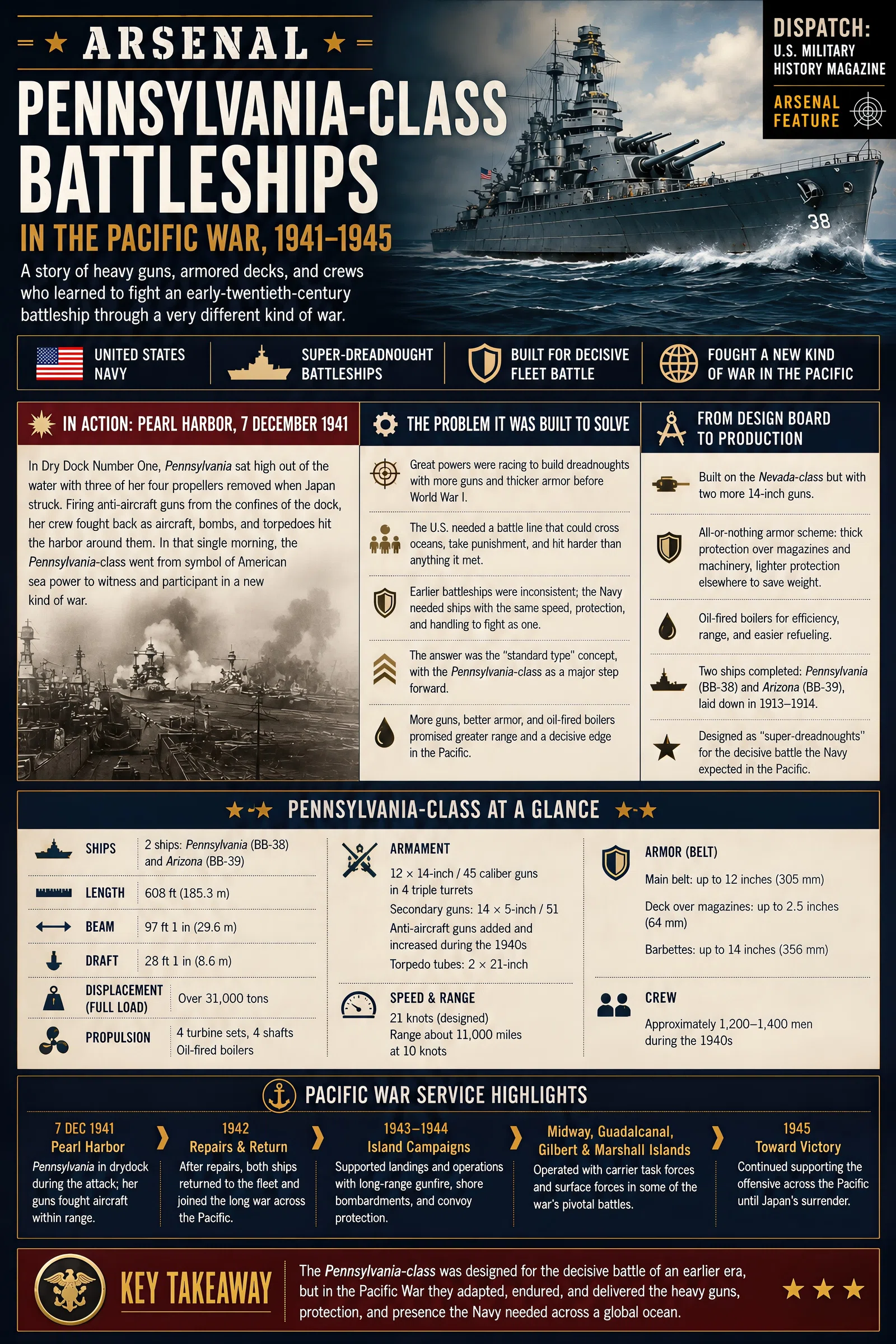
The first hint is the sound. On the morning of 7 December 1941, Pearl Harbor’s Sunday quiet is shredded by the growl of aircraft engines and the thump of distant explosions. In Dry Dock Number One, the battleship Pennsylvania sits high out of the water with three of her four propellers removed, a steel giant temporarily hobbled. Across the harbor, columns of water leap up around the other battleships and the dull boom of torpedoes echoes off the hills.
On Pennsylvania’s decks, men sprint from peacetime routines to battle stations, clattering up ladders toward anti-aircraft guns that were never meant to be fired with the ship locked in place. Ammunition parties heave boxes of shells along narrow passageways as the first Japanese planes scream low over the yard. Gunners swing their mounts as far as the tight confines of the drydock allow and begin to fire, tracers reaching up into a sky now streaked with smoke.
From the battleship’s upper works, crewmen can see the rest of Battleship Row through gaps in the haze. A blossom of orange fire erupts from one of the moored ships, followed by a mushroom of black smoke that turns the whole harbor into an outline of silhouettes and flame. Men on Pennsylvania can do little but fight the aircraft within range, tend the wounded on their own decks, and watch as the neat peacetime battle line is hammered into twisted metal.
In the space of a single morning, the Pennsylvania-class goes from symbol of American sea power to witness and participant in a new kind of war. To understand how these ships ended up in that drydock, and why they were built the way they were, we have to step back to the age of coal smoke, naval treaties, and the first generation of super-dreadnoughts.
The Problem It Was Built To Solve
Long before the rising sun flags appeared over Pearl Harbor, the United States Navy had been wrestling with a simpler, colder question: how do you build a battle line that can cross oceans, take punishment, and still hit harder than anything it meets? In the years just before the First World War, dreadnought battleships were the currency of great power status. Britain, Germany, Japan, and the United States were all racing to put more big guns and thicker armor to sea without creating ships so large and costly that the fleet could never be completed.
For the United States, the likely ultimate battleground lay across the vast distances of the Pacific. Any battle fleet sent west would have to steam thousands of miles, arrive with enough fuel to maneuver and fight, and then stand in the line of fire against enemy ships built to similar standards. Earlier American battleships were powerful but inconsistent, with different speeds, turning circles, and protection schemes that made it hard to handle them as a single, cohesive unit once the guns opened.
The answer was the “standard type” concept: a series of battleship classes designed to share the same tactical speed, similar armor protection, and comparable turning characteristics, so they could all fight together without the slower or weaker ships dragging the rest down. The Pennsylvania-class represented a major step in that evolution. Building on the Nevada-class, the designers wanted more heavy guns—twelve fourteen-inch guns in four triple turrets instead of ten—wrapped in an “all-or-nothing” armor scheme that concentrated thick protection over magazines and machinery while leaving less critical spaces exposed to save weight.
At the same time, the Navy was shifting from coal to oil-fired boilers, trading the bulk and labor demands of coal bunkers for cleaner, more efficient oil fuel that promised greater range and easier refueling at sea. The Pennsylvania-class had to fit all of this—more guns, better armor, new machinery—into a hull that could still be built in existing yards and pass through existing drydocks. The result was a pair of super-dreadnoughts that, on paper, were tailored for the decisive battle the Navy expected someday in the Pacific. That expectation would shape their peacetime careers and set the stage for how they went to war when the real enemy finally appeared out of a clear Hawaiian sky.
From Design Board To Production
The Pennsylvania-class began on drawing boards already crowded with ideas from the Nevada-class, but the General Board wanted more firepower without sacrificing the new “standard-type” handling that planners were counting on for a decisive fleet action. The underlying concept was simple on paper: take the basic hull proportions, speed, and armor layout of Nevada, then add two more fourteen-inch guns and strengthen underwater protection against torpedoes and mines. That demand drove a series of design sketches in the early nineteen teens, as naval architects hunted for a way to fit four triple turrets, an all-or-nothing armor scheme, and oil-fired machinery into a hull that American shipyards could realistically build. Oil firing was non-negotiable by this point; it promised more range and easier refueling than coal, and it freed up internal volume for magazines and machinery.
The final design produced two “super-dreadnoughts,” Pennsylvania and Arizona, laid down in nineteen thirteen and nineteen fourteen. They stretched about six hundred and eight feet from bow to stern, displaced over thirty-one thousand tons at full load, and were driven by four turbine sets fed from twelve oil-fired boilers, giving a designed top speed of about twenty-one knots. They carried twelve fourteen-inch, forty-five-caliber main guns in four triple turrets, backed by a broadside of twenty-two five-inch guns in casemates, a handful of three-inch anti-aircraft guns, and a pair of submerged torpedo tubes. Armor followed the all-or-nothing principle: a thick belt and armored decks over machinery and magazines, massive protection for turrets and barbettes, and much lighter plating elsewhere to save weight.
At a glance, the Pennsylvania-class were American standard-type battleships of the United States Navy, built in the nineteen teens for service in the Pacific battle line, typically crewed in peacetime by roughly eleven hundred officers and men and considerably more in wartime, armed primarily with twelve fourteen-inch guns and capable of around twenty-one knots with a cruising range of roughly seven thousand five hundred nautical miles at economic speed. They entered service too late to see major action in the First World War, but they immediately joined the interwar battle line as representatives of a new generation of oil-burning, long-range capital ships. Over the nineteen twenties and nineteen thirties they received modernizations familiar across the standard-type fleet: improved horizontal armor, bulges to resist torpedoes, upgraded fire control, and stronger anti-aircraft batteries, all aimed at keeping a World War One design relevant in a world of dive bombers and submarines. By the time the Pacific War began, Pennsylvania and Arizona were mature, well-understood ships whose designers had largely achieved their original goal: tough, steady gunnery platforms that could steam and turn in company with their sisters.
Inside The Weapon
Seen from harbor level, a Pennsylvania-class battleship looked every inch a capital ship of its era: a long, beamy hull with a pronounced ram bow, a high freeboard, and four great turrets stepping up from forward to aft. Two triple turrets were stacked in superfiring arrangement over the bow, giving the ship a blunt, powerful profile when pointed toward an enemy, while the remaining two dominated the stern. The original tall cage masts, later replaced by sturdier tripod structures, carried fire-control tops where rangetakers and spotting officers worked among open platforms and optical rangefinders. Around the hull sides, rectangular casemates for the five-inch guns broke up the sheer, reminders that these ships were designed to repel torpedo boats as well as trade heavy blows with enemy battleships.
Walking up the gangway and onto the main deck, a visitor would first notice how quickly the broad vistas of the upper deck narrowed into a maze of ladders, hatches, and watertight doors. The captain’s world centered on the bridge and armored conning tower, high enough to command a view of the horizon but tied by speaking tubes, sound-powered telephones, and engine order transmitters to the plotting rooms and engine control down below. Inside the turrets, gun crews operated in cramped, steel-lined spaces where hoists brought powder and shells up from magazines deep within the armored citadel; each triple mount had its own rhythm of loading, run-out, and recoil, timed to keep the full battery firing in controlled salvos rather than chaotic individual blasts.
Below the armored deck lay the real heart of the ship. Boiler rooms housed rows of oil-fired water-tube boilers, their furnaces tended by firemen who worked in heat and noise, adjusting burners and monitoring gauges to keep steam pressure within safe but powerful limits. That steam fed the four turbine sets, each driving one of the four big propellers, turning thousands of shaft horsepower into steady, twenty-one-knot progress across the Pacific. Around these spaces ran the torpedo-defense system: a complete double bottom and internal torpedo bulkheads intended to soak up underwater explosions before they could rip open magazines or machinery spaces. Crews who served below decks often remembered little of sea and sky during action; their world was vibration, shouted orders, and the discipline of damage control drills.
Living spaces and work areas filled every compartment that armor and machinery left available. Enlisted men berthed in mess decks and compartments with rows of hammocks or bunks, lockers, and long tables that had to be cleared and lashed down at action stations. Chiefs and junior officers occupied slightly more private cabins along passageways closer to their work centers, while senior officers lived in comparatively spacious quarters aft. The routine of watches, drills, cleaning stations, and maintenance meant that every corner of the ship was owned by some division: gunnery, engineering, navigation, signals, supply. In peacetime, the ship felt like an industrial town tightly packed into steel; in wartime, those same spaces became a carefully rehearsed network of fire control, ammunition supply, repair parties, and medical aid stations, all tied together by internal communications and the shared understanding that the battleship only functioned when every station did its job.
Baptism Of Fire
The drydock at Pearl Harbor was not the battle the Pennsylvania-class had been designed for, but it was the crucible that fixed them in American memory. Arizona, moored ahead of her sisters on Battleship Row, took the brunt of the first wave. Bombs walked up and down the line until one armor-piercing weapon found a fatal path into the forward magazines. The explosion that followed tore the ship apart in seconds, turning a powerful super-dreadnought into a burning wreck and killing most of her crew before they could even reach battle stations. Pennsylvania, boxed in at the head of the drydock, could not maneuver or bring her main battery to bear, but her anti-aircraft crews went to work through smoke and spray, throwing up fire at torpedo bombers and high-level attackers alike while nearby destroyers burned and capsized.
In the months that followed, the class split into two very different wartime paths. Arizona remained where she fell, first as a twisted hulk in the harbor and later as a sealed grave, while salvage teams recovered what they could and sealed what they could not. Pennsylvania, damaged but repairable, went through hurried work and upgrades before heading back to sea as part of the resurrected Pacific battle line. She fired her big guns in anger across a long arc of operations: supporting landings in the Aleutians, pounding at island fortifications in the Gilberts and Marshalls, and later standing in as floating heavy artillery at Saipan, Guam, and in the Philippines.
By the time of the Leyte campaign and the battle off Surigao Strait, Pennsylvania sailed with other “old battleships” in the classic line-of-battle role planners had imagined before the war, but the context had changed. Radar, aircraft, and destroyer torpedoes now shaped the fight as much as optics and armor. Pennsylvania’s guns contributed to the overall weight of fire that helped break the last serious Japanese attempt to reach the landing beaches, but increasingly her real value lay in accurate, sustained bombardment ahead of amphibious assaults. At Lingayen Gulf, Iwo Jima, and Okinawa, she and her sisters in the standard-type family spent day after day firing on shore targets, adjusting salvos based on spotter reports from aircraft and troops ashore. Her war ended not in a gunnery duel but after a late-war torpedo hit at Okinawa, another reminder that even heavily armored battleships were never invulnerable in an age of long-range, underwater weapons.
Strengths And Weaknesses
Ask those who served aboard Pennsylvania-class ships what they valued most, and many pointed first to their solidity. The “standard-type” hull form made for a steady gun platform, and the all-or-nothing armor scheme gave crews confidence that the vitals of the ship were wrapped in serious protection. In bombardment roles, twelve fourteen-inch guns with good fire-control systems could deliver punishing, repeatable fire, and once wartime modernizations added more sensitive directors and radar ranging, their ability to hit shore targets or surface contacts in poor visibility improved dramatically. Their internal compartmentation and torpedo-defense systems, especially after bulges and additional armor were fitted, also gave damage-control teams more to work with when things went wrong.
Yet the same design that gave them stability and protection imposed real limitations. Even with oil-fired machinery, Pennsylvania and Arizona were relatively slow by World War Two standards, tied to the twenty-one-knot pace that suited a battle line but lagged behind fast carrier task forces and new treaty-era battleships. Their original secondary armament in hull casemates proved wet and hard to work in heavy seas, and prewar anti-aircraft batteries were simply inadequate against massed dive bombers and torpedo planes. Wartime refits replaced casemate guns, bristled the superstructure with dual-purpose mounts and automatic weapons, and added radar, but there were practical limits to how much weight could be stacked high without compromising stability. Compared to newer designs with larger guns and higher speeds, Pennsylvania-class ships were outmatched in a pure battleship duel, yet they remained highly valued for the kind of grinding, close-in gunnery that island campaigns demanded. Enemies learned to respect their bombardments but also saw that air power and submarines could sidestep the heavy belt armor and strike from angles the original designers had only begun to consider.
Variants And Evolution
On paper, the Pennsylvania-class consisted of only two ships, but wartime photographs can make them look like several different classes as rebuilds and refits accumulated. In the nineteen twenties and thirties, both ships received major modernizations: the tall cage masts gave way to stronger tripod structures better suited to carry heavier fire-control equipment, deck armor over magazines and machinery was thickened in recognition of the growing threat from plunging shell fire and bombs, and anti-torpedo bulges were added along the hull to improve underwater protection and buoyancy. Their boilers and turbines were overhauled, internal layouts adjusted, and some of the original casemate guns removed or relocated to improve habitability and reduce flooding risks in heavy weather.
The Second World War layered further changes on top of these interwar rebuilds. As aircraft proved to be the primary threat and primary scouting tool at sea, both ships received progressively larger anti-aircraft outfits: new dual-purpose secondary batteries, followed by clusters of medium and light automatic weapons, each with their own directors and radar sets. Superstructures grew boxier as extra platforms, directors, and electronic gear were shoehorned into limited space. Torpedo tubes disappeared, judged less important than more ammunition storage and damage-control facilities. By the middle of the war, Pennsylvania in particular bore only a family resemblance to the sleek interwar silhouette, now optimized as a radar-equipped bombardment and anti-aircraft platform rather than as a pure battle-line duelist. These changes reflected not just technological advances but the lessons of years of combat and the realities of budget and yard time, as the Navy chose where to invest scarce modernization resources across its aging standard-type fleet.
Legacy And Where To See It Today
The Pennsylvania-class left a legacy measured less in decisive line-of-battle victories and more in endurance, adaptation, and memory. As part of the standard-type family, they helped prove that a carefully planned series of similar battleships could give a navy flexible, interchangeable units for both training and war. Their service in the Pacific War illustrated how an early-twentieth-century battleship could be reshaped into a mid-century shore-bombardment and escort vessel, trading speed and cutting-edge gun caliber for resilience and sustained firepower in support of amphibious operations. Doctrinally, their careers encouraged planners to think of older capital ships as long-lived, multi-role assets rather than as disposable relics once newer designs arrived.
Physically, one member of the class remains present in a way few warships ever have. Arizona rests on the bottom of Pearl Harbor beneath a memorial that draws visitors from around the world, a place where the outlines of her hull and surviving structures still mark the spot where her crew fought and died. Portions of Pennsylvania’s structure did not survive intact; after postwar use in tests and evaluation, she was ultimately scrapped, though artifacts from both ships live on in museums, veterans’ halls, and state memorials. For readers and viewers, the class also endures in photographic and film records, including the kind of archival coverage that Trackpads and Dispatch draw on for articles, galleries, and future Arsenal features. A natural reading and listening trail links this story to Beyond the Call pieces about sailors and Marines who fought under Pennsylvania’s guns, to Living History interviews with veterans of the Pacific campaigns, and to companion Arsenal studies of other standard-type battleships and their foes. Behind every image of those triple turrets and armored decks were crews, repair gangs, and opponents whose lives turned on how well those ships did their jobs.