In Action
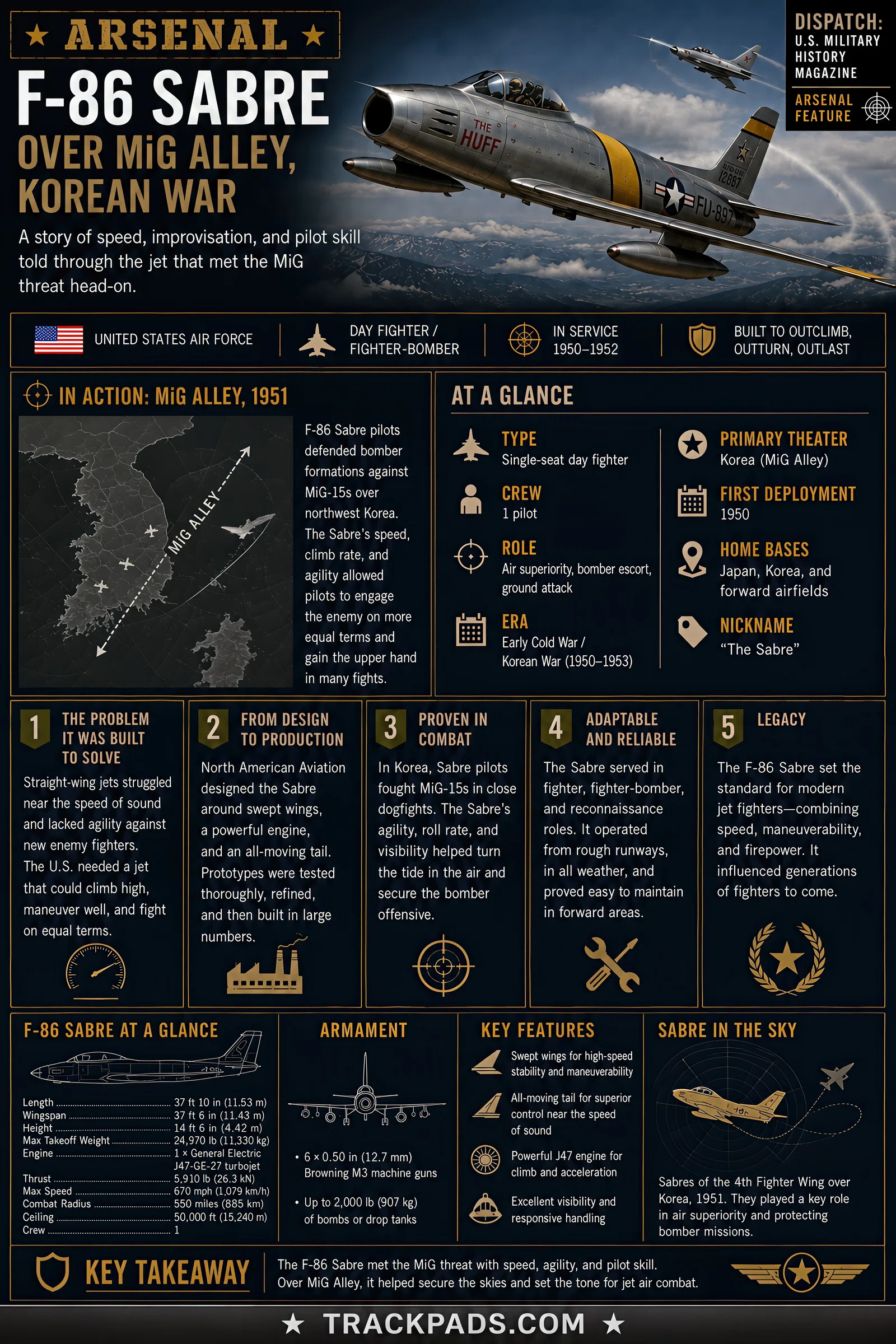
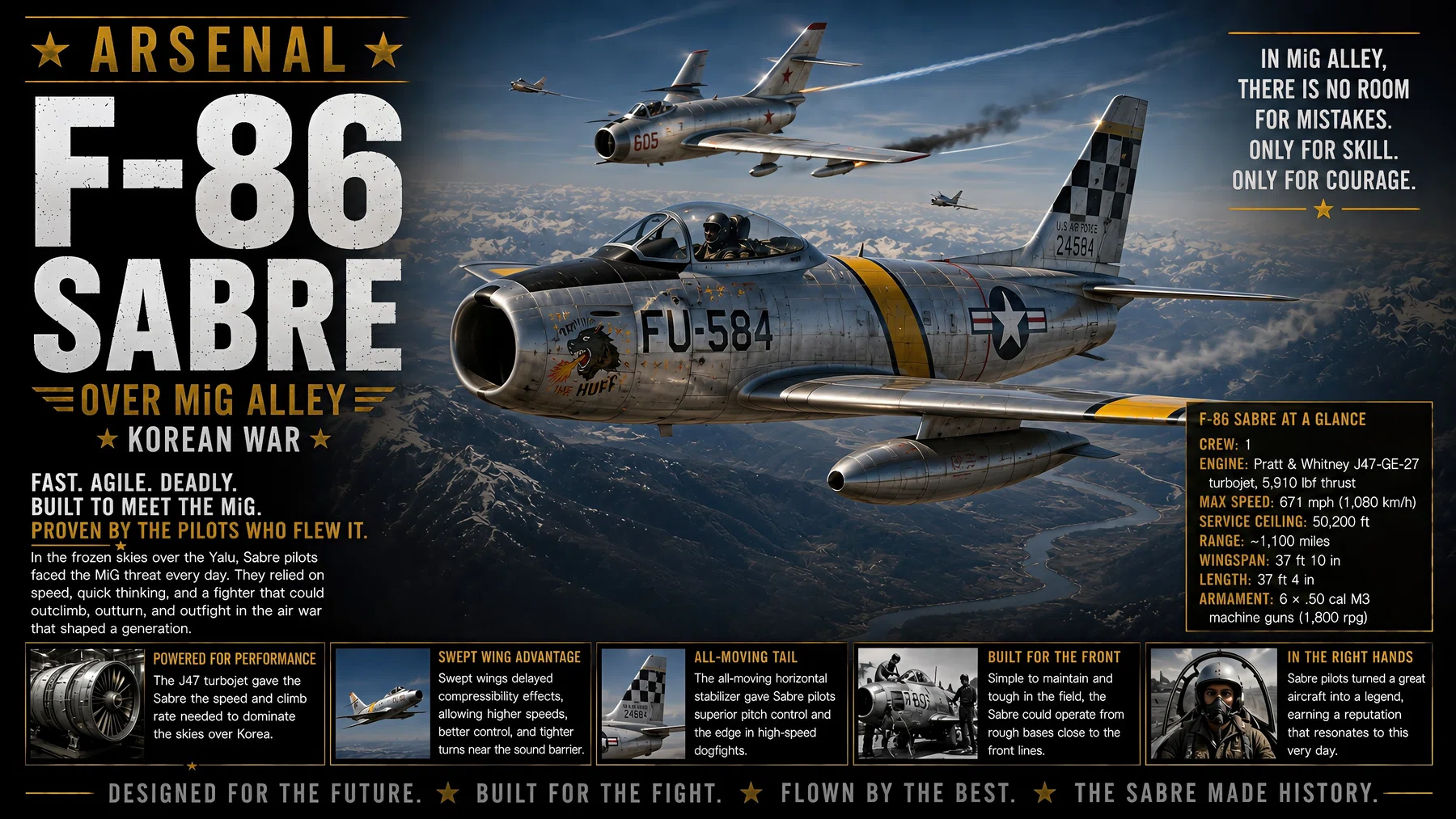
The Sabre pilot catches the glint first. High over northwest Korea, winter haze hangs over the Yalu River, but the flash of silver against blue is unmistakable. He eases the F-86’s nose up, feeling the jet’s swept wings bite into the thin air as the altimeter unwinds past thirty thousand feet. The radio is alive with terse calls. MiGs, twelve o’clock. MiGs, high.
Ahead, the Soviet-built fighters roll in from the Chinese side of the river, slanting down toward a bomber stream that has not yet seen them. The Sabre flight has. Throttles go forward, the cockpit fills with the rising howl of the J47 engine, and the entire aircraft seems to stretch toward the attack. At these speeds, closing happens in seconds, not minutes. The pilot’s world narrows to a gunsight ring, a set of wings crossing that ring, and the instinctive pull of stick and rudder.
Contrails twist into white ropes as Sabres and MiGs cross and recross, trading altitude for angles. Tracers slash past the canopy. The F-86 shudders as its six machine guns hammer, empty shell cases streaming into the slipstream. A MiG breaks, trailing smoke, while another flashes past so close that the pilot feels, rather than sees, its presence. Somewhere below, the bombers turn away, mission preserved for another day. Up here, over a stretch of sky the pilots call MiG Alley, the Sabre is still proving whether it was truly the right answer to a new kind of air war.
The Problem It Was Built To Solve
The F-86 Sabre was born out of the hard lessons of the late Second World War and the uneasy years that followed. Propeller-driven fighters had reached their limits chasing high-flying bombers, and early straight-wing jets could outrun the enemy but struggled to maneuver and stay controllable as they approached the speed of sound. The United States needed a fighter that could climb fast, fight hard, and survive in the thin air where modern bombers and interceptors would meet.
That demand only sharpened as the Cold War took shape. Planners worried about fleets of fast enemy bombers threatening cities, fleets, and forward bases. They needed a jet that could scramble quickly, reach altitude in minutes, and still give its pilot the agility and visibility to dogfight rather than simply fire one pass and dive away. The terrain and weather of northern Korea would make this even harder, with mountains, sudden cloud layers, and brutal winters compressing time and space.
Existing designs like the straight-wing F-80 and F-84 were important steps into the jet age, but they suffered in the transonic region where shock waves battered control surfaces and robbed wings of lift. Pilots reported stiffness in the controls and trouble outmaneuvering newer enemy aircraft. On the other side of the emerging divide, swept-wing concepts promised fighters that could slice through that region with more grace and higher top speeds.
Into this mix came the requirement for a front-line day fighter for the newly independent United States, a jet that could escort bombers, challenge enemy fighters, and operate from rough forward bases. The problem was clear: build a swept-wing, high-performance fighter that could fight on equal or better terms with the most advanced designs in the world. The decision to pursue the aircraft that became the F-86 Sabre was the bet that American industry and test pilots could solve that problem before war made the test real.
From Design Board To Production
The Sabre’s path from idea to front-line jet fighter began on drawing boards crowded with late-war experience. North American Aviation, which had built the P-51 Mustang, started with a straight-wing jet design that looked like a simple step into the future. Test data and wind tunnel work soon made it clear that “simple” would not be enough. As speeds climbed toward the sound barrier, straight wings dragged and control surfaces became heavy and unpredictable, leaving pilots fighting both the enemy and the airframe. The answer, designers believed, lay in swept wings that would delay the onset of those shock waves and give the fighter more margin at the speeds modern combat required.
Captured research from German wartime projects confirmed the benefits of sweep, and North American’s engineers reworked their design around it. This meant more than just angling the wings back. The new planform changed where the jet’s center of lift sat, how it handled fuel, and what sort of landing speeds pilots would face on real-world runways and pierced-steel planking. The team had to juggle climb rate, range, stability, and maintenance. A powerful new turbojet engine promised performance, but demanded careful thought about airflow, intake design, and cooling. Each change rippled into the next, forcing tradeoffs between raw speed and day-to-day reliability.
Prototypes took shape quickly, and test pilots pushed them through the unknowns of high subsonic flight. Early flights exposed issues with control authority at high speeds and the need for a more responsive tail. The eventual solution, an all-moving tailplane, became one of the Sabre’s trademark features and a crucial edge in combat maneuvers near the sound barrier. Bit by bit, the airframe and systems matured into an aircraft the United States could trust as its primary day fighter. At a glance, it was a single-seat, swept-wing jet fighter for the United States, serving mainly in the during the early Cold War, armed with six heavy machine guns and able to fly high and fast enough to match the newest enemy fighters. By the time it reached squadron service, thousands of Sabres were planned or already on order, ready to guard airspace in both Europe and Asia.
Inside The Weapon
Walk up to a Sabre on the ramp and the first impression is of a compact, purposeful machine. The nose is dominated by a large circular air intake that feeds the engine buried in the fuselage, giving the aircraft a clean, bullet-like profile. Above and behind that intake sits a clear bubble canopy, offering the pilot a wide view forward and to the sides, a hard-earned lesson from earlier wars when frames and armor blocked too much sky. The wings sweep back gracefully from the fuselage, their leading edges angled to cheat the drag that had plagued straight-wing jets. A tall vertical tail and swept horizontal surfaces complete the silhouette, making it clear that this was built to live in thin, fast air.
Climb the ladder and the cockpit feels tight but organized. The pilot straps into an ejection seat, surrounded by an arc of analogue gauges showing airspeed, altitude, engine performance, and fuel. To the left sits the throttle, controlling the turbojet’s thrust with smooth but deliberate movements, while the stick between the knees links directly to the aircraft’s control surfaces through hydraulic assist. In front, a gyro-stabilized gunsight helps the pilot judge lead on high-speed targets, a critical aid when closing rates can be hundreds of knots. The canopy rails are close to the shoulders, but once closed, the view over the nose and down the wings gives a reassuring sense of control.
Inside this one-seat fighter, the pilot is not just a flyer but also navigator, radio operator, and weapons officer. On the ground, a small army of maintainers makes that possible. Crew chiefs oversee daily checks, guiding specialists who inspect the engine, hydraulics, and electrics, while armorers service the gun bays and ammunition feeds in the nose. Communication runs along well-practiced lines: hand signals and brief shouts on the ramp, clipped radio calls once the jet is on the taxiway, and carefully agreed procedures for emergencies. The Sabre’s design reflects that partnership. Panels open along the fuselage to give access to the engine and critical systems, and the gun bays can be reached quickly for reloads during intense operations.
Under the skin, the major subsystems are arranged to balance performance with maintainability. The turbojet sits low in the fuselage, with the intake duct curving around the cockpit and exhaust exiting just ahead of the tail. Fuel tanks are distributed in the wings and fuselage, with provisions for drop tanks to stretch range on patrols over Korea’s northern valleys. Control runs and hydraulic lines thread through channels where they are protected but still reachable, a compromise between battle damage survivability and the realities of field maintenance. The landing gear is sturdy enough to handle rough forward strips, another nod to the fact that this fighter would rarely enjoy perfect concrete runways.
Armament centers on six heavy machine guns mounted in the nose, each with its own ammunition belt feeding from packed trays just behind the intake. For the pilot, this means a familiar feel in the trigger pull and a dense stream of fire converging ahead of the aircraft. Later variants add the ability to carry bombs or rockets on underwing pylons, turning the Sabre into a capable fighter-bomber when missions demand strikes against ground targets. In training manuals, this flexibility is laid out in tidy diagrams and planned profiles. In combat, pilots report how the extra weight and drag of external stores change the way the aircraft accelerates and turns, forcing them to think ahead before mixing it with enemy fighters.
On paper, the Sabre promises stable handling and predictable responses across most of its envelope. In the cold, gusty air over Korea, reality adds texture to that promise. Pilots describe the way controls stiffen as speed climbs, the care needed to avoid overcontrolling in the thin upper air, and the strain of pulling high-G turns while watching for the first signs of buffet. Long missions leave cockpits alternately freezing and sweltering, depending on altitude and sun angle, and the constant noise of the engine, airflow, and guns can be exhausting. Living with the F-86 day after day means trusting a machine that is both finely tuned and unforgiving of distraction, a jet that rewards skill and punishes carelessness in equal measure.
Baptism Of Fire
The F-86 made its combat reputation in a narrow slice of sky the pilots simply called MiG Alley. From late 1950 onward, Sabre squadrons of the United States flew north from bases in South Korea to meet enemy jet fighters rising from airfields across the Yalu River. Their task was simple to describe and hard to survive: keep the MiGs away from United States and United Nations bombers and reconnaissance aircraft. Missions began with long climbs over rugged, snow-dusted ridges, fuel gauges already drawing attention before the first contact calls crackled over the radio. High above, contrails marked where the real fight would take place.
Typical engagements unfolded in bursts of speed and violence. Sabres escorted B-29 formations or prowled ahead of them on sweeps designed to flush out MiGs. When radar controllers or pilots spotted the enemy, both sides jockeyed for altitude, because the jet with the initial height advantage could choose when and how to attack. MiG-15s often tried to swoop down in slashing passes at the bombers, then dive or climb away before escorts could react. Sabre pilots worked to position themselves between the bombers and that threat, rolling into head-on or quartering attacks that brought the enemy into range of their six nose guns. The difference between a firing pass and a collision could be a fraction of a second of stick pressure.
Over time, the Sabre proved it could meet the MiG on roughly equal terms in speed and climb, while giving its pilots better visibility and more forgiving handling in the hands of well-trained flyers. Kill claims and loss figures from the period remain debated, but what mattered to the crews was that the Sabre gave them a fighting chance to contest the high-altitude arena. United Nations commanders could keep sending daylight bomber raids and fighter sweeps into contested territory instead of ceding the sky. Down on the ground, infantry and logistics units measured the Sabre’s impact in fewer enemy aircraft overhead and more predictable patterns of air support and interdiction, the quiet dividends of daily patrols in that strip of air along the Yalu.
Strengths And Weaknesses
Pilots and ground crews came to appreciate the Sabre as a jet that rewarded skill and preparation. They praised its relatively gentle stall behavior for a swept-wing fighter and its solid roll rate, which allowed quick barrel rolls and defensive maneuvers at high speed. The bubble canopy, carefully arranged cockpit, and responsive controls gave pilots confidence in close-in dogfights, where split-second sight pictures and control inputs decided outcomes. Many appreciated the familiar feel of heavy machine guns that threw a dense stream of fire and the aircraft’s ability to absorb a degree of battle damage yet bring its pilot home. For squadron leaders and planners, the Sabre represented a tool that matched or exceeded the performance of the MiG at many altitudes, shifting morale back toward parity.
The weaknesses were just as real. Range was always a constraint, especially on MiG Alley missions that demanded long transit times, high power settings, and combat reserves. Pilots had to think constantly about fuel, balancing aggression with the need to return across mountains and potentially poor weather to the strips in South Korea. The machine-gun armament, while accurate and familiar, sometimes struggled against fleeting targets and robust airframes, especially at higher closing speeds where cannon shells could have more dramatic effect. Maintenance demands in harsh Korean winters tested ground crews, who fought icing, hydraulic leaks, and engine wear on open, windswept ramps.
Enemy pilots learned to exploit what they perceived as their own advantages. MiG-15s often tried to fight in the vertical, using strong climb performance to disengage if caught at a disadvantage, and they favored attacks that forced Sabres to chase into territory close to the river line, where political limits constrained pursuit. Some tactics used the MiG’s heavy cannon for head-on or high-deflection shots that, if they landed, could cripple a Sabre with a small number of hits. In response, Sabre squadrons refined their own doctrines, emphasizing teamwork, positional awareness, and disciplined firing to make the most of their aircraft’s strengths and keep its flaws from becoming fatal.
Variants And Evolution
The Sabre that first entered combat over Korea was only the starting point of a family of jets shaped by experience and technology. Early F-86A models established the basic pattern: swept wings, six nose-mounted machine guns, and day-fighter systems tuned for visual combat at high altitude. As squadrons reported back on their needs, subsequent F-86E and F-86F variants refined control systems and power. The adoption of the all-moving tail on production models gave pilots more authority near the sound barrier, while engine improvements pushed thrust higher, offering better climb and acceleration when fully loaded. Wing refinements, including extended leading edges on later versions, further improved maneuverability at high altitudes and lower speeds.
Combat reports and training exercises also drove changes in armament and mission profile. Some versions experimented with cannon armament in place of or alongside machine guns, reflecting ongoing debates about the best mix of rate of fire, projectile mass, and reliability. The ability to carry bombs and rockets on underwing pylons turned the Sabre into a fighter-bomber when required, giving commanders flexibility to task squadrons with both air superiority and ground attack roles. This multi-role use came with tradeoffs in handling and performance, but it allowed the airframe to stay relevant as mission demands shifted.
Beyond the United States, the design spread widely. License-built and derivative variants served in allied air forces across Europe, Asia, and other regions, often under local designations and with national modifications. Some countries upgraded avionics, radar gunsights, and engines as new technology became available, stretching the design’s service life well into the later jet age. Navalized relatives, while distinct in designation and structure, carried the same basic aerodynamic ideas onto carrier decks. In each case, the underlying Sabre concept—a swept-wing, transonic fighter that balanced speed, handling, and maintainability—proved adaptable enough to survive changing threats and budgets.
Legacy And Where To See It Today
The F-86 Sabre’s legacy runs through both the hardware that followed and the doctrines that governed how air forces thought about jet combat. Lessons learned in MiG Alley about energy management, teamwork, and visual acquisition shaped air combat training programs for years afterward. Tactics manuals and fighter schools drew heavily on Sabre versus MiG engagements to explain concepts like boom-and-zoom attacks, bracket maneuvers, and mutual support. Designers carried forward the idea of carefully harmonizing swept wings, tail surfaces, and control systems into later fighters that pushed deeper into the supersonic regime. The Sabre sat at the hinge point between the straight-wing piston era and the more complex world of modern jet fighters.
Physically, the aircraft survives in museums, gate guards, and private collections around the world. Visitors to major air museums can walk beneath those swept wings, look into the circular nose intake, and peer into cockpits that once climbed into the thin, hostile air over Korea. Some Sabres still fly in heritage and demonstration roles, their engines lighting and their distinctive outlines cutting across the sky at airshows. For many veterans, seeing the jet on static display or in flight opens a direct line back to long-ago missions, squadron ready rooms, and the faces of comrades.
The story of the Sabre also lives on in photographs, gun camera footage, and interviews with pilots, maintainers, and opponents. Collections of images and film, including those hosted by organizations like Trackpads, allow modern students of airpower to study the aircraft not as an abstract shape but as a machine in motion on crowded flight lines and in crowded skies. Within Dispatch, the Sabre’s tale connects naturally to Beyond the Call stories involving Korean War air actions and to Living History conversations with aviators and ground crew who worked around jets in that era. Above all, the F-86 reminds us that every elegant aircraft silhouette stands for people who strapped in, took off, and staked their lives on how well metal, fuel, and training came together under pressure. You can also hear narrated versions of Arsenal features as part of the Trackpads podcast feeds and Dispatch audio editions.