In Action
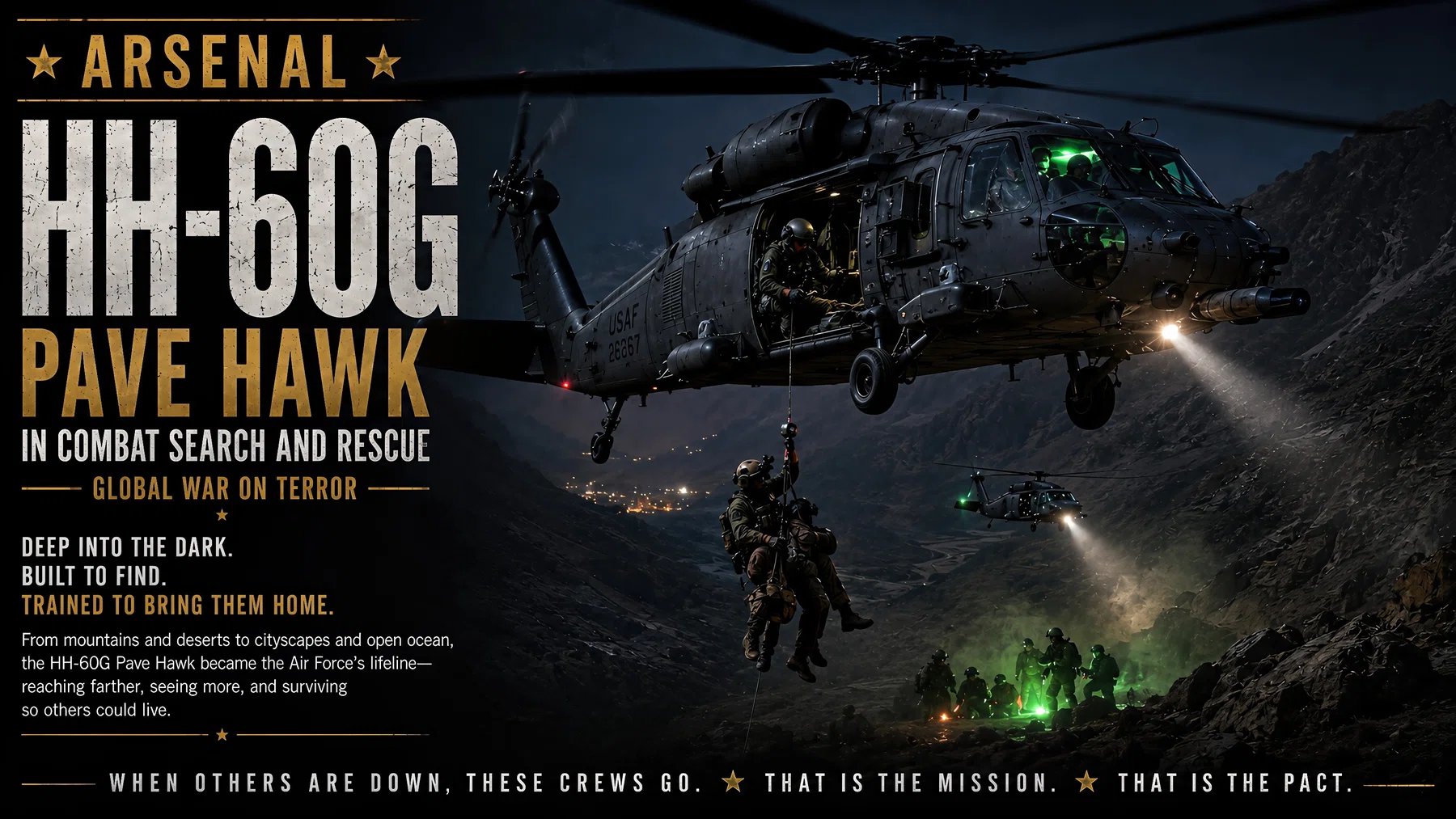
The mountains are already black against the Afghan sky when the call comes in. A patrol has run into an improvised explosive device and small-arms fire in a narrow valley, and there are multiple critically wounded on the ground. A pair of HH-60G Pave Hawks sitting alert on a dusty ramp spin up as pararescue specialists jog toward them, rucksacks and medical bags thumping against their armor. The crews have rehearsed this a hundred times, but the adrenaline spike is real every time the radios crackle with the word “urgent.”
As the formation pushes toward the valley, the pilots ride night-vision goggles, following a river that shines like dull metal in the infrared searchlight. The flight engineer leans out of the cabin door, scanning the ridgelines while a minigun hangs ready at his side. In the back, the PJs talk quietly through the sequence they will follow once the wheels touch down, or if they never can. The Pave Hawks carry a refueling probe, extra fuel in the cabin, and defensive systems, but the last mile is still about judgment and luck.
Over the landing zone, the first helicopter flares into a dusty hover while the second orbits, guns outboard against any muzzle flashes in the dark. The hoist cable runs, a PJ descends into chaos, and for a few long minutes the whole mission shrinks to the glow of chem-lights and the thump of rotor blades. This is what the HH-60G was built for: pushing deep into hostile airspace, on bad nights, when someone else’s worst day depends on a successful pickup. The story of how it came to be starts years before this valley, with a hard lesson about what older helicopters could not do.
The Problem It Was Built To Solve
Combat search and rescue has haunted airmen since the first time a downed crew found itself alone behind enemy lines. By the late years of the Vietnam War, the United States Air Force relied on aging HH-3E “Jolly Green Giant” helicopters and earlier designs that had been stretched far beyond what their engineers imagined. They could be brave, but they were not always survivable. Heavier enemy air defenses, longer-range strike missions, and the need to recover crews at night and in bad weather exposed every weakness in range, navigation, and protection.
The failed hostage rescue attempt in Iran at the start of the 1980s underlined those gaps in brutal fashion. The service needed a helicopter that could accompany fast jets into contested airspace, refuel in flight from tankers, thread through mountain valleys at nap-of-the-earth altitudes, and still have enough power left to hover over a survivor or squeeze into a tight landing zone. It had to do all of that while carrying a small rescue team, defensive guns, and the sensors and radios to find people who might be hiding, evading, or already wounded.
At the same time, peacetime demands were growing. Humanitarian missions, disaster response, and long overwater flights to stricken ships or remote islands all required a machine with long legs and a robust airframe. The Air Force could not afford a bespoke design built from scratch, but it also could not keep patching up helicopters that had their roots in the 1960s. The answer, planners decided, was to start with the Army’s new UH-60 Black Hawk and adapt it specifically for the personnel recovery role. That decision set in motion the process that would turn a utility workhorse into the specialized HH-60G Pave Hawk.
From Design Board To Production
Once the Air Force decided to build a new dedicated rescue helicopter, engineers did not start with a blank sheet of paper. They turned to the Army’s UH-60 Black Hawk, a modern, powerful utility helicopter with a robust transmission and room to grow. The idea was to keep the proven airframe and drive system while weaving in the specialized avionics, fuel systems, and defensive gear that combat search and rescue demanded. The result would carry the “Pave” label from the Air Force’s Precision Avionics Vectoring Equipment program and eventually become the HH-60G Pave Hawk, a machine built from the outset to go looking for people who were lost, hurt, or hunted.
Early prototypes explored how far the Black Hawk could be pushed into bad weather and high-threat environments. Engineers added a retractable in-flight refueling probe so the helicopter could drink from tankers and push hundreds of miles beyond a normal radius. They integrated advanced navigation gear, terrain-following autopilot functions, and night-vision compatible cockpits to make it realistic to fly low and fast in the dark. Defensive systems such as radar warning receivers, infrared jammers, and flare and chaff dispensers were layered on to give crews at least a fighting chance against radar-guided and heat-seeking weapons.
At a glance, the HH-60G is a twin-engine, medium-lift combat search and rescue helicopter built by Sikorsky for the United States Air Force. It flies with two pilots up front and usually at least a flight engineer and gunner in back, with room for pararescue specialists, survivors, or stretchers in the cabin. Typical armament is a pair of door-mounted guns, either 7.62 millimeter miniguns or.50 caliber machine guns, backed by a cargo hook rated for several tons of external load. In clean configuration it can cruise at roughly one hundred eighty miles per hour, with a basic unrefueled range of around six hundred miles that can stretch dramatically when aerial refueling and extra tanks are used.
Production runs in the 1980s and early 1990s delivered just over a hundred HH-60G airframes, enough to re-equip the core active-duty rescue squadrons, the Air Force Reserve, and Air National Guard units that shared the mission. These helicopters quickly spread across commands in the continental United States, Europe, the Pacific, and later the Middle East, standing strip alert for both combat and peacetime emergencies. Over the next decades they would be repeatedly upgraded in electronics and wiring but not fundamentally redesigned, even as they flew hard in operations from Desert Storm through the long wars in Iraq and Afghanistan. That combination of aging airframes and heavy use is one of the reasons newer HH-60W Jolly Green II helicopters are now entering service to take over the role.
Inside The Weapon
Viewed from the outside, a Pave Hawk is recognizably a Black Hawk, but with a rescue specialist’s kit grafted on. The refueling probe juts forward from the nose like a spear, while a prominent rescue hoist is mounted above the starboard cabin door. Sensor turrets under the nose or chin carry infrared and low-light cameras, and various antennas and fairings hint at the radios and navigation systems buried inside the airframe. Door guns bracket the cabin, giving the helicopter teeth to suppress fire when it hovers over a survivor or commits to a landing in a tight, hostile zone.
In the cockpit, two pilots sit side by side behind large armored windscreens, their world dominated by flight instruments, engine gauges, and a busy center console of radios and navigation controls. They manage power settings, terrain-following profiles, and route changes while working closely with aircraft commanders who balance mission risk against the need to reach people on the ground. Modernized Pave Hawks carry integrated avionics that blend satellite navigation, inertial systems, and moving maps to keep the crew oriented in bad weather and on moonless nights. The automatic flight control system can hold a precise hover or fly a low-level course with far less workload than earlier generations of rescue helicopters, buying the pilots a little more mental space during tense extractions.
Behind them, the cabin feels more like a flying rescue bay than a passenger compartment. Along one side, seats can be folded away to make room for litters, medical gear, and pararescue rucksacks. The flight engineer and gunner move through this space as they operate the hoist, manage fuel tanks, and keep an eye on engine and gearbox status through local panels. Pararescue specialists stage their equipment where they can reach it quickly, from breaching tools and ropes to advanced trauma kits. In a typical mission, one or two of them may ride the hoist down with a stretcher while others prepare the cabin to receive multiple wounded, turning the helicopter into a cramped but vital emergency room. YouTube
The rescue hoist itself is a defining feature. Mounted high to keep it clear of obstacles, it can lift several hundred pounds from a hover height that keeps the rotors away from trees, rocks, or power lines. The cable lowers pararescue specialists into mountainsides, narrow alleys, and ocean swells where landing would be impossible or suicidal. Defensive systems hum quietly in the background, sniffing for radar and heat signatures, while the crew juggles radio calls from joint rescue coordination centers, ground forces, and overhead aircraft. Training ranges teach the sequence in clean, controlled conditions, but in combat the same machinery has to work through dust storms, small-arms fire, and the chaos of frightened or injured people on the ground.
Veterans often describe life with the HH-60G as a constant compromise between payload, fuel, and risk. With full auxiliary tanks installed, cabin space tightens and loading litters or additional gear becomes more awkward, yet those same tanks may be the difference between reaching a survivor and turning back short. Extra armor and weapons add survivability but eat into the margin on hot, high-altitude days when engine performance drops. Over years of use, crews and maintainers have learned the quirks of the airframe, from how the rotor system behaves in mountain winds to how long certain components can be pushed before they demand replacement. Living with the Pave Hawk in squadron service means respecting both its strengths and its limits while trusting it to get into and out of places few other helicopters would dare to go.
Baptism Of Fire
The HH-60G’s real proving ground came as soon as it entered service. Late in the Cold War and in Operation Just Cause in Panama, small detachments of Pave Hawks began to show how a dedicated combat search and rescue helicopter could shadow strike packages and stand by for emergencies in tight urban and jungle terrain. The real test, though, arrived with Operation Desert Storm. There, Pave Hawks fanned out across Saudi Arabia and the Gulf, providing rescue coverage for coalition aircraft over western Iraq, coastal Kuwait, and the open water, as well as backing up special operations teams probing the coast. Their job was simple to state and difficult to execute: be close enough, and ready enough, to reach a downed crew before enemy troops did.
By the time of Operation Iraqi Freedom, the type was deeply woven into personnel recovery doctrine. One mission in April 2004 near Kharbut, Iraq, shows what that looked like under extreme pressure. A United States Army CH-47 Chinook went down in a sandstorm with visibility collapsing toward zero. Two Pave Hawks, callsigns Jolly 11 and Jolly 12, launched into the dust knowing their night-vision goggles and infrared sensors would be almost useless in the swirling brownout. Crews leaned instead on the eyes and voices of flight engineers and gunners, talking the aircraft down to the crash site in near-blind approaches while pararescue specialists prepared to leave the safety of the cabin. Once the survivors were aboard, both helicopters had to evade surface-to-air missiles on the way out, using tight formation work and defensive fire to get clear.
The same pattern played out again and again in Afghanistan’s mountains. Pave Hawk crews flew long legs from well-defended bases into high valleys where thin air robbed the rotors of lift and enemy small-arms fire could come from any ridgeline. A typical mission might see the helicopters tanking from a tanker aircraft, then dropping to the deck to follow rivers and folds in the terrain under goggles. At the end of that route lay a hoist through rotor wash, snow, or dust to reach a wounded soldier or airman who could not move on their own. The helicopter’s combination of in-flight refueling, sensors, and hoist systems meant commanders could authorize rescues deep in bad country, but every kilometer of penetration also increased exposure to ambush and mechanical risk.
Across Desert Storm, Allied Force over the Balkans, the long wars in Iraq and Afghanistan, and major disaster responses from Mozambique floods to Hurricane Katrina, the HH-60G became a familiar sight wherever someone needed to be pulled out of danger by air. In many of those missions the guns stayed silent and the most important performance figure was pounds of fuel or minutes of hover time, not speed or climb rate. In others, as in that 2004 sandstorm rescue, every part of the system was pushed to its limits at once. The machine’s baptism of fire was less a single battle than a long series of hard flights in which aircrews and pararescue specialists learned exactly what it could and could not do when lives hung in the balance.
Strengths And Weaknesses
Ask Pave Hawk crews what they value most and they tend to start with reach and flexibility. The combination of twin powerful engines, internal auxiliary fuel tanks, and the forward refueling probe lets the HH-60G push far beyond a normal helicopter radius, or loiter near a survivor while coordination plays out on multiple radios. Its communications and navigation suite, designed to tie together inertial, satellite, and Doppler navigation with secure voice, moving maps, and data links, gives pilots a detailed picture of the route even in darkness or bad weather. Defensive aids from radar and missile warners to flares and infrared jammers add a last layer of protection when the mission demands a low, slow hover in range of small-arms and shoulder-fired missiles.
Inside, the layout suits the Guardian Angel concept of a tight-knit team of pilots, flight engineer, gunners, and pararescue specialists. There is enough space to work on critical patients in flight, enough tie-down points and hoist capacity to manage multiple litters, and enough armament to suppress immediate threats while people are on the cable. Maintainers appreciate that the basic Black Hawk structure is proven and that spare parts pipelines exist across the wider H-60 family. At unit level, Pave Hawks have also shown an ability to pivot quickly from combat rescues to civil search and rescue and humanitarian work without major reconfiguration, which makes them valuable to commanders trying to cover a broad set of missions with limited aircraft.
The weaknesses show up in the same logbooks and hangars. The HH-60G fleet has flown hard for decades, and many airframes are older than some of the airmen who crew them. Age brings fatigue, corrosion, and wiring issues that drive up maintenance hours per flight hour and can reduce availability just when a crisis demands more sorties. The helicopter’s survivability, impressive when it entered service, looks more fragile in the face of dense modern air-defense networks built around long-range missiles and sophisticated sensors. Analysts worry that flying into heavily defended airspace against a peer adversary would be far riskier than the missions flown over Iraq or Afghanistan, even with escorts and careful planning, which is one reason Air Force leaders have pushed to recapitalize the force with the newer HH-60W Jolly Green II and to rethink how personnel recovery will work in a high-end fight.
Variants And Evolution
The Pave Hawk story begins with a simple idea: take the Army’s UH-60A Black Hawk and tailor it to rescue downed aircrew. Early in the 1980s, the Air Force acquired basic Black Hawks and modified them with refueling probes, extra fuel, and rescue hoists, creating “Credible Hawk” aircraft that could reach farther and pull people out of tight spots. These airframes, combined with new-build machines, were then upgraded with the full PAVE electronics package, gaining advanced navigation and communications and the ability to work comfortably at night and in poor weather. Special operations versions, designated MH-60G, carried some of the most capable gear but were later consolidated and redesignated as HH-60G when the combat search and rescue mission migrated fully to Air Combat Command and its Reserve and Guard partners.
Over the years, the baseline HH-60G has seen multiple upgrade programs rather than a clean-slate redesign. Avionics have moved toward glass cockpits and digital moving maps, new radios have been added to talk with joint and coalition forces, and survivability suites have been updated to keep pace with evolving threats. Some “operational loss replacement” aircraft were built to replace combat and accident losses, slightly modernized compared to early airframes but still recognizably part of the same family. Incremental wiring and structural improvements kept the fleet flying, but they could not erase the fact that many Pave Hawks date back to the early 1980s in basic structure, even if their cockpits look far more modern than they did when they first rolled out of the factory.
The most visible evolution is actually the step beyond the HH-60G. Concern over aging aircraft and the demands of future conflicts led to the Combat Rescue Helicopter program and the selection of the HH-60W Jolly Green II as the Pave Hawk’s successor. The new variant keeps the familiar Black Hawk outline but adds more fuel, improved armor, refined sensors, and enhanced defensive systems. Deliveries have begun to active-duty and Air National Guard rescue wings, including units like the 129th Rescue Wing in California, which are trading in their Pave Hawks for small batches of HH-60Ws. Budget pressures and shifting priorities have capped the number of new helicopters, however, so for some years the rescue community will operate a mixed fleet in which venerable HH-60Gs share ramp space with brand-new Jolly Greens while leadership debates what personnel recovery should look like in the era of long-range missiles and contested airspace.
Legacy And Where To See It Today
In doctrinal terms, the HH-60G Pave Hawk helped cement the idea that personnel recovery was not an improvised afterthought but a core capability. Its presence alongside strike and special operations forces in planning cells meant that missions were built from the start with realistic options to retrieve aircrew, forward observers, and special operators if things went wrong. Tactics developed around the Pave Hawk’s strengths, such as teaming with fixed-wing escorts and tanker aircraft, and around its limits, such as vulnerability to certain threat envelopes. Over time, this fostered a broader “Guardian Angel” approach in which pararescue specialists, survival instructors, and combat rescue officers shaped how units prepared for evasion, signaling, and pickup, knowing that a Pave Hawk might be overhead if those skills had to be used.
On the public side of its legacy, more and more Pave Hawks are finding their way into museums and static displays. At the National Museum of the United States Air Force in Ohio, for example, visitors can walk past an HH-60G that once led a daring 2004 rescue of soldiers stranded after a sandstorm crash in Iraq, a mission that earned its crew the Mackay Trophy for the most meritorious Air Force flight of the year. Other retired aircraft stand guard at rescue wing bases, Air National Guard facilities, and regional air museums, often still wearing the subdued grays and greens they carried into combat. For veterans and families who walk under those rotors, each airframe is a reminder of specific flights, faces, and nights when the promise “We will come for you” turned into reality.
For readers and listeners exploring this story through Dispatch and Trackpads, the Pave Hawk also serves as a gateway into a wider web of personnel recovery tales. Photos and video from exercises and real-world missions show the helicopter in deserts, jungles, coastlines, and mountain valleys, often with pararescue specialists fast-roping or riding the hoist into places that barely seem big enough for a man, let alone a helicopter. A natural companion to this Arsenal feature might be a Beyond the Call narrative about a downed aviator, or a Living History interview with a rescue pilot or PJ who can put voice and memory to the hardware described here. Together, they underline the point that the HH-60G is not just a type designation but a symbol of a community that has spent decades training for the worst days of other people’s lives.
