In Action
The jungle around the night defensive position is still black when the first rocket-propelled grenade hisses in. The crew of the M551 Sheridan feels it before they see it, a flat crack and a shower of dirt against the aluminum hull. The driver is already awake, boots on the pedals, eyes flicking between the dim red glow of his instruments and the vague outline of the trail ahead. Above him, the commander kicks the gunner’s boot and snaps him fully into consciousness with a single word: “Contact.”
Flares pop overhead and the world turns white and green. The Sheridan’s low turret swings toward the tree line where muzzle flashes stutter and disappear. The gunner fights the sight picture, trying to keep a clump of darker shadows centered as the tank shudders on its torsion bars. The commander calls for beehive, a flechette round designed to turn the 152 millimeter gun into an enormous shotgun. When it fires, the blast is a physical blow, rolling across the position and out into the paddies.
Infantry from the attached company are already hugging the ground, shouting to each other over the noise. They are close enough to feel the concussion and hot dust from the Sheridan’s main gun, close enough to depend on it and fear it at the same time. Somewhere beyond the burning brush and drifting smoke are the enemy rocket teams who came in confident that light armor would be easy prey. Tonight they are learning how violently this awkward-looking airborne tank can answer when it is in the right place and properly handled.
By dawn the contact has burned out into sporadic fire and the clatter of empty brass. The little tank squats in the churned mud, its thin hull scorched and dented but still running, its crew exhausted and half-deaf. This is what the M551 Sheridan has become in Vietnam: a mobile bunker, an improvised artillery piece, and a lightning rod for enemy fire. It is a far cry from the role its designers imagined, and the gap between concept and reality is the heart of its story.
The Problem It Was Built To Solve
The Sheridan’s story began not in the jungles of Southeast Asia but in the shadow of the Cold War. In the late nineteen fifties and early nineteen sixties, the United States Army faced a difficult question: how could airborne and light armored units carry enough firepower to matter on a battlefield crowded with increasingly heavy Soviet tanks, without losing the speed and deployability that made them valuable in the first place? Existing light tanks like the M41 Walker Bulldog were fast and familiar, but they were too heavy to drop safely with paratroopers and too lightly armed to inspire confidence against the latest enemy armor.
At the same time, the Army was embracing airmobile operations and rapid reaction forces. Paratroopers and helicopter-borne infantry could arrive quickly, seize airfields, block passes, or reinforce threatened sectors. What they lacked was a gun that could follow them in the first wave, not days later on a crowded port or rail line. Heavy main battle tanks like the M48 Patton offered excellent protection and a solid gun, but they were too heavy for airborne delivery and too demanding for the fragile infrastructure of many likely battlefields. Bridges, roads, and landing zones in much of the world could not support entire fleets of heavy armor.
The answer, on paper, was a radically light tank with an outsized punch. The concept that became the M551 Sheridan promised an aluminum-hulled vehicle light enough to be air-dropped or air-landed, yet armed with a large gun that could fire both conventional rounds and a guided anti-tank missile. In Europe, it was supposed to give airborne and cavalry units a way to threaten enemy tanks at long range. In other theaters, it would offer mobile fire support wherever roads and airstrips could take it. The risks were obvious even then: thin armor, complex weapons, and the need to marry cutting-edge missile technology to a small, fragile chassis. Nevertheless, the urgency of the problem pushed the Army toward production, setting the stage for a light tank that would see its first sustained combat not on the plains of Europe, but in the rice paddies and rubber plantations of Vietnam.
From Design Board To Production
Turning the Sheridan from concept into metal meant solving a series of conflicting demands. The Army wanted a vehicle light enough to air-drop, amphibious enough to swim rivers, and yet armed strongly enough to threaten contemporary Soviet tanks. Earlier attempts at a new light tank had been canceled when they could not meet new requirements like swimming or they grew too heavy. By the end of the nineteen fifties, the answer shifted from refining an existing gun to pairing a very large, low velocity cannon with a guided missile, all mounted on a compact chassis built with aluminum rather than traditional thick steel.
A design from the Cadillac Motor Car Division of General Motors won the competition. Engineers shaped a low, boxy hull to keep weight down and volume usable, then placed a four-man crew in a relatively large turret so that commander, gunner, and loader could work together in a familiar pattern. Inside that turret sat the heart of the project: a one hundred fifty two millimeter gun and launcher intended to fire both powerful short range rounds and a missile that could reach out and defeat heavy armor. Around it, designers wrestled with recoil forces, electronics, and the need to keep everything small enough for air transport.
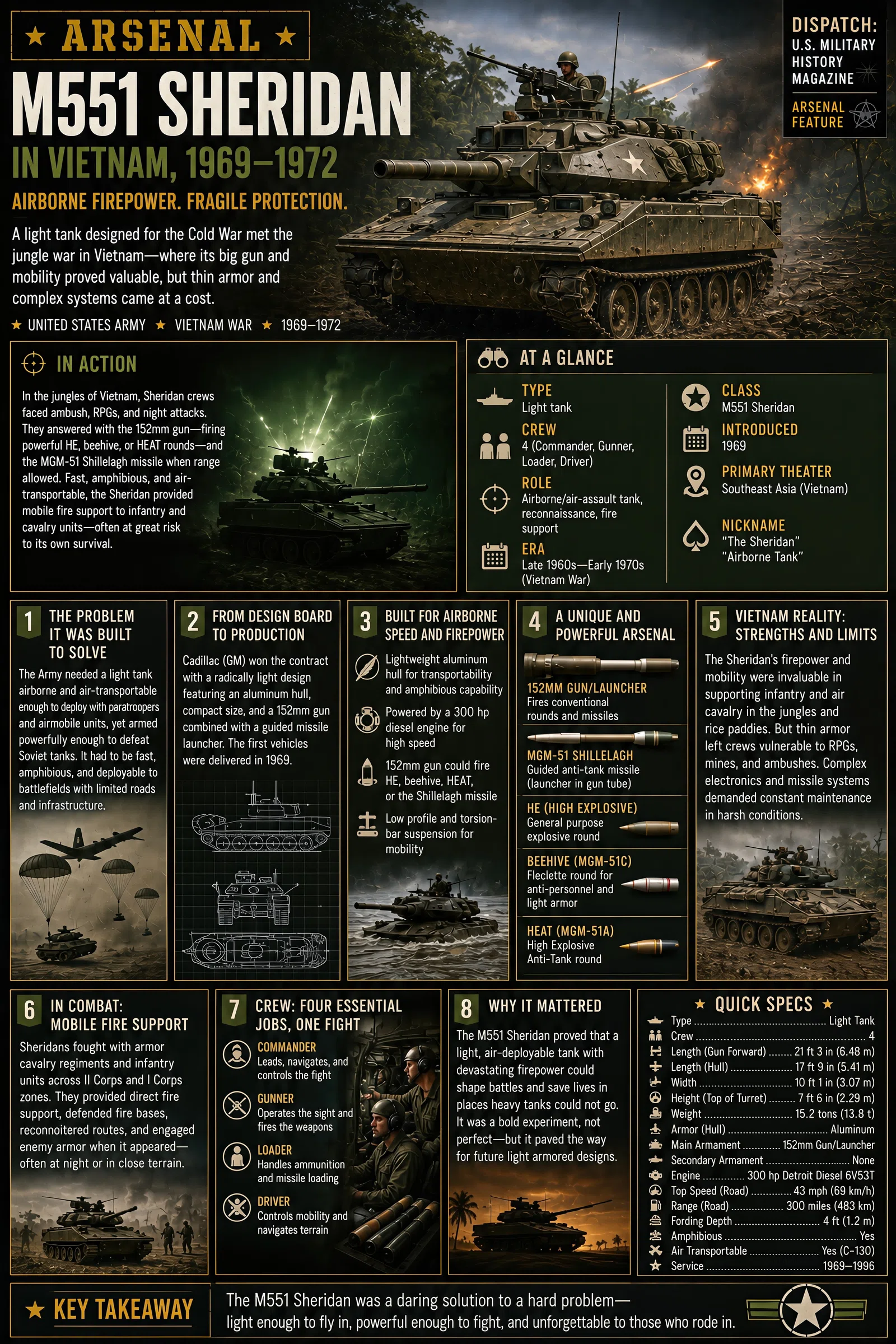
At a glance, the M551 Sheridan was an American airborne and reconnaissance light tank for the United States Army, serving mainly in the late Cold War. It carried a crew of four, with a driver in the hull and three men in the turret, and its primary armament was the large gun and missile launcher supplemented by a heavy machine gun and a coaxial medium machine gun. On roads it could run at highway speeds and travel hundreds of miles on a tank of fuel, and with flotation gear fitted it could swim narrow rivers and canals. Production models weighed a little over seventeen tons in combat trim, making them light enough for special air delivery methods that heavier tanks could not attempt.
Limited production was approved in the mid nineteen sixties and full production followed quickly. The first Sheridans reached Army units just as debates over their wisdom were heating up. Supporters pointed to their strategic mobility and powerful gun; critics worried about the thin armor, the complexity of the missile system, and the safety of combustible-case ammunition. Even so, more than a thousand were built before the production line closed. The long development of the missile and gun meant that some early vehicles reached troops before every ammunition type was fully ready, and the Army’s decision to rush the Sheridan into combat in Vietnam would expose both the strengths and the painful weaknesses of this ambitious design.
Inside The Weapon
Seen from the outside, the M551 Sheridan looks almost delicate compared to its heavier cousins. The hull is tall and angular, built from aluminum alloy plates that save weight but do not offer the same blunt sense of invulnerability as thick steel. The turret sits high on this hull, with a long, stubby barrel and a prominent commander's cupola bristling with a heavy machine gun. Around the front, mounting points for flotation gear hint at its amphibious ambitions. On a narrow jungle trail or in a European training area, the tank’s compact footprint and lively suspension make it feel more like a fast, rough riding scout than a traditional main battle tank.
Inside, the driver sits low in the front hull, almost lying back, surrounded by controls and periscopes. Behind and above him the turret ring carries the fighting compartment where the commander, gunner, and loader work in close quarters. The gunner’s station is packed with sights, hand controls, and indicators for the gun and missile system. To his side and behind, racks of ammunition crowd the space, including bulky main gun rounds that must be handled carefully because of their combustible casings. The loader’s job is physically demanding in the cramped turret, especially when the vehicle is bouncing over rough ground.
The commander’s world is even more complex. He must manage radios, watch the battlefield through his own sights and periscopes, direct the driver, and give fire orders to the gunner while also handling the turret-top machine gun. In Vietnam and later conflicts, commanders often added improvised shields and extra armor around their hatches to gain some protection from small arms and fragments while fighting from the open cupola. Communication inside the turret is a mixture of shouted commands, intercom chatter, and well practiced routines, because the tight space and high noise levels punish any confusion.
Behind the fighting compartment, the engine and transmission pack fills the rear hull. A compact diesel engine gives the Sheridan a high power-to-weight ratio, which translates into rapid acceleration and the ability to keep up with armored cavalry formations or race to secure river crossings. The cost is heat, noise, and maintenance demands that crews must live with in the field. In theory, flotation screens can be erected around the hull to let the tank swim, driven in the water by its tracks. In practice, crews often find the gear cumbersome and focus instead on fording and conventional maneuver.
Veterans remember the Sheridan as a lively but unforgiving machine. Its big gun produces a violent blast, rocking the light hull and showering the crew with fumes and dust. The thin armor and complex weapon system demand constant attention and careful handling. In training manuals the vehicle appears as a flexible scout and missile carrier; in combat, crews quickly learn that it behaves more like a fragile, over-armed brawler. Understanding that contrast between the clean diagrams and the lived reality inside the hull is essential to understanding how the Sheridan was actually used in places like Vietnam, Panama, and later training centers.
Baptism Of Fire
When the Sheridan finally met combat in Vietnam, it did so not as a tank killer on the plains of Europe but as close fire support in a counterinsurgency war. Armored cavalry squadrons in the Mekong Delta and along the Cambodian border received the new light tanks and quickly folded them into their mixed columns of infantry carriers, gun trucks, and engineers. A typical mission might begin with a squadron rolling out of a night defensive position at first light, Sheridans up front to nose down suspicious tracks, lay main gun rounds into tree lines, and cover engineers as they cleared mines and roadblocks. The big gun, loaded with high explosive or canister, gave commanders a way to smash bunkers or ambush sites at short notice.
In actions along jungle highways and in patchwork rice paddies, Sheridan crews found themselves acting as both bait and shield. The thin armor could not shrug off heavy mines or well-placed rocket-propelled grenades, yet the presence of a turreted gun and a heavy machine gun made the vehicles natural focal points for any engagement. During named operations along the border, they led assaults into tree lines, ringed fire support bases, and raced to reinforce outposts under attack. A single beehive round fired down a trench or into a hedgerow could scatter an assault that had taken hours to prepare, and infantry came to value that instant, devastating wall of flechettes.
The cost was high. Mines could tear off suspension units, breach the hull, or ignite burning fuel and ammunition. The combustible cases of the main gun rounds, designed to save weight, sometimes contributed to fires when the hull was penetrated. Crews learned to stack sandbags on the floor, hang extra track links on the sides, and weld improvised screens around their stations. What had been envisioned as a sleek airborne tank became, in practice, a battered but essential piece of mobile artillery, fighting day after day from the same muddy roads and perimeter berms as heavier armor. Its baptism of fire in Vietnam fixed its reputation in the minds of many veterans, for good and ill.
Strengths And Weaknesses
Sheridan crews often described their mount as a machine of extremes. On the positive side, it was fast, agile, and hit hard. The power-to-weight ratio let it lunge out of cover, cross soft ground that would bog heavier tanks, and reposition quickly along a perimeter. The one hundred fifty two millimeter gun gave platoons a flexible toolbox of high explosive, canister, and other rounds that could be tailored to bunkers, infantry concentrations, or lightly built structures. The turret layout was familiar to men who had trained on other American tanks, and the cupola-mounted heavy machine gun provided valuable overhead fire for infantry in close contact.
Yet the very things that made the Sheridan light and deployable also made it vulnerable. The aluminum armor could stop small arms and shell fragments but offered little comfort against anti-tank mines or rockets. Hits that a heavier tank might absorb could be fatal to a Sheridan, especially when burning propellant from ruptured ammunition spread through the fighting compartment. Early in its service, crews and maintainers also struggled with the complexity and fragility of the missile and gun system, which was sensitive to dust, heat, and rough handling. In Vietnam, the guided missile component was seldom used in combat, leaving the vehicle to rely mainly on its conventional rounds.
Enemies learned quickly that the Sheridan did not share the staying power of heavier tanks. Well-sited rocket teams would wait for a column to commit, then aim for the thin sides or rear as the light tanks passed. Booby-trapped roads and culverts targeted their relatively fragile running gear. Comparisons with the older M48 Patton were inevitable. The Patton was heavier and less suitable for airborne delivery, but its thick steel armor and proven seventy five and later ninety millimeter guns made crews feel more secure. Many cavalry units valued the Sheridan’s mobility and firepower, but they accepted it with the sober understanding that it carried its crews into harm’s way with less margin for error than a full-sized main battle tank.
Variants And Evolution
Over its service life, the Sheridan went through a series of modifications that reflected both combat experience and changing doctrine. The basic M551 model remained visually recognizable throughout, but units in Vietnam and later theaters piled on local additions. Extra armor plates, track links, sandbags, and improvised gun shields appeared on turrets and hulls. Some vehicles received improved fire control components, night vision devices, and changes to ammunition stowage intended to reduce the risk of catastrophic fires. In many combat zones, the delicate missile equipment was de-emphasized or disabled, turning the Sheridan in practice into a conventional gun tank with a very large, low velocity cannon.
Outside Vietnam, the vehicle’s original role as a reconnaissance and airborne light tank continued to shape experiments. Airborne units in Europe and the United States trained with Sheridans dropped or air-landed from transport aircraft, refining techniques for getting armored firepower into remote airfields or crisis zones. Lessons from reliability problems led to incremental improvements in components and maintenance procedures. Engineers and planners carried the core idea forward: a rapidly deployable direct fire vehicle that could back up light infantry and airborne forces without the logistical burden of full-sized main battle tanks.
The Sheridan’s influence extended into later designs even as the vehicle itself aged. Concepts for new armored gun systems drew on the notion of pairing a relatively light chassis with a potent main gun, though later projects often reverted to more conventional cannon and ammunition to improve safety and reliability. The experience of integrating a complex missile system into a tank turret informed how designers approached the balance between sophisticated electronics and rugged field performance. In the end, the M551 remained something of an evolutionary branch: important not because it produced a line of direct descendants, but because it forced the Army to confront the tradeoffs of airborne armor in a very concrete way.
Legacy And Where To See It Today
Today the Sheridan’s legacy is a mix of hard lessons and quiet respect. Many veterans remember it as a flawed but necessary tool, a vehicle that saved lives with its firepower even as its thin skin exposed crews to great risk. In doctrinal terms, it marked a serious effort to give airborne and light armored formations their own tank-like punch, rather than relying entirely on attached heavy units. The hard-earned understanding that complex missiles, combustible ammunition, and very light armor made for a dangerous combination shaped subsequent debates over how much sophistication a field vehicle can carry before reliability and survivability suffer.
The Sheridan’s impact can also be seen in training and readiness. For years after Vietnam, Sheridans served as visually modified “enemy” tanks at major training centers, helping generations of soldiers practice fighting armored threats. In that role, their high mobility and distinctive silhouette contributed to more realistic exercises. Later discussions about providing modern airborne and light infantry brigades with mobile direct fire support revisited many of the same questions raised by the M551, giving the Sheridan an indirect hand in shaping systems that came after it.
Physical survivors of the type now rest at armor and airborne museums, on base display pads, and in collections across the United States. Visitors to major Army museums and airborne division posts can often find a Sheridan on the grounds, paint faded but lines unmistakable, representing the era when light tanks tried to keep pace with both helicopters and main battle tanks. Photographs and video from places like Dispatch and Trackpads dot com capture the vehicle in its prime, from muddy Vietnam firebases to desert training grounds. For modern readers and listeners, the Sheridan stands as a reminder that every bold attempt to solve a difficult tactical problem carries real human consequences for the crews who ride inside the solution. You can also hear narrated versions of Arsenal features as part of the Trackpads podcast feeds and Dispatch audio editions.