In Action
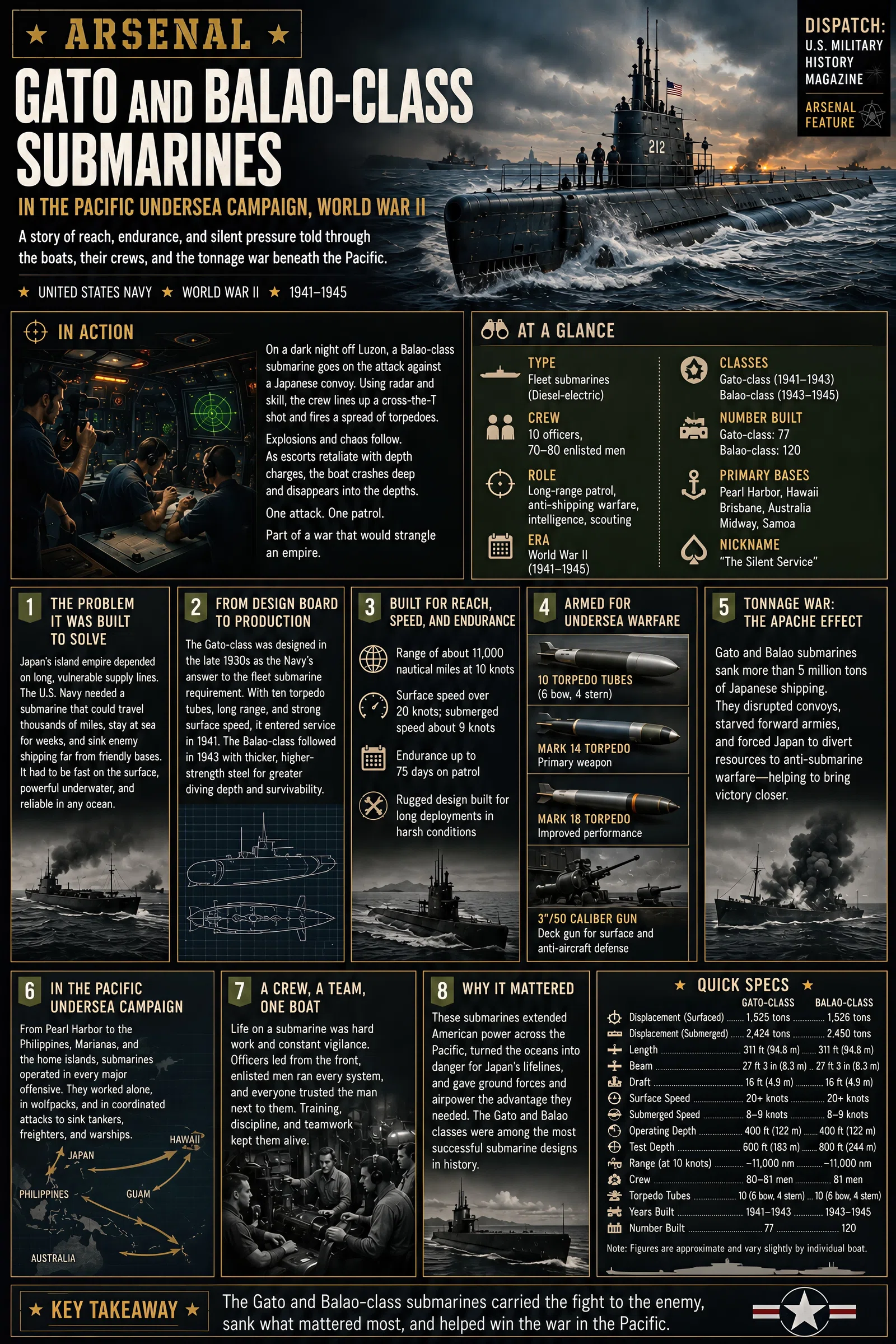
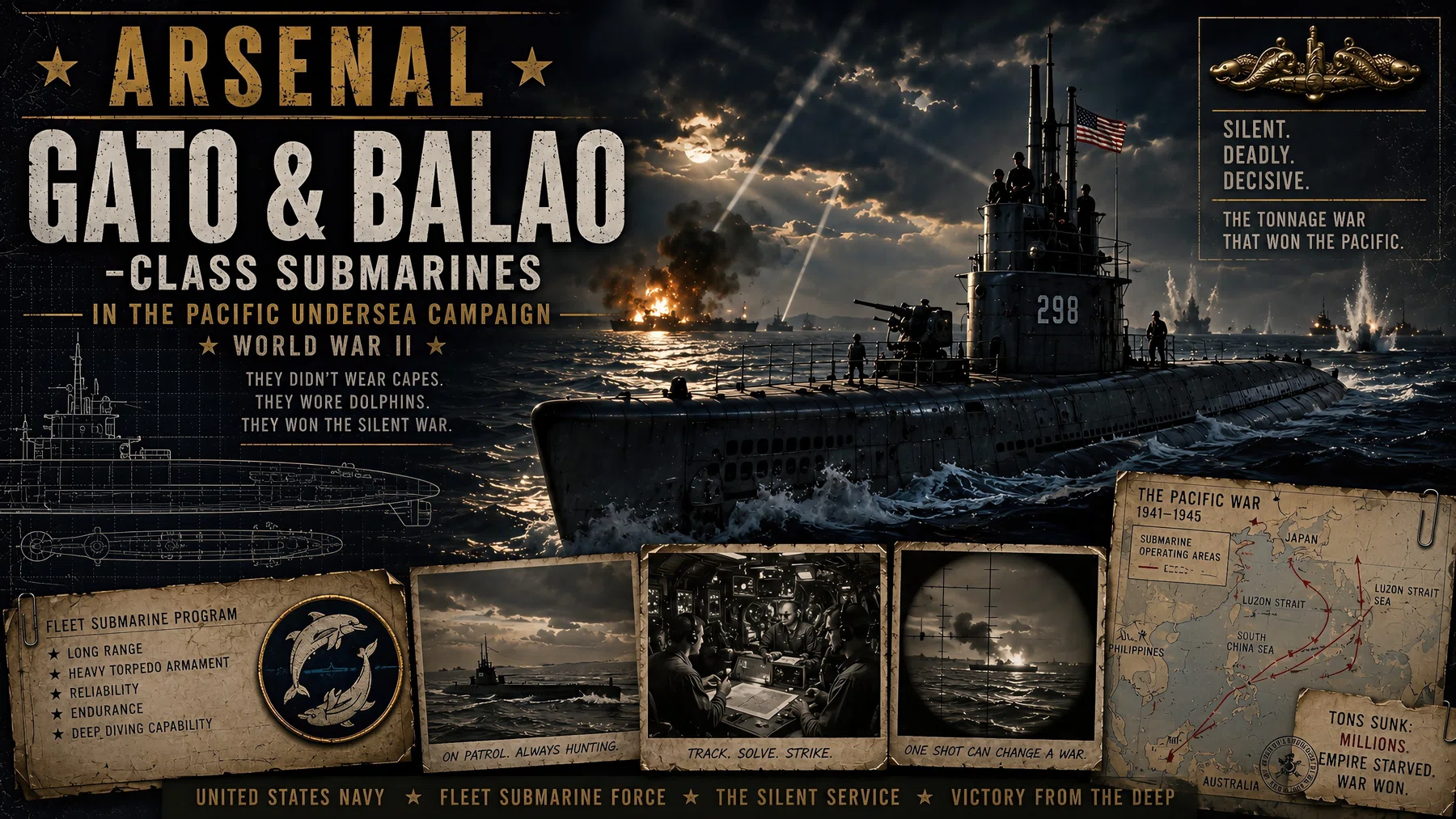
The sea off Luzon is black and restless, broken only by white streaks of foam and the dim loom of a convoy pushing north toward the Japanese home islands. On the surface, a Balao-class fleet submarine runs low and fast, her deck awash, bridge crowded with bundled lookouts and the attack party. An orange glow from the eastern sky hints at dawn, but for now the boat is wrapped in darkness, her crew hunched over radar scopes and T-shaped bearing indicators, measuring range and angle as the targets creep across the screen.
Down below, the control room is hot and tight. Men crowd around the plotting table, tracking the zigzag of a fat freighter guarded by nervous escorts. The air smells of diesel fuel, coffee, and sweat. Orders travel quickly but quietly: come left to new course, ahead full, open outer doors forward. Torpedomen in the bow room stand ready beside gleaming Mark 14s and Mark 18s, waiting for the words they have practiced a hundred times in drills and only a few times in real war.
The skipper chooses to fight on the surface, using the boat’s long-legged speed in the cool predawn air. He swings across the convoy’s path to “cross the T,” lining up a bow shot that will send a fan of torpedoes slanting through the formation. When he is satisfied, the quiet becomes absolute for a heartbeat. Then: “Fire one… fire two… fire three… fire four.” The hull shudders as the fish leave the tubes, compressed air kicking them into the sea. Seconds drag into years until, far ahead, a blossom of fire and water lifts a ship out of the night.
Now the escorts have found their courage. Searchlights stab the dark, tracer arcs hunt for the low, thin shape of the submarine. The skipper orders a hard turn away and a crash dive. The bridge empties in seconds, hatches slam, and the boat angles down, gauges swinging as she races for the safety of depth. Overhead, the first depth charges roll, and the Pacific undersea war closes in around the men of this steel cigar. This one attack is only a single patrol on a single night, but it is part of a wider campaign that will strangle an island empire’s lifelines and define the reputation of the Gato and Balao-class boats.
The Problem It Was Built To Solve
Decades before that night off Luzon, planners in the United States Navy already suspected that any future war in the Pacific would be a long-range fight against a maritime power. The distances were enormous: thousands of miles from the West Coast or Hawaii to the likely battlefields around the Philippines, the Dutch East Indies, and eventually the Japanese home waters. Older American submarines, the small S-boats and experimental interwar classes, lacked the range, reliability, and comfort to cruise those distances and still have the endurance to fight. The answer, on paper, was a “fleet submarine” that could keep up with the battle fleet on the surface, scout far ahead, and then deliver heavy torpedo attacks when ordered.
Turning that concept into hardware meant solving several problems at once. Designers needed boats with long legs, able to travel roughly eleven thousand nautical miles at economical speed and stay on patrol for as long as seventy-five days. They had to carry a serious torpedo battery and enough fuel, food, and spare parts for repeated dives and high-speed surface dashes. At the same time, they had to be trustworthy machines: complex diesel-electric systems that still worked in tropical heat, rough seas, and under the pounding of depth charges. Early attempts fell short, but they taught lessons about hull form, internal layout, and the balance between speed, endurance, and reliability.
When war came in 1941, those paper ideas met a brutal reality. Instead of supporting a line of battleships in some set-piece fleet engagement, American submarines found themselves almost alone in a vast ocean, ordered to wage unrestricted war on Japanese shipping. Japan’s island empire depended on merchant convoys to haul oil, ore, and food across the Pacific and through narrow choke points like the South China Sea and the Luzon Strait. If those convoys could be hunted down far from land-based air cover, factories at home would starve and frontline armies would go hungry.
Gato-class submarines were the first American fleet boats to bring all the necessary traits together: long range, decent surface speed, a strong torpedo armament, and enough internal volume to support relatively large crews for prolonged patrols. Balao-class submarines followed as an evolutionary step, with thicker, higher-strength steel in their pressure hulls, allowing them to dive deeper and survive more aggressive anti-submarine tactics. Together, these boats formed the backbone of a campaign that would eventually sink millions of tons of Japanese merchant and naval shipping, severing the arteries of an empire. The decision to invest in standardized, mass-produced fleet submarines set the stage for a design story that ran from drawing boards and shipyards straight into the dark waters of the Pacific.
From Design Board To Production
The fleet submarine that became the Gato-class did not spring from nowhere. It grew from a series of interwar experiments where the United States Navy tried to balance speed, range, and reliability in a single hull. Designers studied earlier long-range boats and realized they needed something stronger and bigger, with a full double hull, ample fuel tanks, and robust engines that could be maintained far from major bases. The result was a standard design that set the pattern for most of the war: a long, relatively beamy submarine with a raised bow, a substantial sail, and enough internal volume to carry a heavy torpedo load and a large crew without immediately wearing them down.
Tradeoffs shaped every line on the plans. A stronger pressure hull and double-hull construction added weight but gave the boat toughness and reserve buoyancy, making it more survivable when depth-charged and easier to trim as fuel and torpedoes were expended. Designers accepted that underwater speed would be modest in exchange for long, efficient surface cruising on diesel power. They also accepted a relatively tall silhouette so that the boat’s bridge, periscopes, and air intakes would work on the rough Pacific, where low, wave-hugging European profiles could be buried in heavy seas. Everything had to support extended independent patrols rather than short coastal ambushes.
At a glance, these boats were ocean-going attack submarines built by the United States for the Pacific war, serving mainly in the United States Navy’s submarine force from the early nineteen forties onward. A typical Gato or Balao carried around seventy men, with six forward and four aft torpedo tubes, along with reloads that could add up to a full load of torpedoes for repeated attacks. On the surface, they could cruise across an ocean at moderate speed, then sprint when needed to gain a firing position, while submerged speed and endurance were limited by electric battery capacity. Their main “armament,” beyond torpedoes, included a deck gun and light anti-aircraft weapons, but their real weapon was their ability to appear without warning and vanish back into the depths.
As war pressures mounted, the basic Gato design was refined into the Balao-class. The most important change was a pressure hull built of higher-strength steel, allowing deeper dives and better chances of slipping below the most intense parts of a depth-charge pattern. Shipyards across the United States learned to build these boats in series, turning a once-rare type into a mass-produced undersea fleet. By the middle years of the Pacific campaign, Gato and Balao-class submarines were sailing from Pearl Harbor, Fremantle, and other forward bases in a steady stream, each boat part of a long logistical chain that ran from design boards and factories straight to enemy shipping lanes.
Inside The Weapon
Seen from the outside, a wartime Gato or Balao looked like a long, lean steel cylinder with a knife-like bow and a high, angular sail near the front third of the hull. The main deck stretched from bow to stern, broken by the gun platform and the raised fairwater that housed the bridge and periscopes. Along the sides of the hull, subtle bulges and openings marked fuel tanks, ballast tanks, and flood ports. The boat’s lines were not elegant in the way of some smaller European submarines, but they were purposeful: enough freeboard to ride the Pacific swells and enough internal space to hold everything needed for a two-month war cruise.
Climb up onto the bridge and you would find a compact open platform with the skipper’s “cage,” a few standing positions for lookouts, and the controls for the radar and the boat’s surface steering. In action on the surface, this space might be crowded with officers, petty officers, and lookouts scanning the horizon, while the commanding officer paced between the bearing repeaters and the periscope well. Just below, in the enclosed conning tower and control room, the real brain of the boat pulsed. Here, helmsmen and planesmen sat at their wheels and levers, the diving officer watched depth and trim, and the plotter tended the attack plot, turning intercepted bearings and radar contacts into firing solutions.
Move forward and you entered the forward battery and crew spaces. Bunks were arranged in tiers wherever they would fit, some slung directly over torpedoes in the bow room. Personal space was almost nonexistent; many men “hot-bunked,” sharing sleeping racks in shifts as watches changed. The atmosphere was always a mix of machine smells and human presence: diesel fumes wafting up from the engine rooms, cooking odors from the tiny galley, and the constant background scent of oil, rubber, and metal. The galley itself was small but vital, turning out hot meals that helped keep morale stable through the long routine of watch rotations.
Farther aft lay the engine rooms, where big diesel engines throbbed and clattered during surface running, driving generators that charged the batteries and, when wanted, turned the propeller shafts. When the order came to dive, the engines were shut down, clutches disengaged, and silent electric motors took over. Electricians and machinist’s mates tended switchboards, gauges, and valves, managing the delicate balance between battery draw, motor output, and the need to keep enough charge in reserve for emergencies. In the stern torpedo room, a smaller group of torpedomen maintained the aft tubes and their own cramped living space, ready to fire “down the throat” at a chasing escort if necessary.
Every compartment had its role and its rhythm. Torpedomen wrestled with heavy weapons and complex firing gear, ensuring that each torpedo left the tube ready to run true. Sonarmen hunched in darkened corners, headphones on, listening for the change from the distant murmur of merchant screws to the sharp, urgent beat of an approaching escort’s propellers. Radiomen copied traffic that could redirect an entire patrol with a few code groups. The executive officer kept track of supplies, fuel, and torpedoes, constantly weighing how much fight the boat had left. Life inside a Gato or Balao was a blend of routine and sudden terror, of card games in the mess between dives and violent depth-charge attacks that rattled every pipe and fitting. To the men who crewed them, these submarines were more than steel; they were cramped, noisy, dangerous homes from which they waged a distant, grinding war against ships they might never see except as burning silhouettes on the horizon.
Baptism Of Fire
The first wartime patrols for Gato-class submarines came in the hardest possible circumstances. In the weeks after the attack on Pearl Harbor, boats sailed from Hawaii, the Philippines, and Australia into seas suddenly dominated by Japanese air and surface forces. Charts were incomplete, minefields were poorly marked, and the rules of engagement shifted as the United States Navy moved to unrestricted submarine warfare against Japanese shipping. Crews who had trained for textbook fleet scouting now found themselves hunting troop convoys into the Philippines and supply ships heading south toward the oil fields of the Indies, often with little intelligence beyond rough estimates of traffic lanes.
Those early cruises exposed painful flaws. The much-trusted Mark 14 torpedo frequently ran too deep, failed to detonate, or sometimes exploded prematurely, turning carefully set up attacks into dangerous near misses. Commanders watched in disbelief as perfect shots produced nothing but white wakes and dull thuds, forcing them to remain in exposed positions longer than they liked or to risk a second attempt under the eyes of escorts. At the same time, Japanese anti-submarine forces were learning on the job, combining aggressive small destroyers and converted patrol craft with seaplanes and land-based aircraft to sweep likely approach routes.
Despite the setbacks, the long-legged fleet boats slowly began to turn their design strengths into combat results. Boats patrolled from Pearl Harbor out across the Marshalls, Carolines, and along the routes from Japan to Truk and Rabaul. Others operated from Fremantle and Brisbane into the shallow, crowded waters of the South China Sea and the Java Sea. Here, Gatos used their surface speed at night to work into convoy lanes, then slipped under at dawn or when aircraft appeared. As radar sets and tactics improved, skippers began to rely on nighttime surface attacks, using the submarine almost like a low, hard-to-see destroyer that could suddenly vanish under the surface when threatened.
By the time the Balao-class began to join the fleet, the undersea campaign had matured into a coordinated tonnage war. Wolfpack tactics, where two or three boats worked the same convoy lane, became more common. Intelligence from code-breaking and aerial reconnaissance helped direct patrols toward the richest targets. The Balaos, with their deeper-diving hulls, were better able to ride out the increasingly heavy Japanese depth-charge barrages. Ship by ship, convoy by convoy, the combined efforts of Gato and Balao-class submarines began to strangle Japan’s access to oil, ore, and food. The dramatic explosion that lifted a freighter out of the night off Luzon was repeated again and again across the Pacific, each blast another cut into the arteries of an island empire.
Strengths And Weaknesses
To the men who fought in them, Gato and Balao-class submarines had clear virtues. They were dependable long-distance machines, able to cross the Pacific, patrol for weeks, and still have the fuel and torpedoes to fight on the way home. Their relatively large size gave better habitability compared to many foreign designs, with room for extra food, spare parts, and some measure of personal comfort, even if bunks were still scarce. Radar, once widely installed, gave commanders a powerful edge for finding targets and avoiding aircraft, while the sturdy double hull and careful compartmentation gave crews confidence that the boat could take punishment and still bring them home.
Their offensive power was respectable. A full load of torpedoes, concentrated in six forward tubes and four aft, allowed a single submarine to threaten a convoy or even a major warship given the right opportunity. The deck gun provided a way to finish off stragglers or smaller vessels without expending precious torpedoes, especially later in the war once the air threat in some areas eased. On the best days, crews felt that their boats were perfectly suited to the wide Pacific, combining reach, stealth, and enough firepower to make each patrol count.
Weaknesses were equally real. The early war torpedo crisis undercut confidence and cost lives, forcing commanders to take risks in order to verify hits or to press repeated attacks against well-defended convoys. Even after technical fixes, the submarine’s basic limitations remained. Submerged endurance was constrained by battery capacity and the need to conserve air; a boat could not simply remain deep and fast indefinitely. The relatively large silhouette that made the boat seaworthy on the surface also made it easier for alert lookouts or aircraft to spot against the horizon.
From the Japanese perspective, these American submarines were dangerous intruders that had to be kept away from shipping routes at all costs. Escorts learned to use active sonar, fast runs, and heavy depth-charge patterns to box in a contact, and aircraft grew more adept at spotting periscope wakes and oil streaks. As the war went on, minefields, patrol lines, and improved tactics did claim many Gato and Balao-class boats. Their losses were felt keenly in the tight-knit submarine force, where the disappearance of a familiar hull number meant dozens of names would never come home. Even so, the balance of strengths and weaknesses favored the patient hunter. The boats’ endurance and the crews’ growing experience slowly overwhelmed the ability of an overstretched empire to defend every sea lane.
Variants And Evolution
The Gato and Balao-class submarines were not static designs. Wartime experience pushed constant modifications, some subtle and some dramatic. Early in the conflict, boats carried relatively high fairwaters with prominent “ears” that housed gun platforms and lookout positions. As aircraft became a more serious threat, these structures were cut down and streamlined to reduce silhouette and drag, making the boats slightly harder to spot and more efficient on the surface. Successive radar sets and sonar gear were added or upgraded, sprouting new masts and domes that gave the bridge and sail an increasingly bristling look by mid-war.
Internally, systems improved as well. Better air-conditioning and ventilation made long patrols in tropical waters more bearable and reduced equipment failures. Torpedo data computers and fire control gear were refined, helping convert bearings and ranges into accurate firing solutions faster and under more chaotic conditions. Crew accommodations were adjusted as lessons from the fleet filtered back into design offices and shipyards, leading to small but meaningful improvements in stowage, bunk arrangements, and the placement of vital machinery.
The step from Gato to Balao represented a structural evolution more than a radical redesign. The Balao used higher-strength steel and a slightly modified hull structure to increase test depth, giving commanders more room to maneuver under depth-charge attack. In turn, late-war and immediate postwar Tench-class submarines built on the same general theme with further refinements. Some boats from this family were converted after the war into specialized roles such as radar picket submarines or training platforms, with enlarged sails and new electronic suites. Others were modernized under postwar programs that streamlined their hulls, removed deck guns, and emphasized underwater performance for the early Cold War. Through all these changes, the core concept remained recognizable: a long-range fleet submarine designed to roam far from home and strike at an enemy’s lifelines.
Legacy And Where To See It Today
The legacy of the Gato and Balao-class submarines lies in both their wartime record and the design path they set. By the end of World War Two, American submarines, most of them from this family of fleet boats, had sunk a large share of Japan’s merchant fleet and a significant number of its warships. They did so with a relatively small force compared to surface fleets and air armadas, trading massed numbers for endurance, stealth, and well-drilled crews. Their successes helped establish the submarine as a strategic weapon, not just a tactical ambusher, and laid the groundwork for the long-range patrol doctrines that would carry into the early Cold War.
Technically, these boats influenced later generations of diesel-electric submarines and even the first nuclear-powered designs. The idea of the fleet submarine, capable of independent operations thousands of miles from base, persisted in the thinking behind early nuclear attack submarines, even as hull forms and propulsion systems changed dramatically. Many of the human systems also carried forward: the watch-standing patterns, the crew roles, and the culture of quiet professionalism inside the submarine force all drew on experiences forged in the cramped compartments of Gato and Balao-class hulls.
Today, several boats from this family survive as museum ships, offering visitors a chance to walk their narrow decks and duck through their steel hatches. Preserved Balao and related fleet submarines lie moored in harbors from Pearl Harbor to the American mainland, their interiors restored to wartime condition with bunks, torpedo racks, and control rooms frozen in time. Stepping inside, visitors can see for themselves how little space seventy men had to share and how complex the machinery was that took them to war.
Photographs and film of these submarines underway, surfaced with bow waves curling back from their hulls or sliding into harbor with battle flags flying, continue to appear in features across Dispatch and in the broader Trackpads family. They link stories of individual patrols and lost boats to the larger narrative of the Pacific undersea campaign. For every preserved submarine open to the public, there are many more that rest on the ocean floor, war graves for their crews. Remembering them through history, visits, and shared stories keeps the focus where it belongs: on the people whose lives depended on those steel hulls and on the sailors, on both sides, whose fates were decided in the dark waters between attack and counterattack.