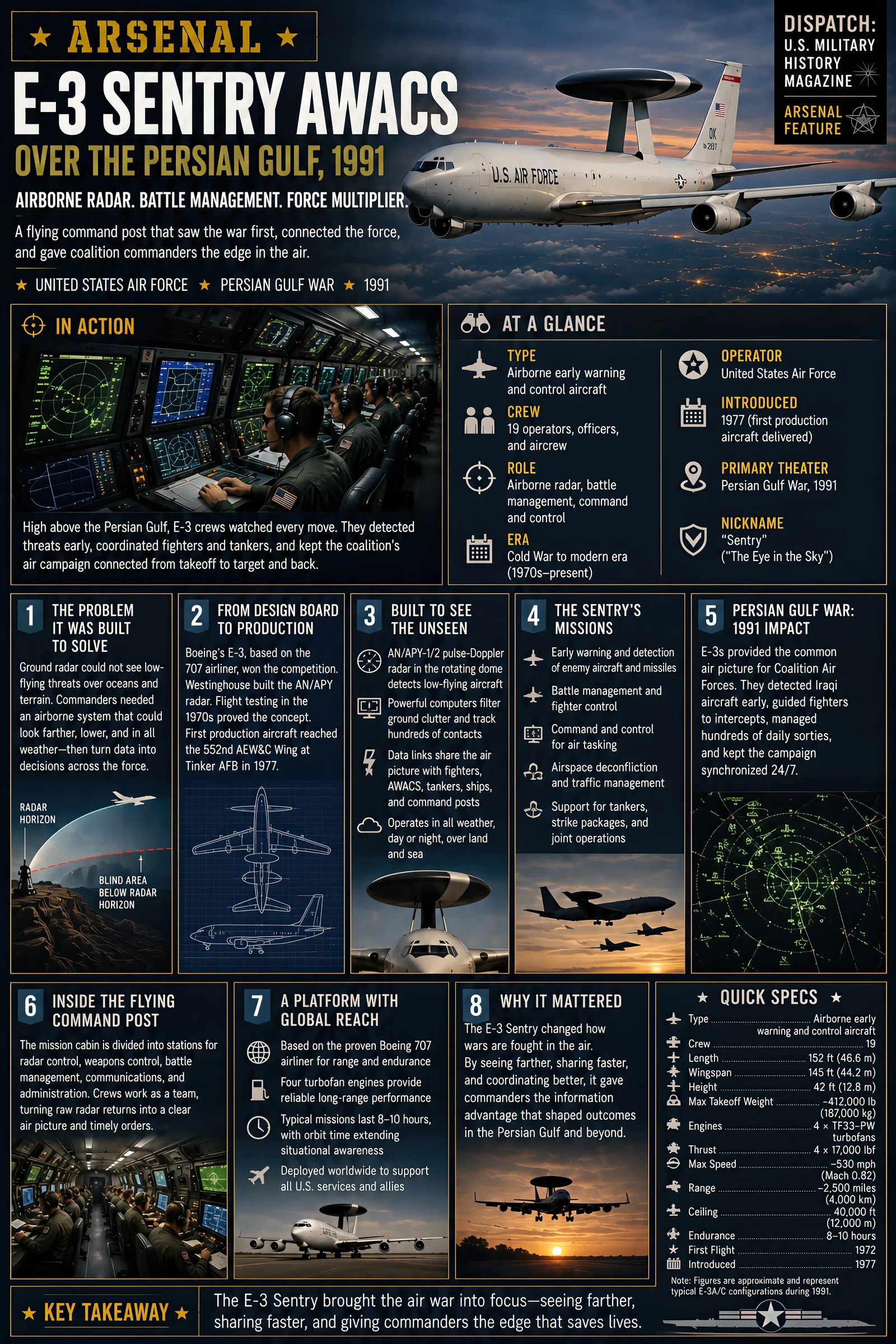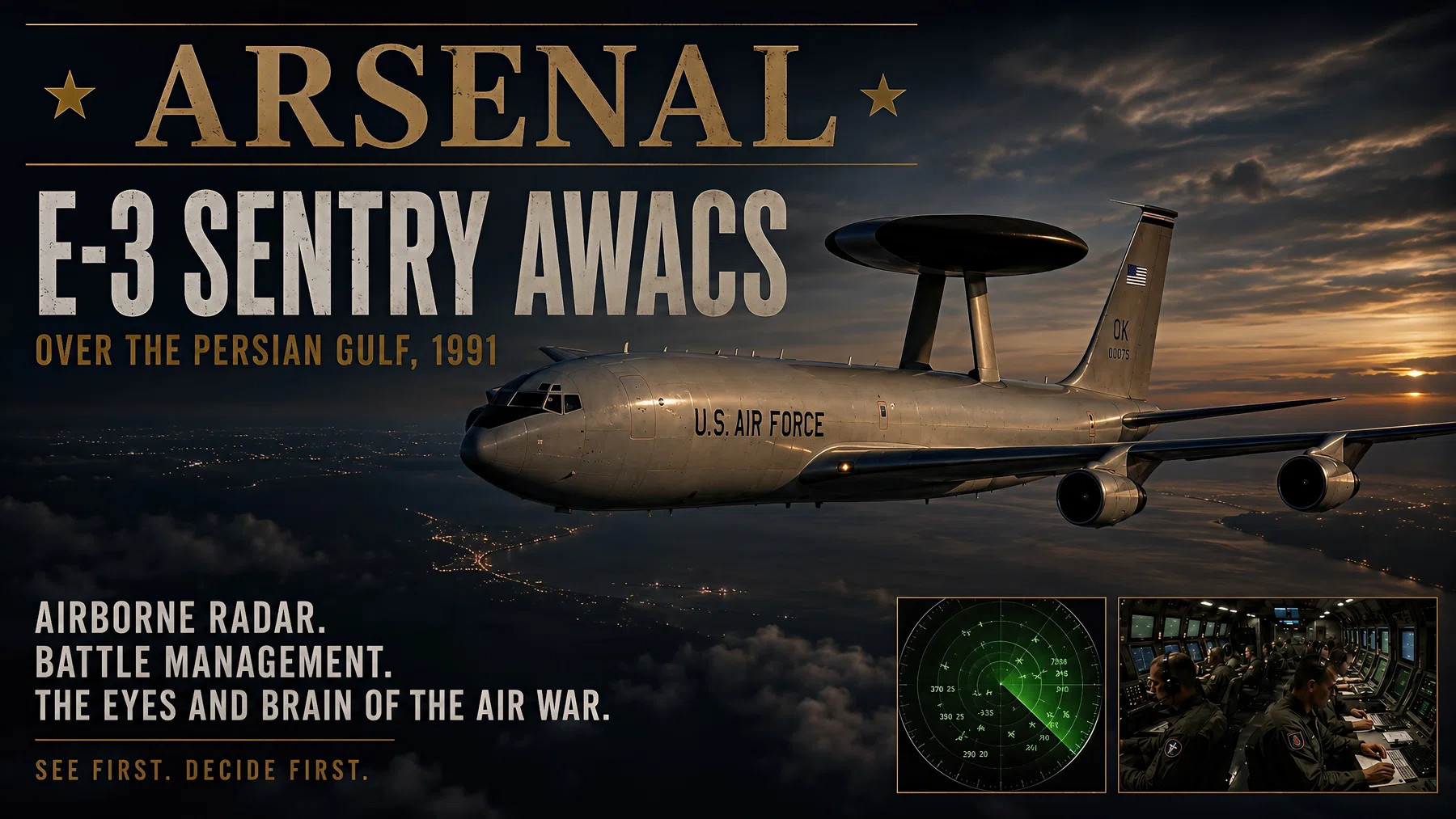
In Action
Night over the Persian Gulf, early in the air campaign against Iraq. Far above the tanker tracks and strike packages, an E-3 Sentry circles slowly in its orbit, a lone ring of light in the darkness. Inside the windowless cabin, the outside world is reduced to radar symbols and alphanumeric tags marching across green displays. Controllers sit shoulder to shoulder at their consoles, headsets on, hands wrapped around trackballs and switches, speaking in clipped call signs to fighter crews they will never meet.
A spike of returns appears at the edge of the scope, low and fast, pushing out from hostile airspace. One controller zooms in, filtering ground clutter, watching the doppler traces settle into a pattern that says “aircraft, not noise.” Identification friend or foe data flashes negative. Within seconds, the contact is tagged and a pair of coalition fighters is turned toward it on vectors the aircrew cannot see, guided only by the calm voice from the Sentry.
Down below, surface-to-air missile batteries and anti-aircraft guns wait for a glimpse of jet exhaust. Up here, the E-3’s crew is trying to stay one move ahead, watching for pop-up threats, refueling gaps, and lost navigational fixes before they cascade into disaster. The aircraft itself is unarmed, relying on altitude, escorts, and distance from the front to stay alive. Yet in this war, control of the air picture runs through this flying radar picket. This single orbit is only one slice of a much larger story about how airborne early warning reshaped modern air campaigns.
The Problem It Was Built To Solve
The E-3 Sentry grew out of a very specific anxiety: ground-based radar could not see everything commanders needed to see. During the Cold War, both NATO and the Soviet bloc depended on huge radar networks to monitor their borders, but those radars were chained to the curvature of the earth and to terrain. Low-flying bombers or fighters could slip through valleys or approach under the radar horizon, and clutter from hills, cities, and weather made it hard to pick out real threats from noise. In a European crisis, that blind spot at low level could mean enemy aircraft over friendly cities or airbases with little warning time.
At the same time, air warfare was becoming more complex. Long-range surface-to-air missiles, supersonic fighters, and large strike packages meant that simply knowing a vague heading and altitude was not enough. Commanders needed a single, coherent air picture that could be shared with fighters, interceptors, and ground defenses in real time. Earlier attempts at airborne warning platforms had shown the concept worked, but they were limited by older radar technology, aging airframes, and cramped crew spaces.
The United States wanted something more: an aircraft that could climb above weather, orbit for hours, and look far beyond the line of sight of any radar on the ground. It had to detect low-flying intruders, sort friend from foe in crowded skies, and serve as an airborne command post coordinating fighters, tankers, and support aircraft. It also had to integrate into NATO defenses, providing a shared shield over Western Europe. Those requirements drove the decision to build a new airborne early warning and control system, not just another radar on an existing aircraft. The result would be the E-3 Sentry: a modified jetliner carrying an unmistakable rotating radar dome and a cabin filled with consoles, radios, and the people who would turn dots on a screen into decisions in the air.
From Design Board To Production
The Sentry’s story begins in the early nineteen sixties, when the United States set out to replace its piston-engined EC-121 Warning Star with something that could see low-flying threats over land instead of just high bombers over the ocean. Pulse-Doppler radar, new computers, and data links promised that an airborne radar could finally “look down” into ground clutter and still pick out moving aircraft, but turning that into a working system meant marrying a powerful new radar to a reliable jet airframe and keeping both running for long hours at altitude., Douglas, and Lockheed all offered concepts; ’s proposal, based on the 707 airliner with a large rotating radar dome on top, eventually emerged as the best balance of space, endurance, and growth potential.
Once the basic approach was set, the radar competition chose Westinghouse’s design, which became the AN/APY-1 and later AN/APY-2 pulse-Doppler radars housed inside the distinctive dome. Full-scale development was approved in the early nineteen seventies, and prototypes began flying with the new radar and mission systems mid-decade. Engineering and evaluation flights refined everything from dome aerodynamics to operator consoles, while software teams taught the computers how to turn raw radar sweeps into tracks controllers could actually manage. By March nineteen seventy seven the first production E-3 reached the 552nd Airborne Warning and Control Wing at Tinker Base in Oklahoma, with more aircraft following into the early nineteen eighties.
At a glance, the E-3 Sentry is an American airborne early warning and control aircraft based on the 707 airliner, flown mainly by the United States and NATO, usually with a crew of roughly seventeen to twenty five split between a four-person flight deck and a larger mission crew. In broad terms it cruises at around five hundred miles per hour at high altitude, can stay on station for eight hours or more without refueling and far longer with tanker support, and its rotating radar dome can search hundreds of miles around the aircraft for targets at multiple altitudes while feeding that picture to other forces by radio and data link.
Production ran from the late nineteen seventies into the early nineteen nineties, with a total of sixty-eight aircraft built for the United States and its allies. The United States took the largest share, followed by NATO’s multinational E-3A Component in Europe and national fleets for the United Kingdom, France, and Saudi Arabia, with later transfers taking ex-Royal aircraft into Chilean service. Each customer made slightly different choices about engines, radios, and later upgrades, but all shared the same basic combination of a proven commercial jetliner and a powerful airborne radar and command system. By the time coalition aircraft flew into the Persian Gulf in nineteen ninety one, the Sentry was a mature platform whose long development arc had been driven by Cold War worries but would prove itself in very real shooting wars.
Inside The Weapon
Seen from the outside, the E-3 looks like a slightly ungainly airliner with a giant hat. The modified 707 airframe carries a thirty-foot-diameter radar dome mounted on two struts above the fuselage, the disc rotating once every ten seconds to sweep the radar beam through a full circle. That dome contains the primary radar and associated antennas, cooled and powered by systems that draw on uprated hydraulics and bleed air from the engines. Beneath it, the airframe gains strengthening, extra wiring, refueling gear, and other fixtures needed to support long missions far from home bases, but the basic lines of the 707 remain clear to anyone familiar with classic jetliners.
Inside, the transition from airliner to airborne command post is complete. The forward cabin houses the flight deck, where a crew of four handles the business of flying: aircraft commander, copilot, navigator, and flight engineer. Behind a bulkhead, the main mission cabin begins: rows of radar, identification, and weapons control consoles running along the length of the fuselage, each with its own screen, keyboard, and communications panel. A typical mission crew includes surveillance operators who build and maintain the air picture, identification specialists who decide whether a track is friendly, neutral, or hostile, weapons controllers who talk directly to fighters and other aircraft, and a mission crew commander who coordinates the whole airborne team with the air operations center on the ground.
Every console is tied into the central computers and the AN/APY radar, which is designed to filter out ground returns and highlight moving targets even when they are flying low over cluttered terrain or over the sea. Identification friend or foe transponders, passive electronic support measures, and data links add extra layers of information, allowing operators to see not just where something is, but what it probably is and who may control it. One of the defining features of the E-3 is that these systems are not just sensors but also communications hubs: the aircraft can pass its synthesized picture to fighters, tankers, and command centers, and receive updates in return, making it a node in a network rather than a one-way radar truck.
Life on board is a mix of long stretches of quiet scanning and bursts of intense coordination. The cabin is windowless, lit by instrument glow and small task lamps, with constant background noise from avionics, air conditioning, and the low rumble of the engines. Crew members rotate through stations, grab quick meals from the galley, and stretch in narrow aisles while the mission continues around them. Training tells each operator how their particular console fits into the bigger picture, but it is during complex air campaigns, when dozens of friendly aircraft crowd the scopes and potential threats creep along the edges, that the teamwork really matters. In those moments, the E-3 is less a machine and more a flying operations room, where technology gives the crews reach and persistence, but human judgment ultimately decides which track becomes a priority call to a fighter pilot somewhere in the dark.
Baptism Of Fire
For all its Cold War origins, the E-3 Sentry’s defining trial came over the deserts of Iraq and Kuwait in 1991. Coalition planners needed to orchestrate hundreds of sorties a day, from strike packages and escorts to tankers, jammers, and rescue aircraft, all while watching for Iraqi fighters and surface-to-air missiles. Ground-based radar alone could not knit that moving puzzle together. The Sentry’s orbits over Saudi Arabia and the Gulf became the invisible scaffolding of the air campaign, the place where the scattered pieces of the sky were pulled into a single, shared picture.
On the first nights of the war, when strike packages swept in to hit airfields, command bunkers, and radar sites, E-3 crews watched Iraqi fighters lifting off and pointed coalition interceptors toward them before most could threaten the strikers. Controllers assigned call signs, set up kill boxes, and helped keep different national contingents from colliding in the dark. When Iraqi pilots tried to flee to Iran, Sentry crews saw their tracks angling away from the fight and quietly flagged them so fighters would not waste time and fuel chasing aircraft that were no longer part of the threat.
The Sentry’s reach proved just as important in the quieter but deadly work of protecting tankers and support aircraft. Refueling tracks sat well away from hostile airspace, but a lucky long-range fighter or a wandering intruder could still cause havoc if it reached those lumbering targets. E-3 controllers kept a constant watch on the approaches, adjusting orbits when threats crept too close, and rerouting traffic when weather or airspace restrictions pinched the flow. The crews in the mission cabin might never feel the shock of a missile launch, but every vector they gave and every warning they passed carried consequences downrange.
Later conflicts reinforced that role. Over the Balkans, Afghanistan, and Iraq again in the early twenty-first century, the Sentry acted as a referee in crowded skies where fighter patrols, drones, transports, and civilian air traffic shared thin slices of airspace. In some cases, controllers helped deconflict tense intercepts before they turned deadly, or coordinated quick reactions when a search and rescue mission suddenly had to thread its way through bad weather and hostile fire. Each campaign added new procedures and new software to the E-3’s consoles, but the core lesson remained the same: battles in the air are won and lost not just by the aircraft that fire weapons, but by the aircraft that see and decide first.
Strengths And Weaknesses
Ask crews and commanders what they value most about the E-3, and the answers tend to cluster around three words: reach, clarity, and control. The Sentry can stand back from the front line and still see deep into hostile airspace, spotting threats that ground radar might miss or see too late. Its pulse-Doppler radar and identification systems give controllers a way to sort the chaos of a modern air war into a manageable picture, while its radios and data links let that picture flow to fighters, tankers, and ground command centers. In the best cases, that means a fighter pilot hears a calm voice call out a threat vector with plenty of time to react, instead of a rushed warning when danger is already close.
The aircraft’s limitations are just as real. Physically, it is a large, unarmed jet that depends on altitude, distance, and escorts for protection. An opponent with long-range missiles or fighters that can reach its orbit can force it farther back, shrinking radar coverage and making life harder for friendly forces. Technically, the E-3’s avionics and radar have needed repeated upgrades to keep up with cluttered environments, low-observable aircraft, and new forms of electronic interference. Maintaining a fleet of aging airframes derived from a commercial jetliner designed decades ago also brings high support costs and availability challenges.
From the enemy perspective, the Sentry is both a prize target and a shaping presence. Adversaries know that degrading or even just pushing back the E-3’s orbits can complicate coalition operations, and they study ways to jam or deceive airborne warning systems. At the same time, many pilots and planners on the other side of the radar beam have come to respect what an integrated airborne early warning and control system can do, and some nations have invested in their own counterparts as a result. The comparison with ground-based networks or smaller, less capable platforms often comes down to resilience and flexibility. The E-3 is not perfect, but it offers a moving, adaptable vantage point in a world where fixed sites are increasingly vulnerable.
Variants And Evolution
Over its service life, the Sentry has been less a fixed design and more a rolling set of upgrades wrapped around the same basic airframe and radar dome. Early United States aircraft evolved from initial configurations into improved blocks with better computers, enhanced identification systems, and more capable data links. NATO and national fleets in Europe and the Middle East adopted similar baseline airframes but tailored mission systems to their own communication standards and defense networks. In each case, the essential idea stayed constant: a rotating radar feeding consoles staffed by human controllers, but the tools at those consoles grew more sophisticated with each software and hardware refresh.
Combat experience and peacetime patrols pushed that evolution forward. Operations over land with complex terrain drove improvements in how the radar handled clutter and low-flying targets. The rise of datalink-equipped fighters and command centers encouraged upgrades that allowed more of the air picture to move digitally instead of by voice alone. Later in its life, the E-3 faced new pressures from stealthier aircraft, cruise missiles, and the sheer volume of objects in the sky, from drones to civilian traffic, nudging designers toward more advanced processing and integration with other sensors. At the same time, s began to explore successor concepts, such as placing similar mission systems on more modern airframes or using different radar technologies, but those newer platforms still follow the trail the Sentry helped blaze.
Export customers and partners added their own twists. Some fleets emphasized national command and control roles, using the E-3 as a flying air operations center during regional crises. Others focused on homeland air defense, integrating the Sentry with ground-based fighters and missile batteries to guard specific corridors and strategic sites. Across all of these variations, the aircraft’s shape and core purpose remained recognizable even as antennas sprouted, consoles changed, and software rewrote what the crew could see on their screens.
Legacy And Where To See It Today
The E-3 Sentry’s legacy is not confined to the sight of a jetliner with a disc on its back. Its deeper influence lies in how militaries think about the air domain. Before platforms like the Sentry became common, air defense and offensive air operations often relied on separate chains of command and patchwork radar coverage. The E-3 helped normalize the idea that a single airborne node could pull in data from sensors, distribute a coherent picture, and directly influence the timing and route of individual aircraft in real time. That concept underpins many of today’s command and control ideas, from newer airborne platforms to ground-based centers that expect constant feeds from multiple sources.
In the decades since its introduction, the Sentry has become part of the background of many operations, a familiar call sign rather than a headline machine. Yet its presence has shaped outcomes in ways that are easy to overlook. Safer refueling tracks, cleaner separation between friendly flights, early warnings that prevent ambushes, and rapid coordination when something goes wrong all trace back to the kind of persistent, airborne oversight that the E-3 provides. As s modernize, some fleets are moving toward newer aircraft that promise more efficient engines, smaller crews, or different radar technologies, but those successors inherit the mission pattern that Sentry crews refined in practice.
For enthusiasts, veterans, and students of air power, surviving E-3s are gradually making their way from front-line units to storage and eventual museum display. Some remain in active service, still flying long, quiet orbits over training ranges and operational theaters. Others sit at airfields where they once operated, used for training on the ground or waiting to be preserved. Photography and video from exercises and deployments, including material highlighted through Trackpads and Dispatch, capture these aircraft in their working environment: turning gently above the horizon while the battles and patrols they support play out beyond the camera’s frame. Behind every one of those images are the crews whose judgment turned radar traces into life-and-death decisions for pilots and ground forces below.