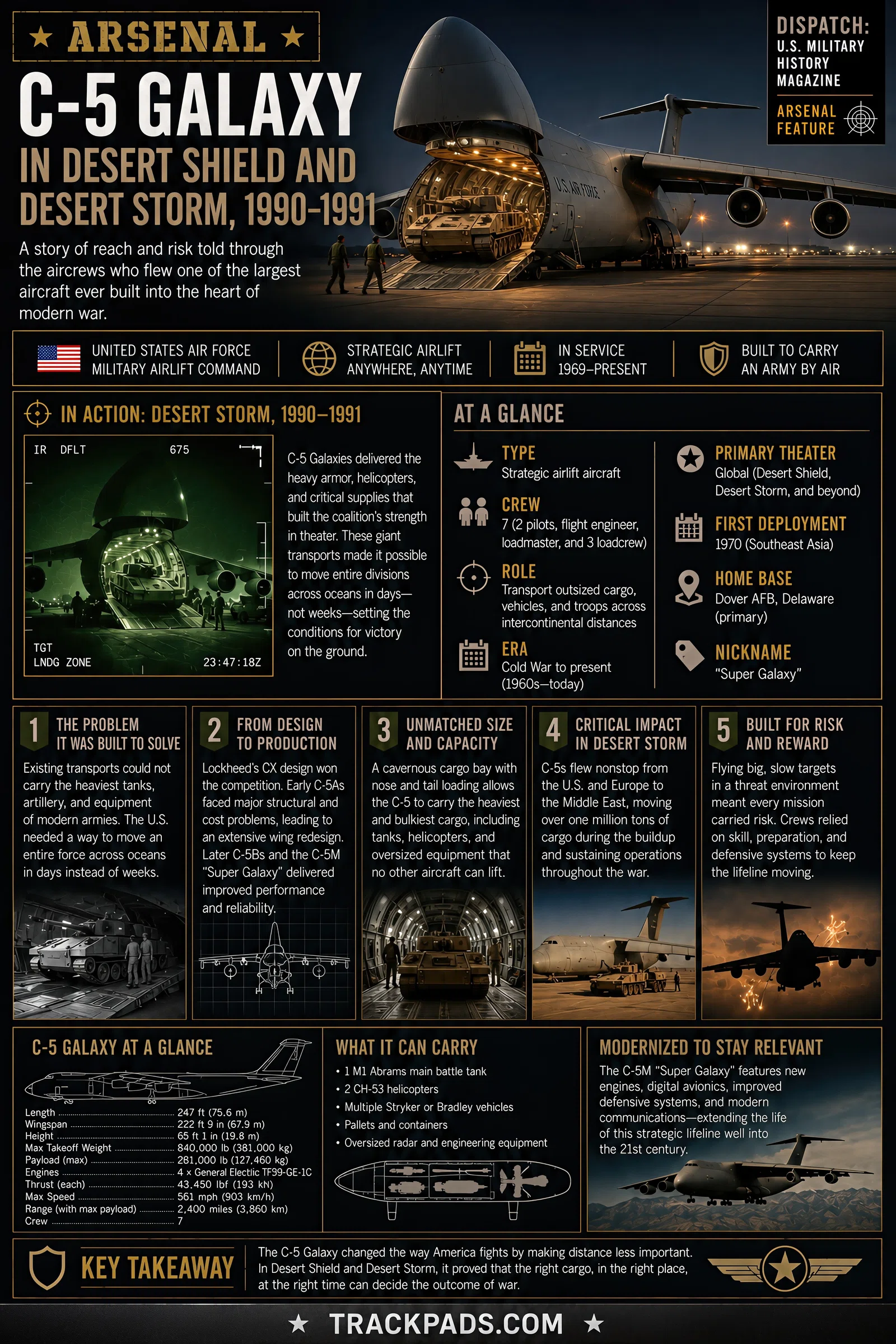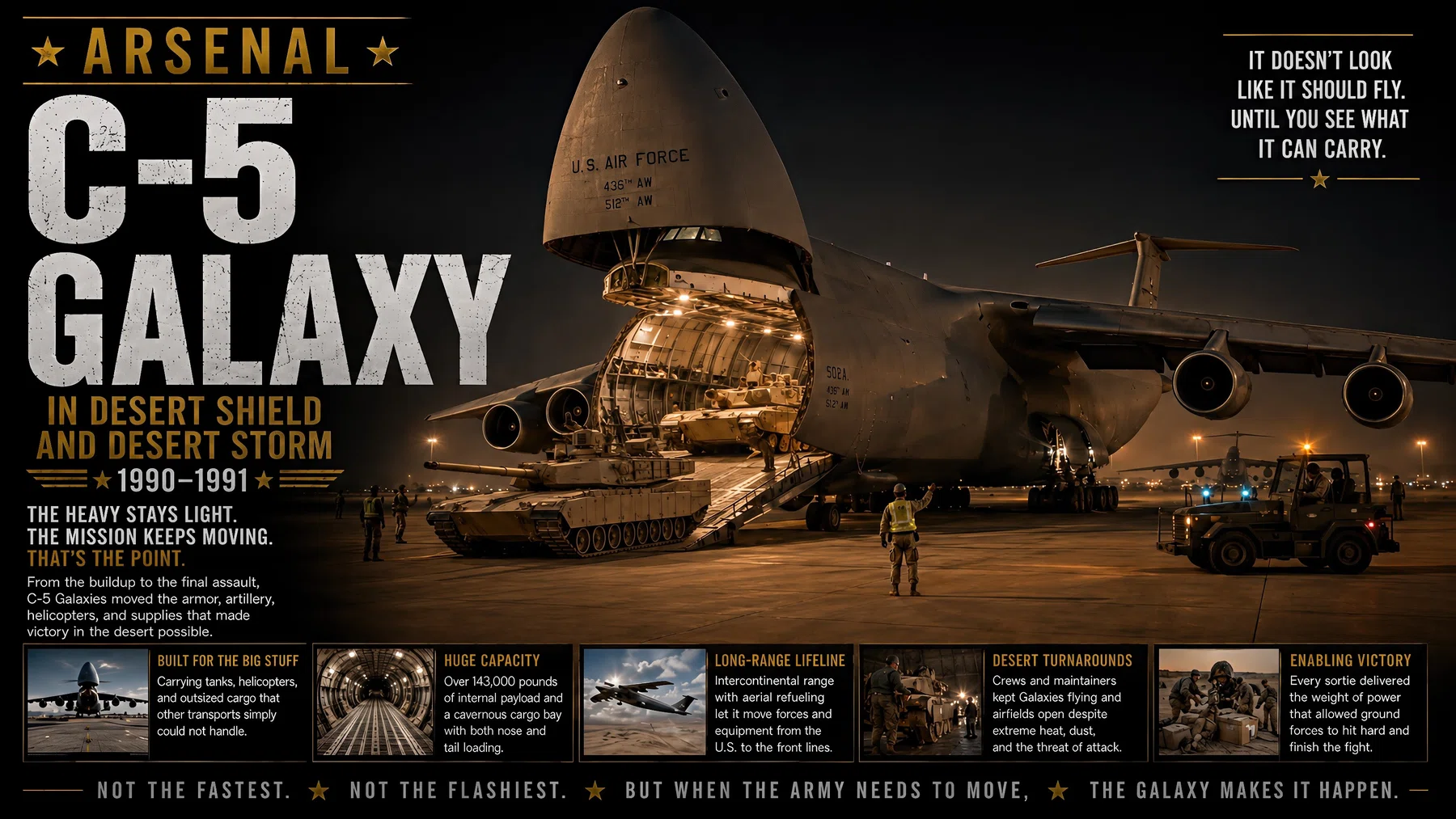
In Action
The ramp at Dhahran glows under sodium lights as another sand-laced night falls over Saudi Arabia. A C-5 Galaxy, its gray fuselage looming higher than the control tower roofline, turns off the taxiway and seems to blot out the stars. Ground crews in reflective vests jog toward it, dwarfed by landing gear taller than a house. The aircraft’s four engines wind down with a metallic whine while the heat of the desert rolls through the open cargo doors.
Inside, the air is thick with hydraulic smell and dust. Combat vehicles and pallets of ammunition sit chained to the cargo deck, paint still fresh on some, others scarred from previous wars. Loadmasters unhook tie-downs with practiced movements, shouting over the rumble of auxiliary power units. They know the clock is running. Higher headquarters wants another turnaround tonight, another lift of tanks, helicopters, and spare parts pushed forward before enemy missiles or raids can disrupt the flow.
Outside the perimeter, the ground war is still days away, but the airlift war has been raging for months. The C-5s are doing what ships and trains cannot: moving heavy armor, outsized radar systems, and the bulk of a mechanized army across oceans in days instead of weeks. Every landing in theater carries the same tension. If a Galaxy blows a tire, if a hydraulic line fails, if a Scud lands close to the airfield, the entire schedule ripples. For the crews of these giant aircraft, this night is one link in a much longer chain, forged decades earlier when the United States set out to build a machine that could carry a modern army on its back.
The Problem It Was Built To Solve
The C-5 Galaxy was born from a strategic headache. By the early 1960s, the United States found itself committed to a truly global posture, with treaty obligations, overseas bases, and the possibility of large conventional wars far from home. Moving people by air was straightforward. Moving the heavy machinery of modern warfare was not. Existing transports like the C-124 and the newer C-141 could carry many troops and light vehicles quickly, but they struggled with the largest and heaviest pieces of equipment that defined postwar armies.
Main battle tanks, self-propelled artillery, long-span bridging gear, and oversized radar systems all posed the same problem. They were too tall, too long, or too heavy for most aircraft, and shipping them by sea took weeks. In any future crisis, the United States might have to reinforce Europe, rush support to Asia, or respond to an unexpected flashpoint in the Middle East. Waiting for ships to cross the Atlantic or Pacific could mean arriving after the decisive phase was already over. Senior commanders worried that they could win the air battle and still lose the campaign because the right equipment was stuck on the water.
At the same time, nuclear strategy was shifting. Flexible response and the need to fight limited conventional wars demanded rapid reinforcement options that did not rely solely on nuclear threats. The United States Air Force, and specifically its Military Airlift Command, needed an aircraft that could swallow the heaviest armored vehicles, fly them intercontinental with aerial refueling if necessary, and operate from airfields that were not perfect peacetime showpieces. That meant enormous payload, long range, and the ability to load and unload quickly from both nose and tail.
The result was a requirement for a truly outsized transport, larger than anything then flying. It would have to bridge the gap between the flexibility of airlift and the capacity of sealift, giving political leaders a way to move a credible conventional force at strategic distances in a matter of days. From that demanding wish list, the C-5 Galaxy began to take shape on drawing boards and wind tunnel models, long before it cast its shadow over desert tarmacs during Desert Shield and Desert Storm.
From Design Board To Production
The Galaxy’s story moves from abstract requirement to metal in the early 1960s, when planners put numbers to their logistics headache. Under the “CX” heavy logistics studies, the United States Air Force called for an aircraft that could haul outsized Army equipment across oceans, land on reasonably long runways, and do it at jet speeds. Several big names in American aviation responded with designs, including and Lockheed, each wrestling with the same tradeoffs: how big a wing, how tall a tail, how much structure it would take to lift a small freight train into the sky. The Army wanted a cargo box big enough for its heaviest armor and engineering gear, and that single demand drove much of the shape that followed.
Lockheed’s winning proposal wrapped a cavernous cargo bay in a high-wing, four-engine layout and added both nose and tail loading to speed turnarounds. As the design hardened into the C-5A, those earlier paper trades turned into painful realities: weight creep, wing strength concerns, and major cost overruns that drew congressional scrutiny. Fixes to the wing structure and load-alleviation systems restored the aircraft’s intended payload and service life, but only after a long, expensive re-winging program on early airframes. The later C-5B batch incorporated many of these improvements on the production line, while the modern C-5M “Super Galaxy” added new engines and avionics to keep the fleet relevant into the twenty-first century.
At a glance, the C-5 is a United States strategic airlifter, designed by Lockheed for the United States Air Force in the late Cold War, crewed by a flight deck team and a handful of loadmasters, and optimized less for speed than for reach and sheer volume. It can carry dozens of standard cargo pallets or multiple main battle tanks and helicopters in a single lift, then refuel in the air to push that load across continents. Across several production blocks, more than one hundred thirty C-5s were built, enough to anchor the nation’s heavy airlift force for decades. By the time Galaxies were streaming into the Gulf in 1990, they represented not just a single aircraft type, but the accumulated lessons of twenty years of design fixes, production restarts, and modernization decisions aimed at solving the same core problem: how to put the weight of a modern army wherever national strategy demanded it, fast.
Inside The Weapon
Seen from the ramp, a C-5 Galaxy looks less like an airplane and more like a mobile building. A high wing spans more than two hundred feet, with four turbofan engines slung out on pylons and a tall T-tail towering above the fuselage. The landing gear forest beneath the belly spreads twenty-eight wheels across multiple bogies, giving the aircraft enough footprint to operate from long but not perfect runways. On the ground, those gear can “kneel,” lowering the whole aircraft so that its cargo deck lines up with truck beds and low loaders. Up front, the nose can hinge upward to reveal a wide, unobstructed loading opening, while a second set of doors and ramps at the tail turns the cargo deck into a drive-through tunnel for vehicles.
Inside, the main cargo bay feels like a steel cathedral: over one hundred feet long, high enough to walk atop some vehicles, and wide enough to carry tanks, helicopters, and palletized cargo in combinations that would never fit in smaller transports. Floor tie-downs, rollers, and built-in ramps let loadmasters secure anything from engineering equipment to attack helicopters, sometimes stacking missions so that vehicles roll on and off while pallets slide past them. In practice, that means a single Galaxy can move the sort of heavy armor or bridging units that would otherwise demand an entire ship’s worth of deck space.
Above the cargo deck sits the upper deck, with the flight deck forward and troop seating aft. Here the aircraft feels more familiar: a multi-crew cockpit with pilot, copilot, and flight engineer facing an array of instruments, later updated to glass displays and modern navigation systems in upgraded aircraft. Behind them, rows of rear-facing troop seats allow units to fly with at least a slice of their equipment, while loadmasters move between decks to coordinate loading, weight and balance, and cargo checks in flight. Intercom panels, headsets, and hand signals support a constant flow of information as they manage the complex choreography of loading, unloading, and securing heavy gear.
For the crews, life inside a C-5 is a mix of routine systems management and moments of very real tension. On exercise days at home bases, checklists and training flights dominate, with maintenance teams using built-in diagnostic systems to chase down faults. On deployment, the same cavernous interior becomes a temporary home and workplace stretched across time zones, with crews catching sleep in bunks, doing walk-arounds in blowing sand or freezing rain, and working with ground units to solve last-minute loading puzzles. Veterans often talk about the aircraft’s quirks—its appetite for fuel, the complexity of its systems, the way even a minor maintenance delay can ripple across an entire airlift schedule—but they also remember what it made possible: rolling out of a distant sky with exactly the heavy equipment a supported unit needed, at the moment it mattered.
Baptism Of Fire
By the time that C-5 Galaxy eases its way onto the ramp at Dhahran in late 1990, the aircraft is no longer new, but the scale of the mission in Desert Shield and Desert Storm stretches even this giant. The task is simple to describe and hard to execute: move the heavy backbone of an armored force from the continental United States to the Arabian Peninsula fast enough to deter an Iraqi advance and then support a coalition offensive. Galaxies shuttle between home bases and forward hubs, stacking time zones and crew duty days as they bring in main battle tanks, attack helicopters, air defense batteries, and the support equipment that keeps them running. On arrival, crews often step straight from the cockpit into chemical-defense drills or Scud missile alerts, reminded that their airlift corridor ends inside an active war zone, not a tidy peacetime exercise.
One typical sequence begins at a stateside base where a heavy battalion is marshaling for deployment. Loadmasters work with Army movement officers to decide which vehicles go first, which can be broken down into components, and how to fit as much combat power as possible into each sortie without exceeding weight and balance limits. Tanks and heavy trucks rumble up the tail ramp, while pallets of ammunition and spare parts slide in along the sides. Hours later the C-5 rotates into the night, climbing slowly but relentlessly toward cruise altitude, its cargo bay packed with the tools of ground combat. Aerial refueling en route, or a stop at an intermediate base, extends its reach so that when the nose gear touches down in Saudi Arabia, the armor inside has crossed an ocean in less time than a ship needs to clear its departure channel.
In theater, the Galaxy’s size becomes both asset and liability. Its ability to move outsized loads means fewer total sorties for a given unit, compressing the timeline to build up a credible ground force and reassuring local partners that reinforcements are not just promised but physically arriving. At the same time, its demand for long, strong runways and ample ramp space concentrates operations at a handful of major fields, making them attractive targets for missiles and air raids. When Scud alerts sound, aircrews and ground staff take cover while their aircraft sit exposed, huge and unmistakable against the desert. Every successful landing, offload, and departure is a quiet victory. Over weeks and months, the cumulative effect is visible on any map of the theater: armored brigades standing where there were none before, air defense radars watching where only bare sand once lay, all made possible by repeated arrivals of a machine built precisely for that kind of strategic lift under pressure.
Strengths And Weaknesses
Ask crews and commanders what they value most in the C-5 and the first answer is almost always capacity. A single Galaxy can do the work of multiple smaller transports, moving a complete package of heavy vehicles, support gear, and personnel in one movement instead of several. Its nose and tail doors, combined with kneeling landing gear, make it unusually efficient on the ground. Vehicles can drive straight through from one end to the other, and pallets can be arranged in flexible patterns, reducing the time that a loaded aircraft sits still on a vulnerable ramp. Long range, especially when paired with aerial refueling, allows planners to design routes that balance speed with political and airspace constraints, giving national leaders visible options during crises.
Those strengths come with costs that are very real to the people who fly and maintain the aircraft. The C-5 is complex and maintenance-intensive. Its systems occupy a generation of technology that preceded the more compact avionics and diagnostics found in later designs, so keeping it in fighting trim demands deep technical expertise, plentiful spare parts, and time. Early models in particular earned a reputation for reliability challenges, with aircrews well aware that a single delayed part or minor system fault could hold up not just their aircraft but the entire flow of a deployment. Its size also restricts where it can operate. Shorter, rougher runways that might be acceptable for smaller transports are off limits, forcing the Galaxy to rely on major airfields that may be politically sensitive or militarily exposed.
Enemy planners, watching this pattern, quickly learn to read the Galaxy’s presence as a strategic signal. The arrival of multiple C-5s at a regional hub suggests more than just routine rotation; it hints at armored divisions and heavy brigades on the way. That makes the aircraft themselves, and the bases they use, tempting targets for missiles, sabotage, or air attack. Compared to smaller transports that can disperse to many locations, the C-5 concentrates risk along with capability. Later aircraft like the C-17 would try to blend some of the Galaxy’s outsized capacity with more flexible airfield performance, but they do not erase the essential tradeoff. The C-5 remains a specialist: unmatched when there is a need to move very heavy equipment quickly, less adaptable when planners must balance lift against stealth and dispersal.
Variants And Evolution
Over its service life, the C-5 family evolves through several distinct variants, each one shaped by hard experience and changing technology. The original C-5A fleet introduces the basic concept at scale: a huge high-wing transport with both nose and tail loading, designed primarily for intercontinental movement of outsized cargo. As those early aircraft accumulate hours, structural and systems issues emerge, most notably in the wing. Addressing those concerns leads to redesigns and a major re-winging effort, one of the first signs that this aircraft will require sustained investment if it is to remain viable across decades of heavy work.
The C-5B batch follows with improved structure, updated systems, and refinements driven by lessons from both peacetime operations and crises. These later aircraft benefit from better understanding of actual load patterns, mission profiles, and maintenance realities. In practice, that means changes that are invisible to casual observers but important to crews: more reliable components, tweaks to the cargo handling system, and avionics updates that reduce workload on long flights. A small number of C-5C aircraft are modified to support space and test payloads, with the cargo compartment adapted to carry large, delicate items that would never fit in conventional transports. This niche role underlines how the Galaxy’s raw volume makes it attractive far beyond purely military tasks.
The most visible evolution arrives with the C-5M “Super Galaxy,” which combines structural upgrades with modern engines and advanced avionics. New powerplants deliver better fuel efficiency, shorter takeoff distances, and improved climb performance, extending the aircraft’s practical reach and giving planners more flexibility in selecting routes and airfields. Cockpit modernization brings glass displays, enhanced navigation and communication systems, and better diagnostic tools, easing crew workload and improving reliability tracking. Across the fleet, defensive systems, communication suites, and mission equipment are quietly updated to keep pace with changing threats and interoperability demands. Through these iterations, the core idea remains the same: a very large aircraft dedicated to strategic airlift of the heaviest cargo, continuously adapted rather than replaced outright as new wars and missions test its design.
Legacy And Where To See It Today
The C-5 Galaxy’s legacy lies in the way it reshaped expectations about what airlift could accomplish in the strategic realm. Before its arrival, the notion of flying complete heavy units across oceans at scale belonged more to planners’ wish lists than to routine capability. With the Galaxy in service, the United States could demonstrate in real crises that it could move heavy armored formations, air defense systems, and critical engineering assets rapidly enough to alter an adversary’s calculations. That visible, repeatable capacity influenced doctrine, alliance politics, and the design of later transports, including aircraft that sought to blend strategic range with better performance from shorter or less prepared runways. The concept of “time-definite” delivery of major combat power became more than a slogan; it had hardware behind it.
Beyond doctrine and planning, the Galaxy has left its mark on generations of aircrew and ground personnel who built their careers around this giant. Pilots recall the challenge of handling an aircraft of such size in bad weather and at unfamiliar airfields. Loadmasters remember the puzzle-solving joy and stress of fitting odd combinations of vehicles and cargo into a finite space under time pressure. Maintainers carry stories of late-night repairs in harsh climates, knowing that each successful fix kept the broader flow of a campaign intact. For soldiers, sailors, airmen, and marines on the receiving end, the sight of a C-5 on the horizon often meant that the heavy tools they needed to fight or build were finally on the way.
Today, retired Galaxy airframes stand at air mobility museums and on display at major airlift bases in the United States, where visitors can walk up to the ramp and appreciate just how large the aircraft really is. In some locations, museums open the cargo bay for tours, turning the empty deck into a teaching space where docents explain how tanks, helicopters, and pallets once filled the area. Operational aircraft continue to appear in news footage and personal photos from deployments, humanitarian missions, and exercises, their distinctive profile instantly recognizable. Trackpads and Dispatch can draw on a deep reservoir of imagery and veterans’ stories to bring those machines to life on the page and in audio. The Galaxy’s story also connects naturally to other features, from Beyond the Call accounts where airlift made a critical difference, to Living History conversations with crew members who spent their careers guiding this giant across the globe. However we tell it, the C-5’s legacy reminds us that behind every monumental aircraft are people whose lives, and the outcomes of entire campaigns, were shaped by its ability to bear weight and distance together.