In Action
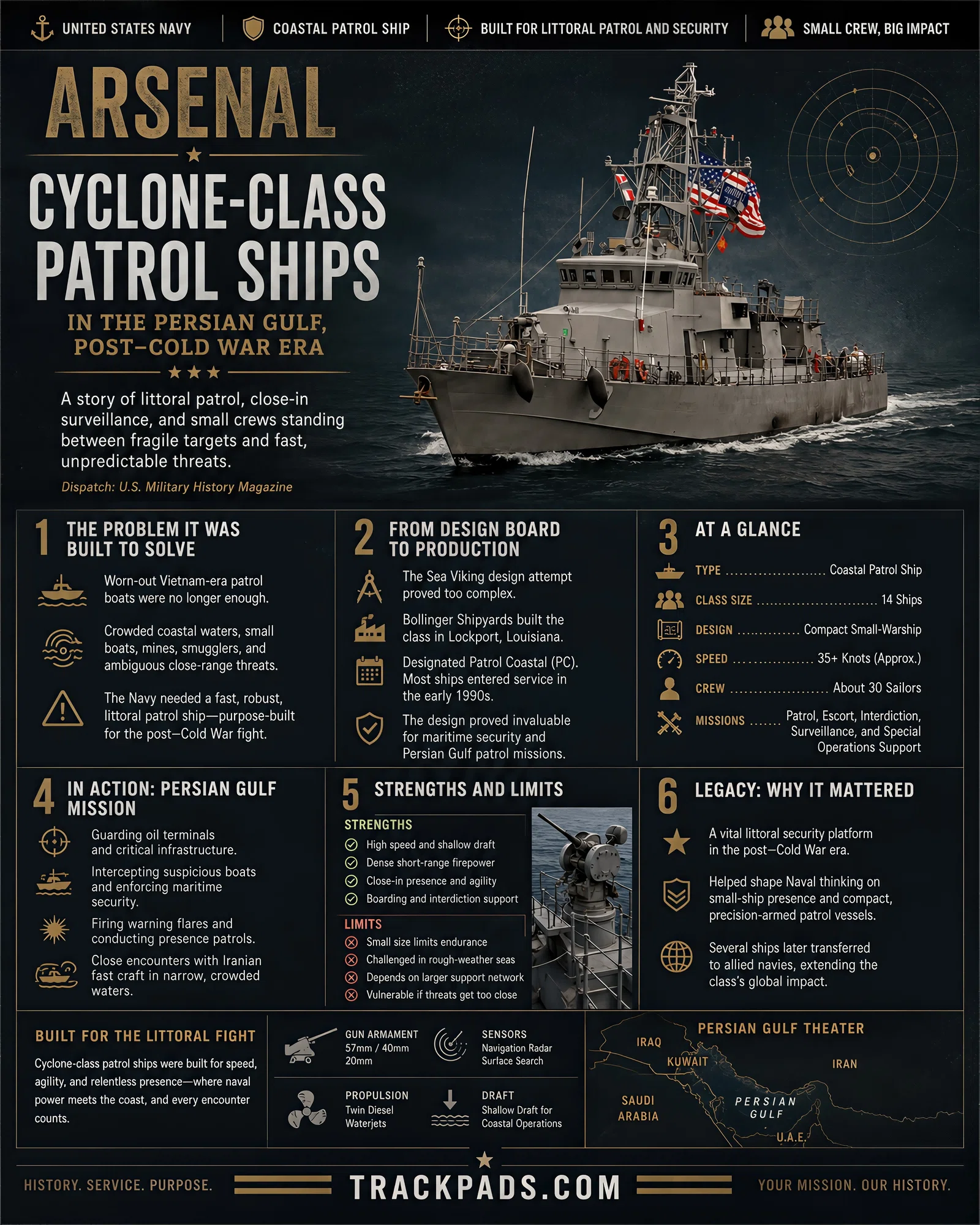
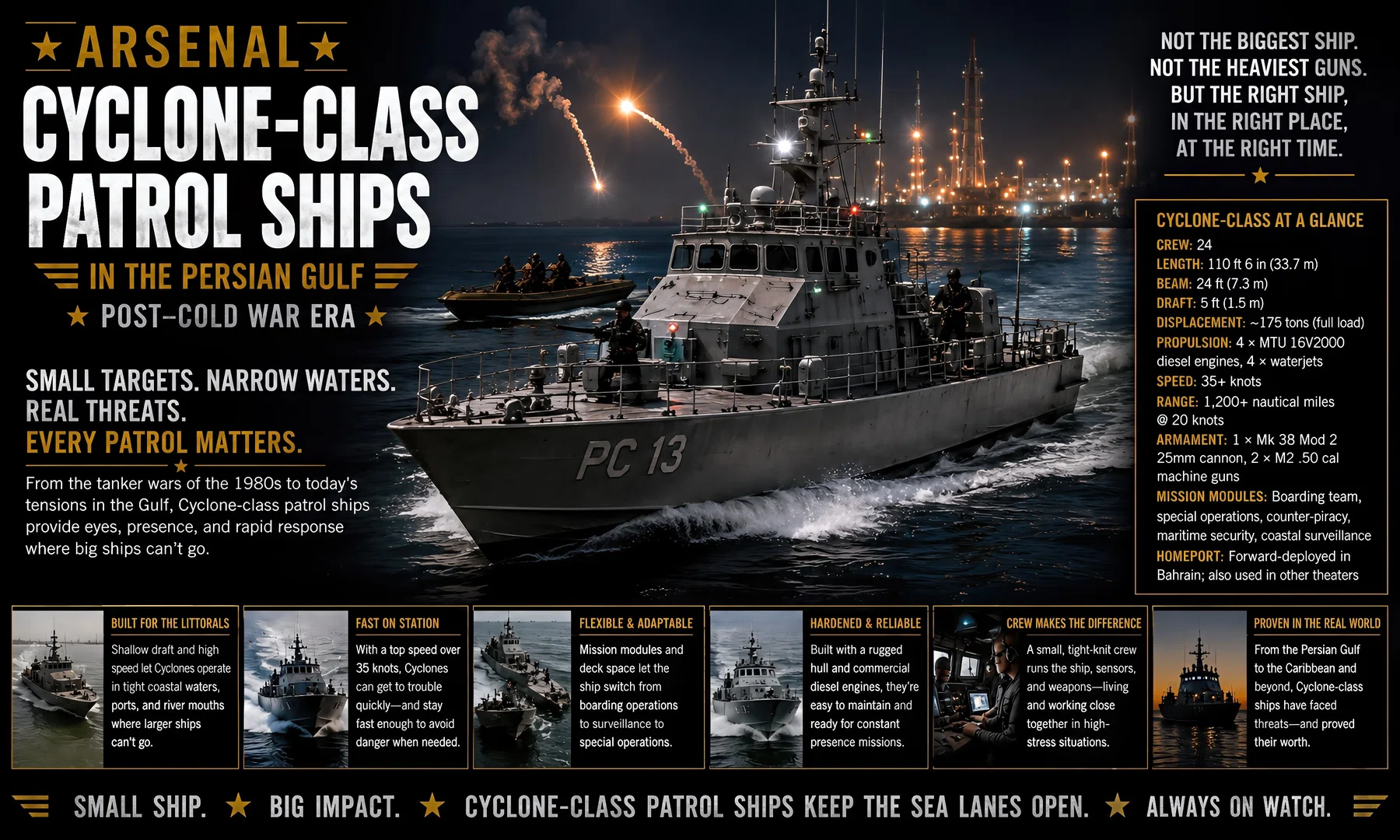
The Northern Persian Gulf is flat calm, but the bridge of the little patrol ship is anything but quiet. It is late August 2016, and a Cyclone-class coastal patrol ship is running a security patrol near the maritime boundaries that separate Kuwait, Iraq, and Iran. Radar is cluttered with tiny returns from fishing dhows and workboats. Out the bridge windows, the night is a smear of running lights and shore glow, with only the white splash of the ship’s bow wave giving a sense of speed.
One contact is different. A low, fast craft has broken out from the Iranian side and is charging across the grain of traffic instead of following it. The officer of the deck watches the range tick down and feels the tension rise with every report. Bridge-to-bridge warnings go out in calm, rehearsed English. A loudhailer message follows, echoing across the water. Flares arc up from the Cyclone’s deck, hissing and throwing harsh white light over dark hull and churning wake.
The message is understood. The fast boat heels away and turns back toward its own coastline, the confrontation ending as abruptly as it began. On the Cyclone, the engines keep their steady rumble and the patrol continues, another tense encounter added to the log. For the crews of these compact ships, this kind of close-range dance with risk is routine. To understand why the Navy built them, and why they spent so much of their service life in these tight, dangerous waters, we have to step back to the problems that emerged after Vietnam and into the late Cold War.
The Problem It Was Built To Solve
By the 1980s, the United States Navy was a blue-water giant. Aircraft carriers, cruisers, and destroyers roamed the oceans, built to face the Soviet fleet on the open sea. But the smaller, messier fights were closer to shore. In Vietnam and in later crises, special operations units and patrol sailors had relied on modest sixty-five-foot patrol boats to move SEALs, watch coastlines, and confront smugglers and gunrunners in shallow water. Those boats were aging, worn out by hard service and never intended to be a permanent answer.
At the same time, the world’s coastal zones were getting more dangerous. The “tanker war” in the Persian Gulf showed how small boats, mines, and improvised attacks could threaten oil traffic and warships in confined waters. In places like the Caribbean and the Arabian Gulf, navies and coast guards faced a constant stream of low-signature targets: fishing dhows that could be smugglers, speedboats that might be harmless or might be carrying weapons or explosives. Large ships could loom over these threats, but they could not react quickly, chase them into shallow channels, or put boarding teams alongside with the same agility as a small craft.
Navy planners also began to rethink strategy around the shoreline. Instead of only projecting power from far offshore, they wanted a force that could live in the littorals, the narrow band of sea where shipping lanes, oil terminals, and coastal cities were most exposed. That shift demanded more than just fighter jets and destroyers. It required fast, maneuverable patrol craft that could work with SEALs and other special operations forces, carrying them close to hostile coasts and then sticking around to provide guns and eyes.
An early attempt at an advanced special operations boat, a high-tech surface-effect craft nicknamed “Sea Viking,” proved too ambitious. It was complex, expensive, and never made it into reliable service. Rather than wait for another experimental design, the Navy decided it needed a simpler, robust coastal patrol ship that could be built quickly and operated hard. The idea was straightforward: a small but seaworthy hull, fast enough to chase or evade, with enough armament and endurance to hold the line in restricted waters.
Out of that requirement emerged what would become the Cyclone-class patrol ship. Intended to replace the Vietnam-era patrol boats and give special operations forces a dedicated platform, it was also meant to fill a widening gap in coastal security, both overseas and eventually close to American shores. The decision to move from concept to a real class of ships would set the stage for three decades of quiet but demanding patrol work in some of the world’s busiest and most volatile sea lanes.
From Design Board To Production
The Cyclone-class story begins with a very specific need: a modern, rugged replacement for the small Vietnam-era patrol boats that had shuttled SEALs to and from hostile shores. In the early 1980s, the Navy tried to jump straight into the future with a high-tech surface-effect craft nicknamed “Sea Viking,” a hover-like design meant to skim over the water at high speed. It proved too complex and fragile for the work ahead, and the prototype was abandoned before it ever joined the fleet. After that disappointment, planners shifted to a more practical approach: take a proven small warship design and adapt it into a purpose-built coastal patrol ship that American yards could build quickly.
The result drew heavily on fast patrol craft already operating with foreign navies, scaled and modified to meet United States Navy standards. Bollinger Shipyards in Louisiana won the job, turning out a compact steel hull with an aluminum superstructure that could survive hard turns and high speeds in rough coastal seas. The new ships were designated Patrol Coastal, or PC, and the first of them, USS Cyclone, was commissioned in the early 1990s. The class was originally envisioned as a sixteen-ship force, but the program was capped at fourteen as it became clear the design sat in an awkward middle ground: larger than SEALs wanted for stealthy insertion, smaller than most surface warfare officers preferred for blue-water work.
Production followed a fast pace for such small ships, with most of the class entering service between 1993 and 1994. They were initially assigned to special warfare support roles on the United States coasts but were quickly drawn into other missions as global demands shifted. A number were loaned to the United States Coast Guard for homeland security, port security, and counter-smuggling work, while others rotated toward forward bases. By the early 2000s, the Navy discovered that what had started as a niche special operations platform had become one of its most useful tools for persistent presence in crowded, politically sensitive coastal waters, especially in the Persian Gulf.
Inside The Weapon
Seen from the pier, a Cyclone-class patrol ship looks like a warship that someone shrunk in the wash. The hull rides low, with a sharp, flared bow and a clean run aft to support high-speed operations in choppy seas. Above that hull, a compact superstructure stacks bridge, operations spaces, and communications masts into a tight package, bristling with antennas and small-caliber weapons. Twin twenty-five millimeter mounts sit fore and aft, while pintle points for machine guns and grenade launchers line the weather decks, giving gunners overlapping arcs around the ship. On some later deployments, small box launchers for short-range missiles add another layer of sting for close-in threats like fast attack craft and small boats.
Walk up the gangway and step onto the narrow main deck, and the scale becomes clear. Passageways are tight, overheads low, and there is very little unused space. Inside the superstructure, the bridge sits high forward, with large windows giving officers of the deck as much visibility as possible in cluttered coastal traffic. A helmsman grips the wheel with one hand and the throttle controls with the other, while the officer of the deck and a quartermaster juggle radar plots, visual bearings, and radio calls. Behind and below the bridge, a compact combat information center gathers radar feeds, navigation data, and communications, allowing watchstanders to track dozens of small contacts and coordinate with larger warships and aircraft offshore.
Further aft, cramped berthing compartments house the crew in stacked racks, often three high, with just enough locker space to keep personal gear out of the way. The mess deck doubles as a lounge, classroom, and planning space, where boarding teams and SEALs pore over charts and intelligence packets before heading out. The engineering spaces pack powerful diesels and reduction gear into a very small footprint, driving propellers that can push the ship from a stop to sprint speed in minutes. Noise, heat, and vibration are constant companions for engineers working below decks, and their efforts keep the ship ready for the sudden accelerations and tight turns that patrol work demands.
On the weather decks, gun crews live within arm’s reach of their weapons. A.50 caliber gunner stands behind an armor shield, harness clipped in, scanning the water for anything that looks wrong: a boat running with unusual speed, a dhow packed oddly low in the water, a sudden wake that does not match local traffic patterns. Nearby, a grenadier tends a forty millimeter automatic launcher, ready to lay down airburst fire if a threat pushes too close. Shoulder-launched surface-to-air missiles are stowed within reach in case a low-flying aircraft or helicopter appears unexpectedly. That concentration of short-range firepower gives the Cyclone-class its bite, allowing a small ship to throw a surprising amount of metal into a close fight.
Crew routines knit all of this machinery together. On an extended patrol, sailors stand frequent watches, often cycling between lookout duty, maintenance, and damage control drills. The small size of the ship means there is little separation between living and working spaces, and everyone quickly becomes familiar with every compartment. Training ashore might talk about neat watch rotations and tidy engineering diagrams, but veterans remember something different: sleepless nights tracking multiple small contacts, sudden calls to man the rails, and the feeling of the hull shuddering as the ship accelerates toward a developing situation. The Cyclone-class is not comfortable or spacious, but it gives its crews what they need most in the littorals: speed, firepower, and enough endurance to stay on station when the situation is tense and the water is crowded.
Baptism Of Fire
For the Cyclone-class, real combat did not arrive in a single dramatic battle but in long months of tense patrols after the invasion of Iraq in 2003. Small coastal patrol ships found themselves at the center of a big strategic problem: how to keep Iraq’s offshore oil terminals, Al Basrah and Khawr al Amaya, safe from mines, suicide boats, and disguised attackers in crowded waters. These terminals were economic lifelines for the new Iraqi state and high-value symbols for insurgents. Cyclone-class ships and their boarding teams were tasked with holding a protective ring around them, intercepting anything that looked even slightly out of place in the Northern Arabian Gulf.
On the night of 24 April 2004 that steady, grinding work turned deadly for USS Firebolt and her crew. While Firebolt was providing security near Khawr al Amaya, her rigid-hull inflatable boat closed on a suspicious dhow that appeared to be heading toward the terminal. As the boarding team drew alongside, the dhow exploded in an apparent suicide attack, capsizing the small craft and killing two sailors and a Coast Guardsman. Their sacrifice prevented the attacking boat from reaching its intended target, and the incident marked one of the starkest reminders of how exposed small patrol craft and their boarding teams could be in this kind of war at arm’s length.
Firebolt’s loss did not end the mission. Other Cyclone-class ships surged forward to maintain the exclusion zone around the terminals, enforcing stand-off distances, escorting tankers, and working alongside coalition units to sift harmless local traffic from those who meant harm. Typhoon and Sirocco rotated into the area later in 2004 to help guard the same infrastructure, while sister ships settled into a pattern of nearly constant presence in the broader Gulf. Their work rarely generated headlines, but it was central to keeping oil flowing and denying insurgents another dramatic strike against fragile coastal infrastructure.
Over time, the “baptism of fire” spread beyond Iraq’s oil platforms to a wider campaign of maritime security. Cyclone-class ships supported operations against smugglers off the Horn of Africa, intercepted arms shipments in the Gulf of Oman, and stood face-to-face with fast Iranian craft in the tight waters of the Persian Gulf. Encounters like the close approach of small Iranian boats that drew warning flares and bursts of fire into the water showed how quickly a routine patrol could tip toward crisis. By the mid-2010s, with most of the class homeported in Bahrain, the Cyclones had become a familiar sight in every tense headline about small boats and warships trading warnings in narrow seas.
Strengths And Weaknesses
Ask the sailors and officers who worked from them, and the Cyclone-class’ greatest strength was that it was simply present where it needed to be. The ships were small enough to operate close to oil platforms, breakwaters, and shipping lanes without dominating the scene, yet fast enough to sprint toward a developing contact and be the first hull on top of a problem. Their shallow draft let them work closer to shoals and channels than larger combatants, and the combination of twin twenty-five millimeter chain guns, multiple.50 caliber mounts, and grenade launchers gave them a dense, quick-reacting wall of short-range fire. In the kind of confrontations where closing an extra hundred yards might decide whether a boat was a threat or just confused, that blend of speed and firepower proved invaluable.
The human side of those strengths was just as important. With a crew of only around thirty, everyone knew everyone, and the distance between the bridge, the engineering spaces, and the guns was measured in seconds rather than long ladders and companionways. That intimacy helped with communication when situations turned urgent. Boarding teams could brief in the mess, kit up, and be in the rigid-hull boat in minutes, while the ship’s watchstanders kept a constant picture of nearby traffic using radar, optical sensors, and radio reports from other units. For special operations forces, the Cyclone-class offered a dedicated, familiar platform that could move them close to shore and then stick around to provide overwatch and a quick exit.
Those strengths came with limits. The same small hull that made a Cyclone so handy in confined waters made life difficult in heavy weather and limited how much fuel, ammunition, and stores it could carry. Long patrols in rough seas were punishing, and the ships depended on a network of tenders, larger warships, and shore facilities for maintenance and resupply. Hull fatigue became a real concern, leading to recalls and inspection programs when the class began to show more wear than its original design life anticipated. Against aircraft, anti-ship missiles, or heavy guns, the Cyclone-class relied on larger escorts and the broader force to provide the outer layers of defense.
Enemies and rivals adapted as well. Knowing that the patrol ships’ power lay in their short-range sensors and weapons, hostile actors leaned on cluttered traffic, night movements, and suicide tactics that exploited the need for sailors to get close enough to be sure before they pulled a trigger. Compared to a frigate or destroyer, a Cyclone-class ship could not carry long-range missiles or a helicopter, but it did not need to. Its role was to stand in the gap between those large combatants and the smallest, most ambiguous threats. In that niche, its advantages and vulnerabilities were two sides of the same coin: it was close enough to see everything, and close enough to be hurt by almost anything.
Variants And Evolution
On paper, there were no dramatically different “marks” of Cyclone-class ship; fourteen near-sisters rolled out of Bollinger’s yards with broadly similar hulls and basic armament. The real evolution came in the way the Navy and its partners equipped and used them over three decades of changing missions. Early in their careers, the ships focused on supporting special operations, with an emphasis on fast boats, small teams, and insertion or extraction along contested coasts. As demands shifted, many received upgraded communications, navigation, and surveillance gear to serve as frontline maritime security platforms in congested shipping lanes.
The most visible hardware change was the addition of a precision missile layer. To give patrol ships a better answer to fast attack craft and swarm tactics, the Navy integrated the Griffin missile into the Mark 60 Patrol Coastal Griffin Missile System, installing launchers and targeting equipment on Cyclone-class hulls forward-deployed to the Fifth Fleet. The new system extended their reach beyond the twenty-five millimeter guns, allowing a ship to engage small, maneuvering boats at several kilometers with guided weapons instead of relying only on unguided fire. Missile test firings from ships like Tempest and Firebolt in the Arabian Gulf underscored how these compact patrol craft were quietly absorbing technologies more often associated with larger combatants.
Operationally, the class also evolved through a series of transfers and reassignments. Several ships spent years with the United States Coast Guard, focusing on port security, counter-smuggling, and coastal patrols close to home before rotating back to Navy control as overseas demands grew. Late in their service lives, others moved abroad entirely, transferring to navies in Bahrain, Egypt, and the Philippines, where they joined local littoral forces and took on new service under new flags. In each case, the basic concept remained the same: a fast, small coastal warship filled with close-range sensors and weapons, tailored to stand watch where larger hulls could not linger.
Legacy And Where To See It Today
By the time the last Cyclone-class ships left United States Navy service in 2023, they had traced a pattern familiar in naval history: a specialized design that arrived quietly, worked very hard in an unfashionable corner of strategy, and then slipped into the background just as new platforms took the spotlight. Their legacy lives on in how the Navy thinks about littoral warfare. Persistent, small-ship presence near critical infrastructure, the integration of precision weapons on compact hulls, and the close partnership between patrol craft, special operations forces, and larger surface combatants all reflect lessons learned from decades of Cyclone-class patrols in the Gulf, the Gulf of Oman, and beyond.
Physically, the class did not simply vanish into scrapyards. Several ex-Cyclone ships now serve with the Philippine Navy as Alvarez-class patrol ships, sailing under new names but retaining their recognizably lean silhouettes and small-crew ethos. Others have joined the Royal Bahrain Naval Forces and the Egyptian Navy, continuing the same missions of coastal patrol, escort, and interdiction in waters where they are already at home. A handful of hulls are slated for disposal, but even they are likely to live on in photographs, models, and veterans’ memories of hard watches and close calls in narrow seas.
For readers and listeners, the best way to “see” the Cyclone-class is often through imagery and stories. Photo and video collections, including those highlighted through Trackpads and Dispatch, capture the class at work: white hulls against the tan haze of the Gulf, gunners at their stations, and missile plumes arcing out over calm water. A natural reading and listening trail runs through any Beyond the Call pieces that touch on sailors guarding offshore terminals, Living History interviews with patrol ship veterans, and companion Arsenal features on other small combatants that shared their waters. However you encounter them, it is worth remembering that behind every compact hull and ring of machine guns are crews who lived shoulder to shoulder with risk, in a band of water where a single fast boat could change everything.