In Action
The desert before dawn is almost black from twelve thousand feet. Ahead of the leading F-16, the horizon over central Iraq is just beginning to glow, a thin band of red cutting through the dust. Inside the cockpit the world is emerald and amber: the heads-up display humming with airspeed and altitude, target symbols marching toward the flight path marker, the soft buzz of the radar and the clipped voices of controllers filling the pilot’s headset. Below, Baghdad’s defenses are very much awake.
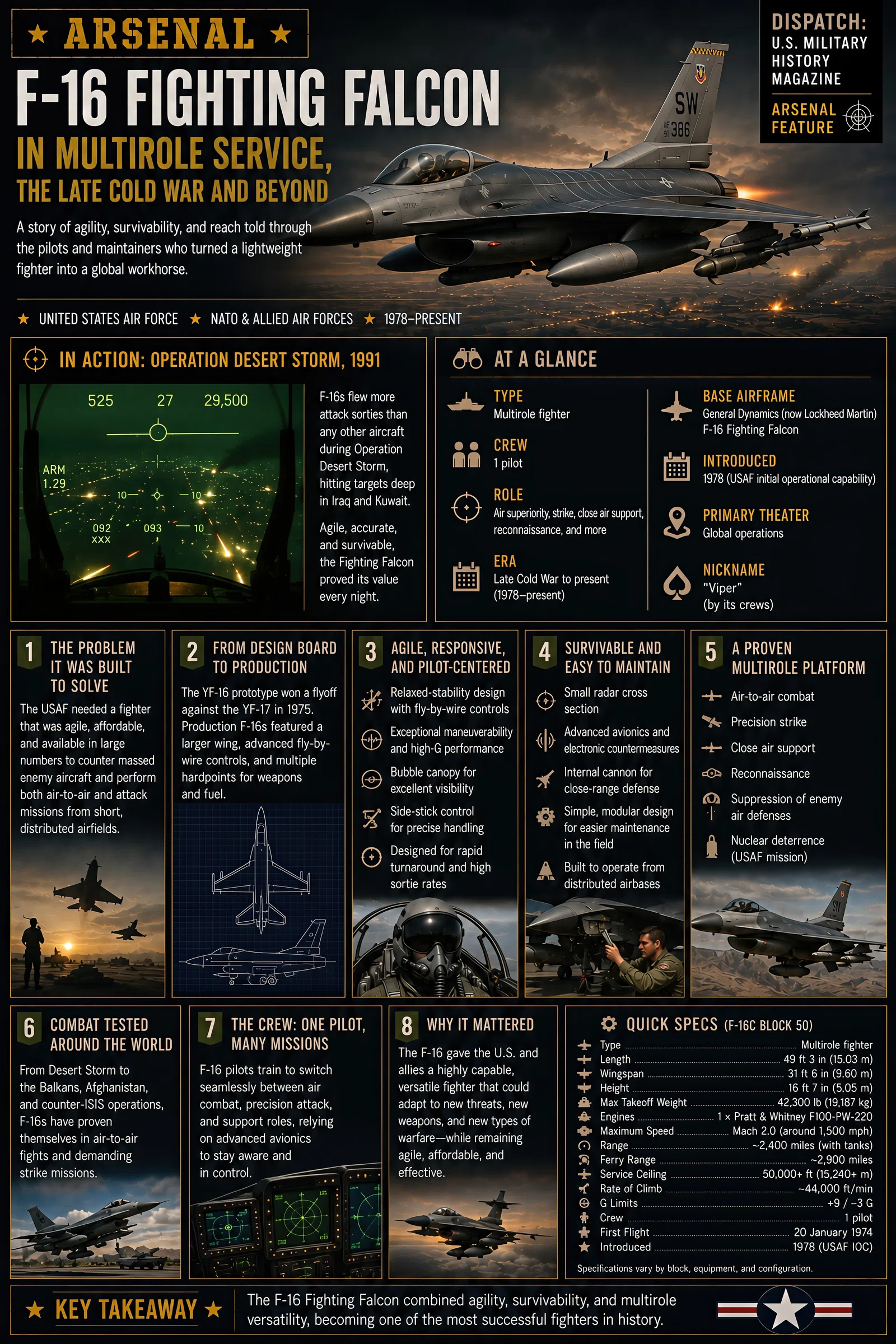
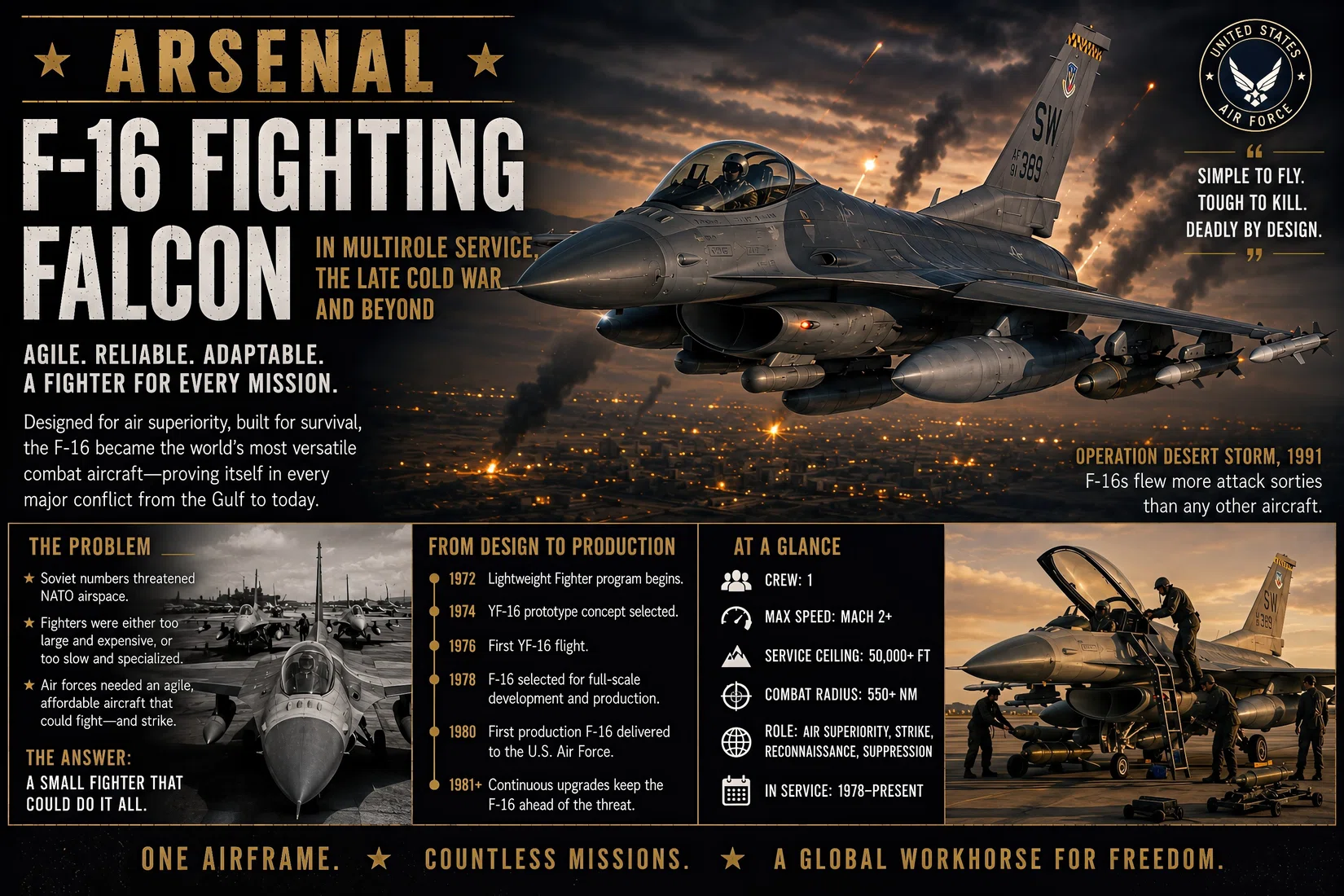
The strike package is mostly Fighting Falcons, each one hauling a mix of bombs and fuel tanks that turns the usually sleek single-engine fighter into a stubby-winged brawler. In Operation Desert Storm, this is the everyday look of the coalition’s workhorse. F-16s fly more attack sorties than any other aircraft, hunting airfields, command bunkers, and Scud missile sites across Iraq and Kuwait.
Tonight’s mission is a low-level run against hardened aircraft shelters on the outskirts of the capital. The formation skims in under radar, climbing only at the last moment to pop up and release. As the first jets pull, the sky ahead erupts with tracers and the bright dots of surface-to-air missile launches, arcing up from the ground in ugly spirals. Pilots ride the jet’s high-G turn capability, trusting the F-16’s responsiveness to yank them out of threat envelopes while the bombs fall toward their aim points.
In the chaos, the structure of the mission still holds: wingmen checking on each other, strike leaders calling defensive turns, tankers and electronic warfare aircraft orbiting far away to keep the corridor open. For the crews, it is another night in a long campaign. For the airplane beneath them, it is proof that a lightweight day fighter, conceived in the political and doctrinal arguments of the 1970s, has become the multirole backbone of modern air power.
The Problem It Was Built To Solve
The F-16’s story begins not over Iraq, but in the uneasy years after Vietnam and the Arab-Israeli wars, when air forces on both sides of the Cold War were rethinking what a fighter should be. The United States Air Force was buying the F-15, a large, powerful air superiority fighter designed to dominate long-range engagements. It was highly capable, but also complex and expensive. Planners worried that it would never be available in the numbers needed to counter massed Warsaw Pact aircraft over Europe’s short, vulnerable airfields.
Combat over North Vietnam and the Middle East had also shown that even in the missile age, close-in maneuvering fights did not disappear. Pilots who survived talked about the value of tight turning circles, good acceleration, and an unobstructed view out of the cockpit. The problem was simple to describe and hard to solve: how to field a fighter that was agile enough to win dogfights, cheap enough to buy and fly in large numbers, and flexible enough to take on ground attack missions when needed.
Inside the Air Force, reformers pushed for what they called a lightweight fighter, a jet that traded sheer size and radar power for energy, responsiveness, and pilot-friendly handling. European NATO allies had their own pressures. They needed a common aircraft that could defend their airspace, support ground forces, and be built under shared industrial arrangements rather than buying everything directly from the United States.
Existing aircraft could only partially meet these needs. Older fighters lacked the acceleration and high-G performance needed to wrestle with the latest Soviet designs. Dedicated attack aircraft were too slow or too specialized to survive in heavily defended airspace. A new design would have to combine cutting-edge aerodynamics, proven engines, and emerging fly-by-wire flight controls into a compact airframe that could be maintained on crowded ramps in Europe and, if necessary, launched in wartime several times a day.
Out of these debates came a demanding brief: a single-engine fighter with superb maneuverability, long legs for its size, and the ability to grow from pure air-to-air specialist into a multirole platform. The competition for that requirement would lead from engineering mock-ups and prototype fly-offs to a production program that reshaped NATO air power and produced one of the most widely used combat aircraft of the late twentieth century. The path from concept to factory floor is the next part of the F-16’s story.
From Design Board To Production
The F-16 began life as a rebel idea on drawing boards shaped by the Lightweight Fighter program, where a small group of officers and engineers argued for a compact, high-energy fighter instead of ever-larger jets. Their concept became the YF-16 prototype, which first flew in the mid-1970s and then went head-to-head against a rival design in a competitive flyoff. The winning aircraft combined a powerful turbofan engine, a blended wing-fuselage shape, and a relaxed-stability airframe controlled entirely by electronic flight controls, something no frontline fighter had fielded before.
Senior leaders accepted the idea of a “high-low mix,” pairing a smaller, cheaper fighter with the larger air superiority jet already in procurement. Once selected, the prototype grew into a production F-16 with more wing area, a larger nose for its radar, and additional hardpoints for weapons and fuel tanks. Full-scale development aircraft rolled out from the Fort Worth plant in the late 1970s, and the first squadron-ready fighters entered United States Air Force service in 1979. Very soon after, a four-nation European consortium ordered the type as a common NATO fighter, building many of their jets locally and locking the design into decades of front-line use.
At a glance, the F-16 is a single-engine multirole fighter from the United States, designed primarily for the United States Air Force but widely exported to allied air arms. It normally flies with a single pilot, armed with an internal M-61 twenty-millimeter cannon and able to carry a mix of air-to-air missiles, precision bombs, and targeting or electronic warfare pods on multiple underwing and under-fuselage stations. In clean configuration it can exceed twice the speed of sound, and with external tanks it has a ferry range of roughly two thousand miles, though its combat radius is much shorter when loaded for strike.
As production ramped up, the airframe was quietly strengthened and avionics steadily upgraded, but the basic shape that first flew in the 1970s remained. Early blocks emphasized air-to-air performance, while later versions added night-attack sensors, precision-strike capability, and improved radars. By the end of the Cold War, hundreds of F-16s stood alert from American bases to European dispersal airfields, ready to fight for air superiority one day and launch low-level strike packages the next.
Inside The Weapon
Walk up to an F-16 on the ramp and the first impression is how small it looks compared to many other modern fighters. The jet sits low to the ground on narrow landing gear, the single air intake tucked under the nose and the blended wing-body surfaces curving into one another without sharp breaks. From the front, the bubble canopy dominates the silhouette, a clear shell with almost no framing that gives the pilot a panoramic view in every direction. Under the wings and fuselage, pylons bristle with fuel tanks, missiles, and bombs, but the core of the aircraft remains a slim, dart-like fuselage wrapped around its engine.
Inside the cockpit, designers arranged everything around the pilot’s ability to fight in high-G maneuvering. Instead of a central control stick, the F-16 uses a side-stick controller mounted on the right console, allowing the pilot to brace against G-forces while still flying precisely. The seat is reclined farther than in earlier fighters, helping the pilot withstand tight turns. A wide heads-up display projects critical information directly into the pilot’s line of sight, while multi-function displays show radar tracks, weapon status, and navigation cues. Hands-on-throttle-and-stick controls let the pilot change radio channels, select weapons, and command sensors without looking down.
Beneath and behind the cockpit, the single turbofan engine forms the heart of the aircraft, fed by the chin intake and exhausting through a variable-geometry nozzle at the tail. Maintenance crews appreciate that large panels open to give access to major systems, reflecting the original requirement for ease of servicing on busy flight lines. Along the spine and in the wings, fuel tanks and flight-control computers share space with wiring harnesses and hydraulic lines, all designed to keep the jet responsive but also survivable when damaged. The fly-by-wire system constantly makes tiny adjustments to keep the deliberately unstable airframe under control, translating the pilot’s inputs into smooth movement of the tailplanes and flaperons.
In combat configuration, an F-16 pilot might launch with radar-guided and heat-seeking missiles, a targeting pod slung under the intake, and guided bombs or rockets on the wings. The radar scans the sky ahead or maps the ground, while the targeting pod provides a zoomed-in view of targets and their surroundings. For air-to-ground work, the pilot and jet act together as a mobile sensor and weapons platform, using onboard systems to identify the correct point of impact and then guiding weapons all the way in. For air combat, the same sensors and displays help the pilot track multiple enemy aircraft, choose the right missile, and manage energy in the turn.
Life with the aircraft reflects this multirole nature. Pilots describe sitting in the F-16 as wearing the airplane, the cockpit so closely wrapped around them that small pressures on the stick translate instantly into rolls and turns. Ground crews talk about rapid turnarounds, hot refueling from tankers, and long deployments where the same jets fly combat air patrol in the morning and precision strike missions in the afternoon. Through all of it, the design philosophy of the original lightweight fighter remains visible: a single-engine jet that puts pilot visibility, agility, and flexible weapon carriage at the center of its personality.
Baptism Of Fire
The night raid skimming into Baghdad that opened this story was not a one-off stunt. It was part of a sustained air campaign in which F-16s became the backbone of day-after-day strike operations. In the opening days of Operation Desert Storm, squadrons launched in waves from bases in Saudi Arabia and the Gulf, threading through crowded air corridors and refueling tracks to hit airfields, command bunkers, rail yards, and Republican Guard units. The first missions were often flown at low level to stay under radar, with pilots wrestling their heavily loaded jets through turbulence and darkness before popping up to release unguided bombs on hardened targets. Losses to ground fire and surface-to-air missiles made it clear just how dangerous that profile could be.
As the campaign settled into a rhythm, tactics evolved. F-16 packages shifted to medium altitude when enemy radars and missile batteries were suppressed, trading the frightening blur of low-level terrain for the exposure of clear air and contrails. With targeting pods and laser-guided bombs, later missions saw pilots talking a single point of light down onto a bridge span, tank revetment, or bunker entrance, guiding weapons all the way in while keeping clear of the densest defenses. It was still a multirole fighter at heart, but in the Gulf it functioned as a precision hammer, coming back again and again until target sets were reduced or destroyed.
The jet’s baptism of fire was not confined to United States colors. Earlier, in the early nineteen eighties, Israeli F-16s had already used their speed, range, and precision to strike the Iraqi nuclear reactor at Osirak and then to fight over Lebanon’s Bekaa Valley. Those missions, too, showed the design’s core strengths: the ability to dash long distances at low altitude, to haul a useful bomb load, and then to defend itself in the air if intercepted. By the time Desert Storm unfolded, the aircraft had already built a reputation as a combat-proven fighter in several air forces.
Across these campaigns, the pattern was similar. Commanders turned to the F-16 when they needed something dependable, flexible, and available in numbers. Whether the task was suppressing enemy air defenses, hitting armored formations, policing no-fly zones, or flying combat air patrol along tense borders, there was almost always a Fighting Falcon variant tailored to the job. Its baptism of fire was really a series of campaigns that proved the same basic point: a lightweight fighter conceived for air superiority could, with the right upgrades and tactics, carry much of the burden of modern air war.
Strengths And Weaknesses
Ask pilots what they liked most about the F-16 and they almost always start with how it flies. The jet’s agility, crisp response to control inputs, and excellent visibility made it a forgiving aircraft in training and a potent tool in a merge. That agility, combined with reliable engines and robust flight controls, gave pilots confidence when maneuvering close to the ground or in tight turning fights. Maintainers and squadron commanders, in turn, valued how often it simply worked. Compared with larger twin-engine fighters, F-16 units could often generate more sorties per day per aircraft, a key advantage in intensive campaigns.
There were other strengths that emerged over time. The roomy nose and avionics bays allowed successive generations of radar and sensors to be fitted. Under-fuselage and wing pylons accepted an ever-wider range of weapons, from early heat-seekers and free-fall bombs to later radar-guided missiles and precision munitions. This growth path meant that the same basic airframe could shift from daylight visual fighting to all-weather, around-the-clock multirole work. For budget-constrained air forces, that versatility made the aircraft attractive because a single fleet type could cover several mission sets.
Weaknesses were just as real. The single-engine layout, while economical, carried inherent risk: a serious engine problem often meant losing the aircraft. Early blocks lacked some of the long-range radar and beyond-visual-range missile capabilities of larger air superiority fighters, forcing pilots to rely more on clever tactics and support from other platforms. When loaded with heavy fuel tanks and bombs, the nimble dogfighter could feel decidedly less sprightly, and in hot, high-altitude environments it relied on careful fuel and weight management. Low-level strike missions exposed it to dense small-arms fire and shoulder-launched missiles, leading to losses even in conflicts where overall air superiority was secure.
Opponents learned to respect and adapt to the jet. Adversary pilots focused on avoiding the kinds of turning engagements that played to its strengths, while ground forces improved camouflage, decoys, and mobility to complicate targeting. Compared with contemporaries like the F-15 or carrier-borne F/A-18, the Fighting Falcon was rarely the largest or most powerful aircraft in the air. Its real strength lay in the combination of good performance, solid reliability, and wide availability, which together made it a constant presence over battlefields rather than a rare, specialized asset.
Variants And Evolution
Over decades of service, the F-16 family branched into a small forest of blocks, sub-variants, and local adaptations. Early F-16A and B models focused on day-fighter performance with relatively simple radars and limited night-attack capability. As experience accumulated, the C and D models arrived with more powerful engines, improved radar, and enhanced cockpit displays. These changes supported new weapons and more demanding missions, including precision night strike and suppression of enemy air defenses. Specialized versions, equipped with anti-radiation missiles and tailored avionics, took on the dangerous task of hunting enemy radars.
Many air forces adapted the basic design to their own needs. Some fitted conformal fuel tanks along the upper fuselage to increase range without filling every pylon with drop tanks. Others integrated indigenous weapons and electronic warfare suites, turning the jet into a testbed for national industries. Two-seat variants served both as conversion trainers and as fully capable combat aircraft, particularly for complex strike or electronic warfare missions where a second crew member could manage sensors and weapons. Each of these paths added wiring changes, structural reinforcements, and new software, all while preserving the recognizable outline of the original fighter.
Later in its life, the aircraft received deeper modernization programs. Newer radars with active electronically scanned arrays, updated mission computers, and modern glass cockpits extended its relevance into an era dominated by networked operations and long-range precision weapons. Structural life-extension work allowed older airframes to continue flying safely despite thousands of hours of hard use. Even as fifth-generation designs entered service, upgraded Fighting Falcons remained valuable as air policing platforms, strike aircraft, and training partners that could realistically simulate many potential opponents. The evolution of the type is a study in how a sound basic airframe, coupled with steady investment, can bridge multiple generations of technology.
Legacy And Where To See It Today
The F-16’s legacy reaches far beyond the units that still fly it. Design lessons from its relaxed-stability airframe, fly-by-wire controls, and pilot-centered cockpit fed directly into later fighters that took those concepts even further. Its success also cemented the idea that a multirole fighter could anchor an air force, trimming fleets of more specialized aircraft while still delivering credible performance in both air-to-air and air-to-ground missions. In doctrine and training, countless pilots from many nations learned basic fighter maneuvers, combat tactics, and strike planning from the seat of a Fighting Falcon, carrying those habits and expectations into later aircraft.
For the public, the jet is widely visible. Retired examples stand at the gates of air bases and National Guard facilities across the United States, their slim silhouettes frozen in a permanent climbing turn or mounted over memorials to local units. Museums such as the National Museum of the United States Air Force, large aviation collections along the coasts, and regional air parks include F-16s in their galleries, often painted in the colors of squadrons that saw combat over the Gulf, the Balkans, or other theaters. Visitors can walk close enough to see the fine scratches in the paint, the scuffed walkways on the wings, and the tight confines of the cockpit.
In the wider media world, photographs and video of the type in flight are everywhere: four-ship formations breaking over airfields, vapor streaming off wing roots in high-G turns, and night-vision footage of bombs leaving the pylons on combat missions. Trackpads and Dispatch can draw on that visual record to bring readers closer to the jets and crews discussed in Arsenal features, turning technical descriptions into something more tangible. For many veterans and aviation enthusiasts, the F-16 is the aircraft that defines the look and feel of the late Cold War and the first decades of the twenty-first century.
The story also connects naturally to other Dispatch features. Medal of Honor narratives sometimes intersect with operations where the F-16 patrolled overhead. Living History interviews capture the voices of pilots, maintainers, and even adversaries who encountered the jet in training or combat. Future Arsenal pieces on later fighters and air defense systems will often trace their roots back to the design and operational lessons forged in F-16 service. You can also hear narrated versions of Arsenal features as part of the Trackpads podcast feeds and Dispatch audio editions. At the heart of all of these stories are the men and women whose lives depended on how well this compact, agile fighter did its job.