In Action
The carrier deck is a strip of light in a black South China Sea night. Somewhere beyond the bow, North Vietnam is hidden under cloud and rain, but the squadron’s A-6 Intruder is already pointed that way. The pilot and bombardier-navigator sit shoulder to shoulder under the bulbous canopy, strapped into ejection seats, drowning in the glow of green instruments. Outside, the catapult crew hunches against the wind, wands slicing the darkness as they bring the Intruder forward into the shuttle.
The aircraft shudders as power comes up. Steam billows, the deck edge blurs, and then the catapult slams it into motion. In seconds the carrier is behind them, swallowed by cloud. There are no stars, no horizon, no visible sea. The pilot flies on instruments alone while the bombardier-navigator works radar and navigation displays, coaxing a path through weather toward a patch of jungle and concrete that looks like nothing on a radar scope and everything on the mission brief.
Far inland, search radars sweep and gun crews wait. The Intruder is coming in low, beneath much of the worst radar coverage, heavy with bombs and trusting its all-weather systems to put those weapons exactly where they must go. The crew knows they may never see the target with their own eyes. They also know that flak, missiles, and the sudden white specks of tracers will be unmistakable when they arrive. Tonight is only one sortie in a long campaign, but for this crew and this aircraft, it is the moment when the design on paper either delivers or lets them down.
The Problem It Was Built To Solve
Scenes like that night launch grew out of a Cold War problem that started long before the Vietnam War. The United States Navy needed a way to hit targets, at long range, in almost any weather, without depending on clear skies or daylight. Early jet attack aircraft could carry nuclear or conventional weapons, but they were often limited by short legs, modest payload, and primitive navigation and radar systems. In heavy cloud, over rough coastline, or in monsoon conditions, those limitations turned into real gaps in the fleet’s striking power.
At the same time, Soviet naval forces and land-based missile sites were becoming more dangerous. Carrier air wings needed aircraft that could strike ships at sea and hardened facilities ashore while the carrier stayed well offshore. That meant a combination that was hard to achieve: serious payload, long range, and the ability to navigate, find, and hit targets in darkness and bad weather. Propeller-driven workhorses like the Skyraider had endurance and toughness, but not the speed or electronics the Navy wanted for the next era. Sleeker light attack jets were nimble, but they could not carry enough fuel and ordnance while also hosting advanced all-weather systems.
By the late 1950s, the Navy was asking for an all-weather attack aircraft that could make the most of carrier decks in any season, in any ocean. It needed room for two crew members, a powerful and flexible radar and navigation suite, and the ability to haul a serious bomb load deep inland at low altitude. In that requirement, the outline of what would become the A-6 Intruder began to take shape, setting the stage for a design that would soon leave the drawing board and head for the fleet.
From Design Board To Production
The A-6 Intruder began life on the drawing boards at Grumman, the company already famous in naval aviation for tough, carrier-capable aircraft. In the late nineteen fifties, Grumman’s engineers took the Navy’s all-weather attack requirement and started shaping an airplane that looked very different from the sleek fighters of the day. Instead of chasing high speed with thin wings and afterburners, they built a chunky, broad-winged machine tuned for long range, heavy loads, and steady handling in rough air at low altitude. Side-by-side seating let the pilot and bombardier-navigator share information quickly over a crowded instrument panel, a deliberate choice in a world where complex radar and navigation gear were just beginning to move into combat aircraft.
That electronics suite drove many of the tradeoffs. The Intruder needed space and power for its integrated navigation and attack system, which blended radar, navigation sensors, and a bombing computer into a single package. To feed all of this, designers accepted extra weight and bulk in exchange for the ability to find and hit targets at night and in bad weather. The result was not elegant in the traditional sense, but it promised to give carrier air wings a reach they had never enjoyed before. It was more truck than sports car, built to haul weapons on schedule when the fleet needed them most.
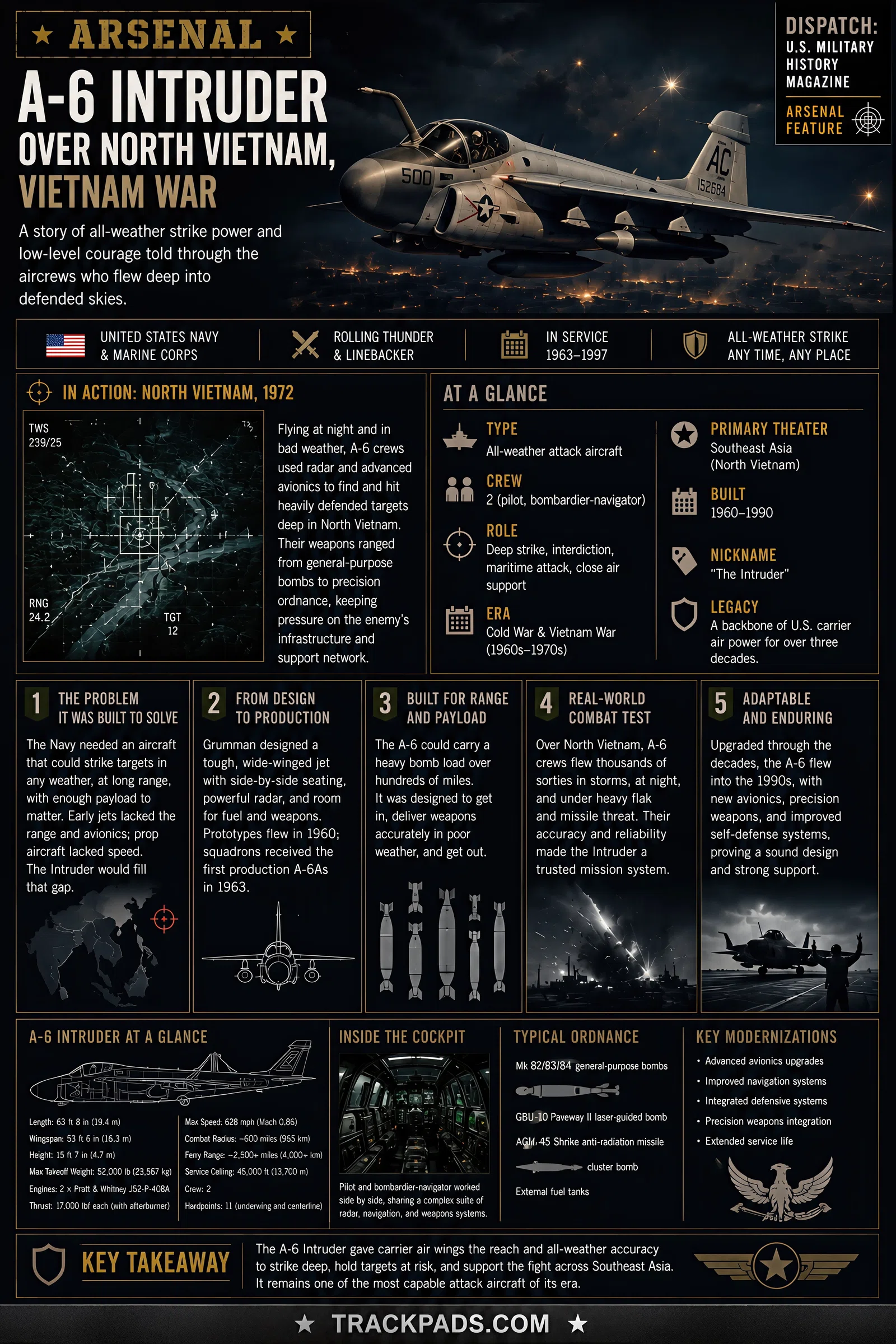
At a glance, the A-6 Intruder was a twin-engine, two-seat, all-weather attack aircraft built in the United States for service with the United States Navy and the United States Marine Corps during the Cold War and the Vietnam War era. A typical crew consisted of a pilot and a bombardier-navigator sitting side by side, operating a powerful radar and attack system to guide a bomb load that could exceed many thousands of pounds, carried on multiple underwing pylons. In service, the Intruder cruised at high subsonic speeds, with a combat radius measured in hundreds of miles, allowing carriers to stay far offshore while still striking deep inland. Over the early nineteen sixties, prototypes gave way to production aircraft, and soon squadrons were bringing this new all-weather attack capability aboard carriers bound for Southeast Asia.
Inside The Weapon
Seen on the flight line, the A-6 Intruder looks compact but purposeful, with a rounded nose packed full of radar and sensors leading back into a deep fuselage. The mid-mounted wings are broad and slightly swept, full of flaps and high-lift devices to help the aircraft stay controllable at low speeds during carrier approaches and low-level runs. Under those wings hang pylons ready to carry bombs, mines, rockets, or later guided munitions, giving the Intruder a flexible armory tailored to different targets. Twin jet intakes on the fuselage sides feed engines buried deep in the body, while a sturdy, trailing-armed landing gear and a refueling probe up front speak to the realities of carrier operations and long-distance missions.
Inside the cockpit, the side-by-side layout defines the crew’s world. The pilot sits in the left seat, hands on stick and throttles, managing the aircraft’s attitude, altitude, and speed through a dense stack of traditional flight instruments and later head-up cues. To the right, the bombardier-navigator sits behind a wall of radar scopes, navigation displays, and attack controls, constantly updating the aircraft’s position, refining the bombing solution, and managing communications and sensors. In training diagrams this division of labor looks clean and simple. In combat, both crew members juggle checklists, radio calls, and system quirks while talking constantly over the intercom to keep the mission on track in darkness and turbulence.
Behind those two seats, the avionics bays and wiring runs support the Intruder’s heart: its all-weather navigation and attack system. The bombing computer integrates returns from the attack radar, navigation data, and aircraft motion to tell the crew when to release weapons, even if the target is hidden under cloud or smoke. Other subsystems tie into this core. The aircraft’s communications radios keep the crew connected to the carrier and strike package, while defensive systems such as radar warning receivers and, in later years, chaff and flare dispensers help them react when enemy radars lock on. In theory, the electronics would quietly guide the aircraft to the release point. In practice, crews learned that low-level flight at night over mountains and jungle meant living inside those instruments, trusting green-lit scopes more than any faint impression out the canopy.
Life aboard the Intruder also depended on more ordinary details. The cockpit was cramped but better for crew coordination than long tandem setups, and the side-by-side arrangement helped reduce isolation during stressful missions. Heating, oxygen, and pressurization systems had to work reliably as the aircraft climbed from humid carrier decks into cold, high-altitude cruise before dropping back down into low-level runs. Maintainers wrestled with access panels and tight spaces to keep engines, hydraulics, and electronics functioning in the corrosive saltwater environment of a carrier and the harsh conditions of expeditionary Marine bases. Training promised a capable, almost automatic all-weather system; veterans of line cruises remembered long hours of tweaking, cross-checking, and improvising to make that promise real when it mattered over enemy territory.
Baptism Of Fire
The Intruder’s true test came when carriers on Yankee Station began sending it across the beach into North Vietnam. The night launch described earlier was not an exception but a pattern: crews left the deck in darkness or thick overcast, climbed just enough to organize, then dropped down into the weather to slip under the worst of the radar coverage. Early missions focused on transportation networks, fuel depots, and other targets that fed North Vietnam’s war effort. That meant flying up cluttered river valleys, over patchwork rice fields, and through narrow gaps in hills that looked like nothing but noise on a radar display, yet had to be navigated with precision if the strike package was to arrive on time.
As Rolling Thunder unfolded, Intruder squadrons found themselves at the heart of some of the most demanding missions the fleet could assign. The aircraft’s ability to carry a heavy conventional bomb load far inland, in almost any weather, made it a natural choice for attacking defended rail yards and storage areas. Crews learned to trust their instruments as they pressed in at low altitude, often seeing little more than scattered ground lights or the sudden flash of anti-aircraft fire. Over and over, they pushed through bands of barrage fire and the threat of surface-to-air missiles that hunted higher-flying aircraft, knowing that turning back meant leaving other aircrews exposed and targets untouched.
One representative engagement might see a section of Intruders tasked to cut a key supply route feeding the defenses around Hanoi. Tankers extended their reach from the carrier, and fighter escorts swept ahead to keep enemy aircraft at bay. When the Intruders descended for their run, the bombs they carried were unguided, but the navigation and attack system allowed releases referenced to radar-mapped features on the ground. As the lead crew called out fixes and corrections, the wingman fought to stay in formation through turbulence and bursts of flak, both aircraft jinking to spoil enemy aim while still holding the timing needed for an accurate drop. Explosions walked across the target area seconds after release, turning carefully hidden supply dumps into fire and smoke before the section clawed its way back toward the safety of the sea.
Combat quickly exposed both the promise and the harsh realities of the Intruder concept. When the systems worked and the crews did their part, carrier air wings could reach targets that once would have been safe behind weather or darkness. But every success was bought with exposure to dense anti-aircraft belts and the constant risk of losing an aircraft with two highly trained specialists aboard. The Vietnam War became the Intruder’s baptism of fire, and the pattern established there would define the way veterans and historians remembered the aircraft: an all-weather workhorse that did some of the fleet’s most demanding jobs, often at high cost.
Strengths And Weaknesses
Crews who flew the Intruder quickly came to appreciate its strengths. High on their list was the combination of payload and range, which let a relatively small number of aircraft deliver serious striking power far inland while the carrier remained at a safer distance offshore. The side-by-side cockpit and integrated attack system turned the pilot and bombardier-navigator into a true team, able to share information easily as they worked their way through complex missions. In bad weather and at night, when other aircraft were forced to stand down or stick to simpler tasks, the Intruder often could still launch, giving commanders an option when circumstances might otherwise have grounded the air wing.
They also praised its low-level handling. The broad wings and strong structure made the aircraft stable when bouncing through turbulence close to the ground, and the engines provided solid thrust without the quirks of high-mounted afterburners. The Intruder’s ability to carry a wide mix of ordnance, from conventional bombs and mines to specialized weapons as the war went on, meant that the same airframe could handle interdiction, close support, and maritime strike missions with relatively modest changes in configuration. From a commander’s perspective, that flexibility was a major strength in a campaign where targets and priorities shifted rapidly.
Yet the aircraft had real weaknesses, and those who flew and maintained it were keenly aware of them. The very electronics that made it valuable were complex and, especially in early years, temperamental, with navigation and attack systems that demanded skill, patience, and extensive maintenance to keep within acceptable reliability. At low altitude over North Vietnam, the Intruder was still vulnerable to heavy anti-aircraft fire, small arms, and the growing network of surface-to-air missiles; its lack of an internal gun and reliance on speed, jinking, and tactics for self-defense left crews feeling exposed when things went wrong. From an enemy perspective, the aircraft was both respected and targeted: it posed a serious threat to key infrastructure and coastal installations, but its predictable need to approach certain types of targets allowed defenders to stack guns and missiles along likely paths, seeking to turn the Intruder’s strengths into liabilities whenever they could.
Variants And Evolution
As experience accumulated in Southeast Asia, the Intruder family began to branch into variants tailored to specific roles and to incorporate lessons from combat. Early modifications focused on improving the navigation and attack system, smoothing some of the rough edges that frustrated crews during the first combat cruises. Specialized versions appeared that traded some standard equipment for sensors and systems tuned to particular missions, such as hunting enemy radars or gathering more detailed information about targets under cover of darkness and weather. These changes reflected a wider shift in naval aviation toward more precise, information-heavy strike operations rather than simple massed bombing.
The main production line moved toward more capable models as new radars, computers, and targeting gear became available. Later Intruders gained upgraded attack systems and, in some versions, turret-mounted sensors that gave crews a clearer picture of the battlefield, especially in low light. Structural improvements, including strengthened and later composite wings, extended the type’s service life and allowed it to remain a frontline asset well beyond the Vietnam era. Throughout these evolutions, the basic shape and concept of the aircraft stayed recognizable: a twin-engine, side-by-side, all-weather attack platform designed to bring bombs onto target when conditions were at their worst.
Around the core attack variants, the Intruder airframe also served as the basis for other roles that broadened its impact. Tanker versions provided in-flight refueling support, helping keep fighters and other strike aircraft on station longer and extending the reach of the carrier air wing even further inland. A related, enlarged design became an electronic warfare aircraft that shared much of the Intruder’s DNA but traded bombs for jamming and surveillance equipment, escorting strike packages to disrupt enemy radars and communications. In this way, the Intruder family helped shape not just how the Navy delivered ordnance, but how it managed the entire environment around a strike, from fuel and navigation to electronic conflict.
Legacy And Where To See It Today
By the time the Intruder left frontline service, its core ideas had already filtered into the broader world of naval aviation. The emphasis on all-weather capability, long reach from the carrier, and close crew coordination carried forward into newer strike aircraft and into the mixed role fighters that eventually took over many of its missions. Lessons learned about low-level tactics in dense air defense environments, and about the importance of reliable navigation and attack systems, influenced training syllabi and doctrine long after the last A-6 squadron stood down. Even when newer aircraft brought precision-guided weapons and more advanced sensors, they did so within a framework of carrier-based strike operations that the Intruder had helped define during the Vietnam War and beyond.
The physical remnants of that legacy can still be found at museums and memorials, where preserved Intruders sit with wings folded on carrier decks or on outdoor display pads. Naval aviation museums in the United States and abroad often include an A-6 in their collections, sometimes alongside the carriers and support aircraft it served with. Visitors can walk close enough to see the size of the bomb racks, the angle of the refueling probe, and the small windows of the cockpit that once framed the world for two-person crews flying through monsoon cloud and tracer fire. On former carriers now serving as museum ships, the Intruder helps show visitors what an operational flight deck looked like in the late Cold War and post-Vietnam era.
For those who cannot travel, images and video from exercises, cruises, and preservation work keep the Intruder’s story alive, including coverage shared through photography and film communities connected to Dispatch and Trackpads. The aircraft also appears in companion features that trace the experiences of the men and women who launched it, armed it, repaired it, and flew it into dangerous airspace. Their stories link this machine to Medal of Honor actions, oral histories, and other Arsenal pieces that together sketch a broader picture of carrier warfare in the second half of the twentieth century. In the end, the A-6 Intruder’s legacy rests not only in its technical achievements but in the lives it changed, the targets it struck, and the crews on both sides of the conflict who learned to respect what it could do when weather closed in and night fell.