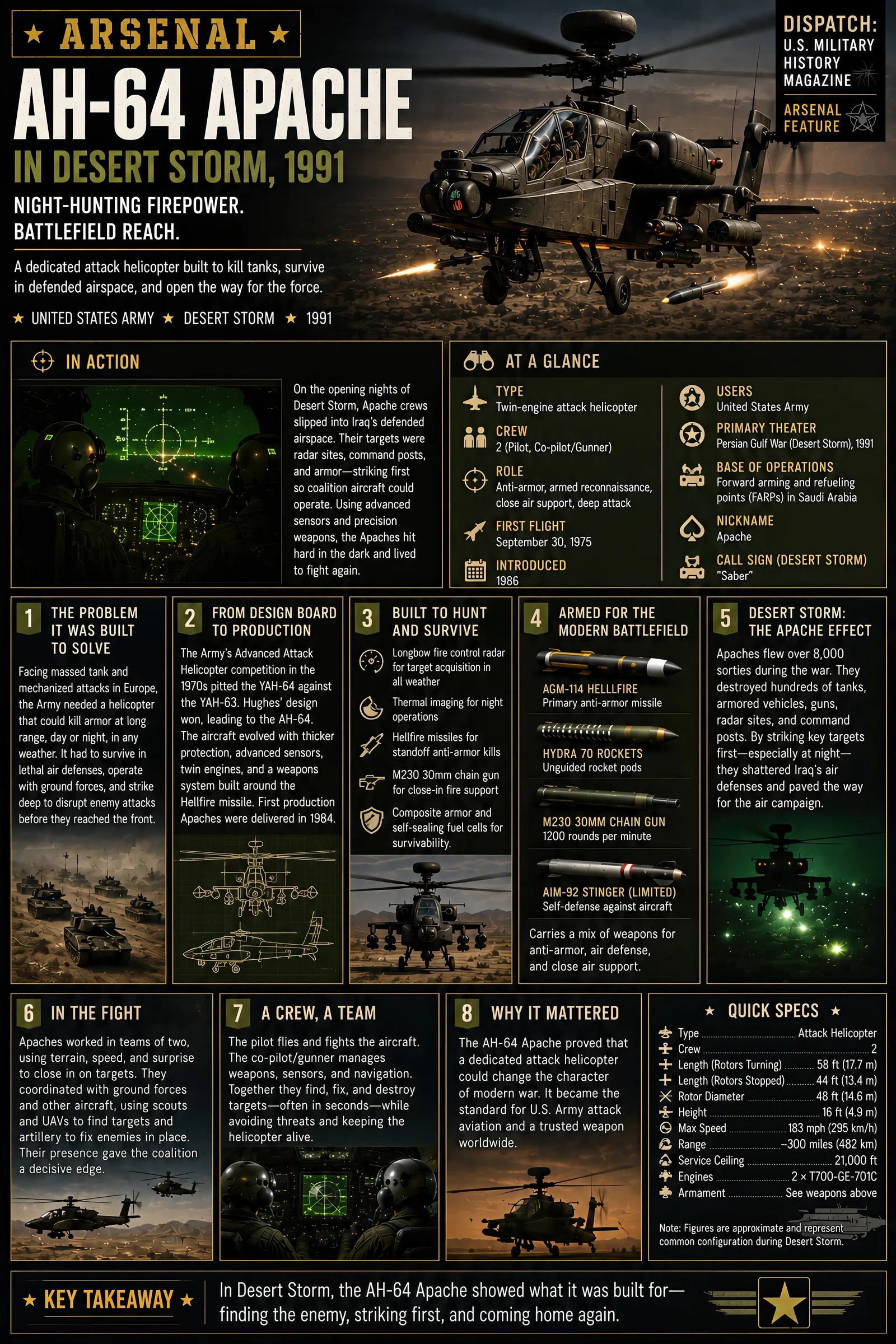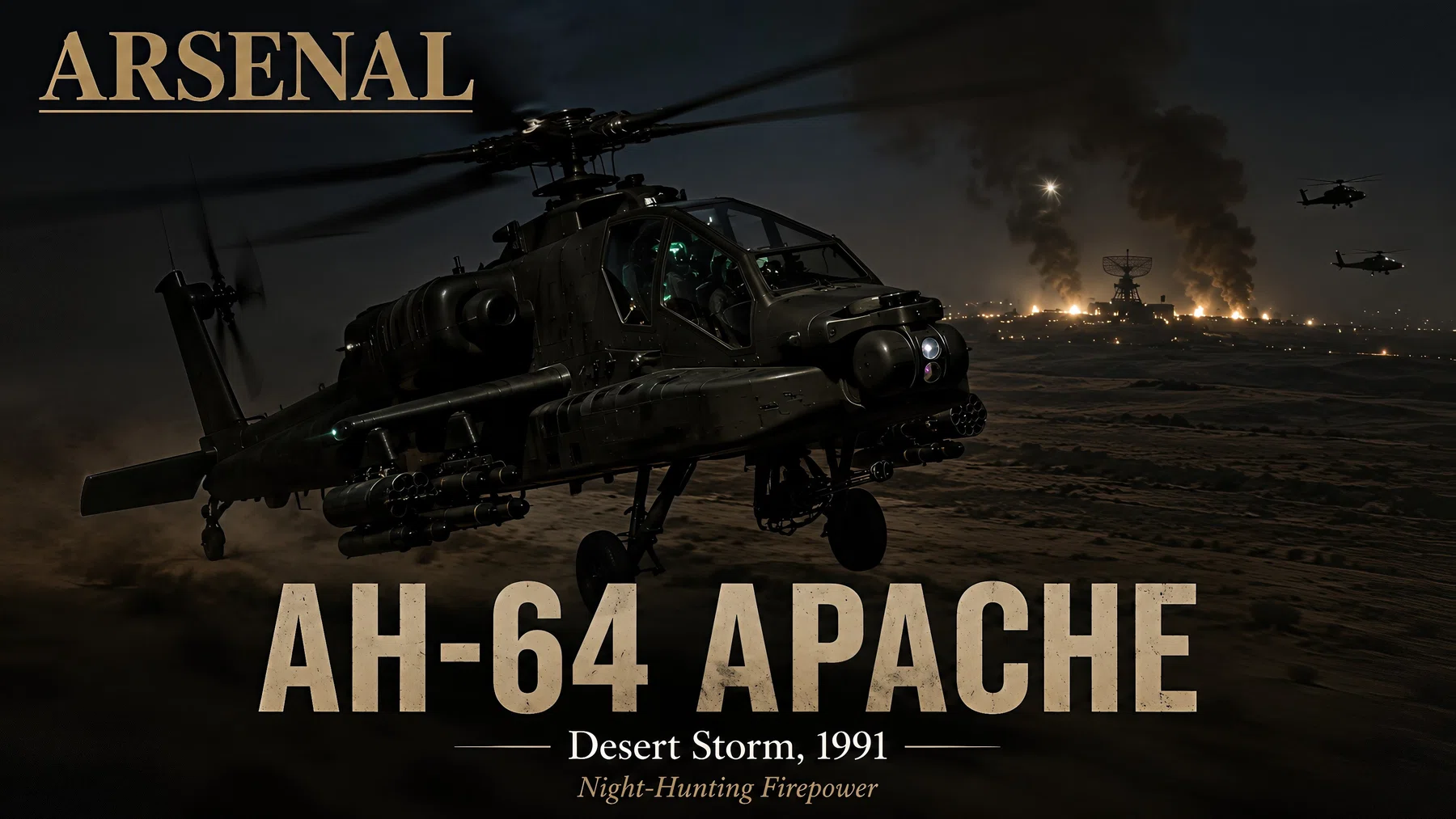
In Action
The desert is almost completely black, but through the green glow of the cockpit displays it looks alive. A pair of AH-64 Apache attack helicopters skims barely above the sand, rotor disks beating the cold January air over western Iraq. The pilots lean into their harnesses, eyes moving between the outside world, night vision, and the flickering symbology of their targeting sights. Ahead of them, beyond a low horizon line, sits one of the radar sites that feeds Iraq’s integrated air defense network. If the Apaches do their job, the opening wave of coalition aircraft will have a safe corridor. If they fail, the sky will be a far more dangerous place.
The front-seater works the targeting sight, slewing the sensor head toward a faint cluster of lights. The image stabilizes into buildings, masts, and the telltale signatures of vehicles parked in revetments. Range data, cues for Hellfire missiles, and threat warnings dance across the co-pilot gunner’s display. The pilot in the back seat keeps the machine low and fast, riding terrain and invisible navigation waypoints the way a ship’s captain rides buoys.
In a practiced sequence the formation pops up just enough to see and shoot. The first Hellfires leap from their rails, motors igniting a heartbeat later, streaking downrange in the darkness. Seconds stretch as the missiles ride invisible beams toward the target. Then multiple flashes roll across the radar site, followed by secondary explosions as stored fuel and ammunition cook off. The Apaches drop back to low level and turn away, already thinking about the next target and the long flight back across the border. This is what the helicopter was built for: slipping into defended airspace, killing key nodes at standoff range, and opening doors for everyone who follows.
The Problem It Was Built To Solve
Long before it was hunting radar sites in Iraq, the Apache’s designers were thinking about a very different battlefield. In the 1970s the United States Army looked at the balance of forces in Europe and saw an uncomfortable picture. Across the inner German border, the Warsaw Pact fielded massed tank and mechanized formations designed to punch through NATO defenses with speed and weight. Traditional anti-tank teams on the ground could be overrun. Fixed-wing aircraft were powerful but vulnerable to bad weather, rough terrain, and the dense surface-to-air missile belts that would surround any major breakthrough.
The Army needed a way to kill tanks and armored columns at long range, in large numbers, under conditions that would defeat older helicopters and most strike aircraft. Vietnam-era gunships like the AH-1 Cobra had shown what attack helicopters could do, but they lacked the sensors, protection, and dedicated anti-armor firepower needed for a high-intensity European war. Planners wanted a machine that could fight at night and in poor visibility, work closely with ground units and artillery, and still survive inside lethal envelopes of guns and missiles.
Doctrine was shifting as well. Concepts like AirLand Battle emphasized hitting an enemy’s second echelon forces before they ever reached the front line. That meant reaching deep into contested territory and striking moving columns on the march. To do that, an attack helicopter would need not just weapons but brains: integrated sensors, sophisticated fire control, and navigation systems that could guide it low through valleys and over forests without betraying its position.
At the same time, the design would have to live in the real world of budgets, maintenance, and field conditions. It had to be tough enough to absorb damage, simple enough for crews and maintainers to keep running in the mud and cold, and flexible enough to serve in other theaters beyond central Europe. Out of this mix of strategic anxiety, doctrinal change, and practical experience emerged the requirement for a new dedicated attack helicopter. The answer would become the AH-64 Apache.
From Design Board To Production
The Apache began as an answer to a formal request for an advanced attack helicopter that could kill tanks on a European battlefield. In the mid nineteen seventies, the Army’s Advanced Attack Helicopter program pitted competing designs against each other in a long series of flight trials, weapons tests, and survivability evaluations. Hughes put forward the YAH-64, while Bell offered the YAH-63, each embodying different ideas about how to mix agility, firepower, and protection. Test pilots and engineers flew these prototypes hard, looking at how well they could hug terrain, acquire targets, and bring guided missiles onto armored formations. Out of that process, the basic Apache shape emerged: a low, purposeful fuselage with a high tail, twin engines, and a nose packed with sensors.
As the Army refined its requirements, the airframe evolved. Designers thickened critical structure around the cockpit, reworked the rotor system, and integrated systems to manage the growing electronics suite. The focus was on giving the crew a stable firing platform while keeping the helicopter nimble at low level. The choice of the Hellfire missile as the primary anti-armor weapon drove much of the fire control architecture, since the helicopter had to point and hold laser energy on targets at standoff ranges. Production-standard aircraft added armor plate, self-sealing fuel systems, improved engines, and early forms of digital avionics that could talk to other battlefield systems.
At a glance, the AH-64 Apache is a twin-engine attack helicopter from the United States, built primarily for the United States Army and entering service in the last decade of the Cold War. It carries a crew of two in tandem, a pilot in the rear and a co-pilot gunner in front. Its main armament combines a thirty millimeter automatic cannon with racks of guided anti-tank missiles and unguided rockets. In level flight it cruises faster than a typical utility helicopter and has a combat radius far enough to strike deep into hostile territory and return. Over the years, hundreds were built, forming the backbone of Army attack helicopter battalions in Europe, the Middle East, and later conflicts around the world.
Inside The Weapon
Walk up to an Apache on the flight line and it looks compact but heavily built, all angles and hard purpose. The stub wings jut out from the fuselage, each with mounting points for missiles and rocket pods, while the sensor turret and gun hang under the nose like clenched fists. Climb the ladder and into the cockpit and the space immediately feels tight. The front seat, where the co-pilot gunner sits, is surrounded by displays, switches, and the hand grips that control the targeting sights and weapons. The rear cockpit, slightly higher, gives the pilot better visibility over the nose and houses the primary flight controls and navigation systems. Between them runs the shared life of the aircraft: intercom lines, data buses, and the constant back-and-forth of two people fighting the same machine.
On a mission, the pilot’s main job is to fly the helicopter where it needs to be: low, masked by terrain, and in the right position to shoot while staying out of unnecessary danger. Hands and feet are never still, trimming the rotor disk, nudging the collective to change lift, and working the pedals to keep the nose pointed exactly where the gunner needs it. The co-pilot gunner, meanwhile, lives inside the sights. Using helmet-mounted displays and stabilized optics, they scan miles of ground ahead, searching for silhouettes, heat signatures, and telltale movement. With a twist of controls they can bring the cannon onto a target or queue up a string of missiles, all while keeping track of friendly positions and radio calls from ground units.
Below and around them, the systems that make the Apache a weapon all hum together. The engines drive not only the rotors but also generators and hydraulic systems that feed sensors, fire control computers, and stabilization gear. The thirty millimeter cannon is slung on a flexible mount tied into the gunner’s helmet, so turning a head can bring the barrel onto a point on the ground. Racks on the wings hold laser-guided missiles designed to punch through modern armor, along with rockets for softer targets or area suppression. Defensive systems sniff for hostile radar and missile launches, ready to trigger countermeasures that might give the crew a precious second to break contact.
For the people who crew it, the Apache is both a workplace and a survival capsule. The armored tubs around the seats, the separated engines, and the way fuel is stored and routed all exist to improve the odds of coming home if the helicopter is hit. Yet veterans often talk about the strain: the vibration transmitted through the airframe, the workload of managing sensors and radios in the dark, and the knowledge that a single mistake in terrain masking can expose the entire formation. Training scenarios present clean target lists and scripted threats, but in combat the cockpit fills with conflicting calls, partial information, and the need to make fast decisions at low altitude. Living inside the Apache means trusting your partner, your machine, and the doctrine that brought you to that stretch of sky.
Baptism Of Fire
For the Apache, the first real proof that all the effort and doctrine were sound came just before dawn on 17 January 1991. A joint formation of Apaches and Air Force special operations helicopters, known as Task Force Normandy, crossed from Saudi Arabia into Iraq at low level, guided by terrain-following navigation through a moonless sky. Their mission was simple to describe and unforgiving to execute: slip deep into the Iraqi air defense network and destroy two early warning radar sites in the opening minutes of Desert Storm. In a few concentrated minutes of firing, the Apaches shredded antennas, generators, and command vans with Hellfires, rockets, and cannon fire, opening a corridor for the first wave of coalition strike aircraft heading toward Baghdad.
That raid set the tone for how the helicopter would be used for the rest of the war. Nearly half of the United States Apache fleet deployed to the Gulf, and by the time the brief ground campaign ended, hundreds of the helicopters had flown combat, often at night, hunting armor, artillery, and logistics columns. Official accounts credit Apaches with the destruction of hundreds of vehicles, including more than two hundred tanks, during those one hundred hours on the ground. The helicopter’s ability to appear suddenly along a road march, pick off the head and tail of a column, and then work methodically along the trapped vehicles made a deep impression on both crews and observers.
Combat did more than prove the design; it exposed all the friction that training scenarios smooth over. Crews juggled navigation, sensor management, and communications while threading formations of heavy helicopters through sand haze, smoke, and ground fire. Maintenance teams learned which components tolerated desert dust and which did not. Commanders wrestled with how far to push deep strikes without leaving the aircraft unsupported. Lessons from Desert Storm, and later Apache deployments to Afghanistan and Iraq, drove refinements in tactics and in the machines themselves. The baptism of fire confirmed that an attack helicopter could be a deep-strike tool against modern air defenses, but it also showed how narrow the margins could be when things went wrong.
Strengths And Weaknesses
Ask Apache crews what they value most and they often start with sensors and weapons. The combination of stable night vision, long-range optics, and precision-guided missiles lets a small team find and hit armored vehicles, artillery, or entrenched positions from well outside small-arms range. In campaigns from the Gulf to Afghanistan, Apaches provided a kind of roaming, on-call fire support, able to loiter over a ridge line or orbit behind terrain until ground forces called them in. The helicopter’s survivability features, from armored crew compartments to redundant systems and ballistic-tolerant blades, gave crews confidence that they had a real chance of limping home even after taking hits.
From the enemy’s point of view, the Apache’s strengths were unnerving. A formation that stayed low and used terrain could be very hard to detect until the first missiles were already inbound. During Desert Storm, Iraqi crews described the shock of vehicles exploding in the dark with no warning beyond the glow of inbound weapons and the sudden chatter of cannon fire. Later opponents in Iraq and Afghanistan had to adapt to the idea that a helicopter they could barely see might already be tracking them from several kilometers away. The psychological effect of that kind of presence—especially at night—became part of the weapon’s reputation, not just its physical damage.
Yet the Apache is not invulnerable, and its weaknesses have shaped doctrine just as much as its strengths. When forced to operate higher or linger too long over dense defenses, the large rotor disk and complex systems make it vulnerable to heavy machine guns, anti-aircraft guns, and man-portable missiles. In Iraq in 2003, a major deep strike against a Republican Guard formation near Karbala ended with many Apaches damaged and one shot down, reminding planners that even advanced attack helicopters can be punished when flown into thick fire without adequate suppression. In Kosovo, concerns about the threat environment and basing delays meant Apaches never flew a combat mission at all. These experiences underscored that the helicopter works best as part of a combined system—linked to scouts, artillery, and fixed-wing aircraft—not as a solitary armored knight.
Variants And Evolution
The Apache that flew into Iraq in 1991 was the AH-64A, the original production model that embodied the basic ideas of the advanced attack helicopter program: tandem crew, powerful twin engines, a nose full of sensors, and a flexible mix of cannon, missiles, and rockets. As technology advanced and operational experience accumulated, engineers and the Army moved toward deeper upgrades rather than clean-sheet replacements. The most visible step was the AH-64D Apache Longbow, with its distinctive radar dome above the rotor and a much more digital cockpit. That radar allowed crews to detect and classify targets while remaining hidden behind terrain, then share that information with other aircraft.
Under the skin, Longbow upgrades brought new engines, improved navigation, and better connectivity to the wider battlefield network. Later blocks added more robust digital communications that let Apaches exchange data with ground units and other helicopters in near real time. Export customers layered on their own changes, from different engines to local weapons and defensive aids, creating a family of related but distinct machines in allied service. The overall pattern, however, stayed the same: keep the basic airframe and concept, but steadily improve the brains, eyes, and muscles.
The newest major step in that line is the AH-64E, often called the Guardian. It adds even more powerful engines, composite rotor blades, and systems that let the crew control unmanned aircraft, pulling video and target data directly into the cockpit. In practical terms, that means an Apache team can see over the next ridge using a drone instead of their own rotor disk, then decide when and how to commit. By the mid twenty twenties, thousands of Apaches of various marks had been built, and upgrade programs continued to keep older airframes in front-line service even as armies debated the future of manned attack helicopters in an era of increasingly capable drones.
Legacy And Where To See It Today
Decades after its first flight, the Apache remains a symbol of modern land warfare: a machine built to turn information and precision firepower into protection for troops on the ground. Its influence shows up in the doctrine of many armies that field their own attack helicopters, in the emphasis on night operations and deep strikes, and in the expectation that aviation and ground maneuver are tightly woven together. In the United States, the Apache’s record from Panama to Desert Storm, and on through Afghanistan and Iraq, helped cement the idea that rotary-wing firepower is not just an adjunct to artillery,
You can see that legacy made physical in museums and on flight lines. At Fort Novosel in Alabama, the United States Army Aviation Museum emphasizes the story of Army helicopters from their earliest days to modern types like the Apache, displaying aircraft and artifacts that trace that evolution. Other air museums and base displays around the world include Apaches as static exhibits, from American training posts to British collections where local variants sit beside earlier gunships. Each airframe on a pedestal represents thousands of flight hours, deployments, and maintenance shifts that kept similar machines in the air over real battlefields.
For readers of Dispatch and followers of Trackpads, the Apache’s legacy also lives in images and voices. Photographs and video from exercises and combat tours capture everything from dusty forward arming points to night launches under green-lit goggles. Living History interviews and related Beyond the Call stories introduce the pilots, gunners, mechanics, and ground troops who depended on those dark, angular silhouettes overhead. Together with other Arsenal features on tanks, guns, and warships, they sketch a broader picture of how technology, training, and human judgment collide in war. The Apache’s place in that story is secure precisely because its crews have spent so many years testing its design under fire.