In Action
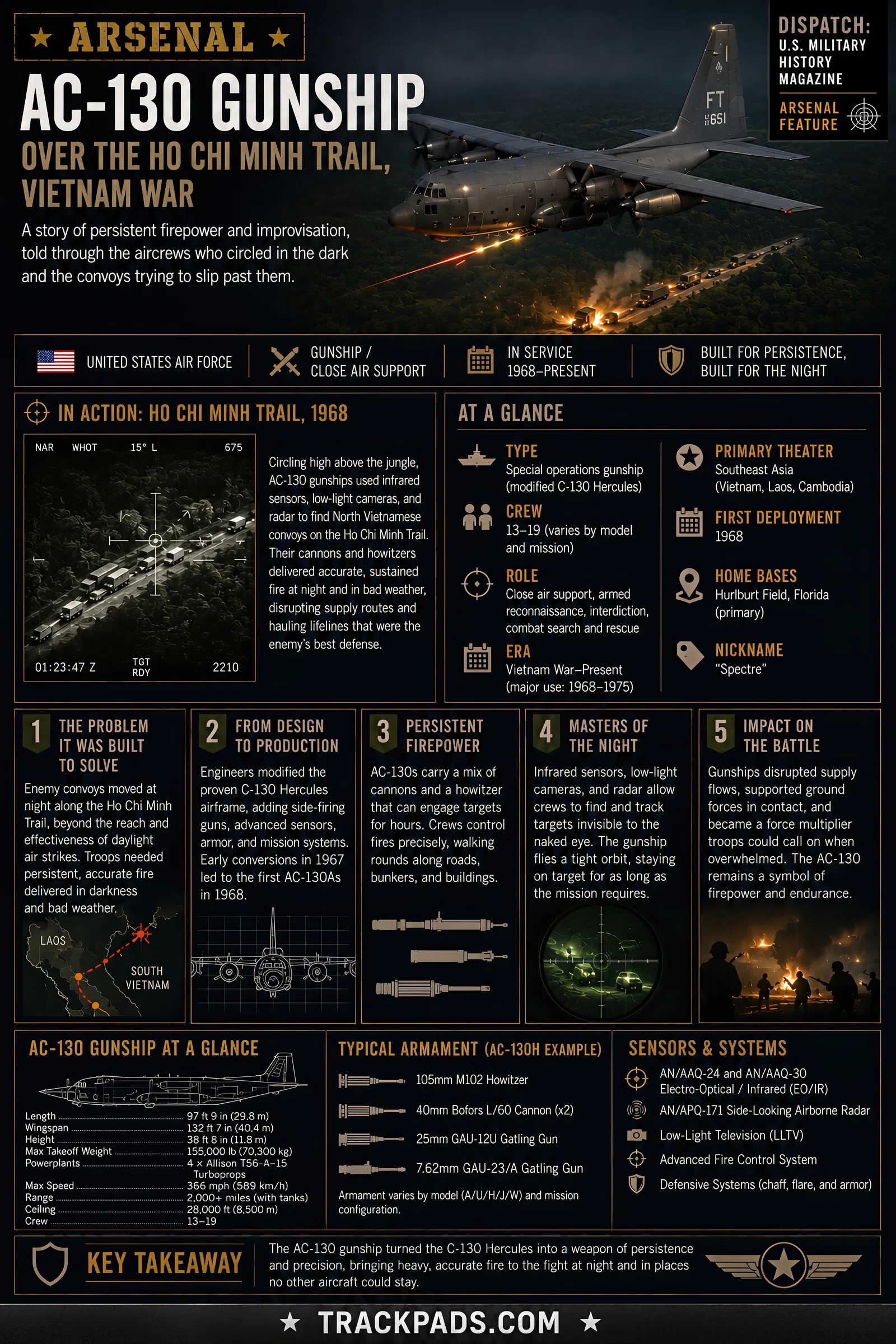
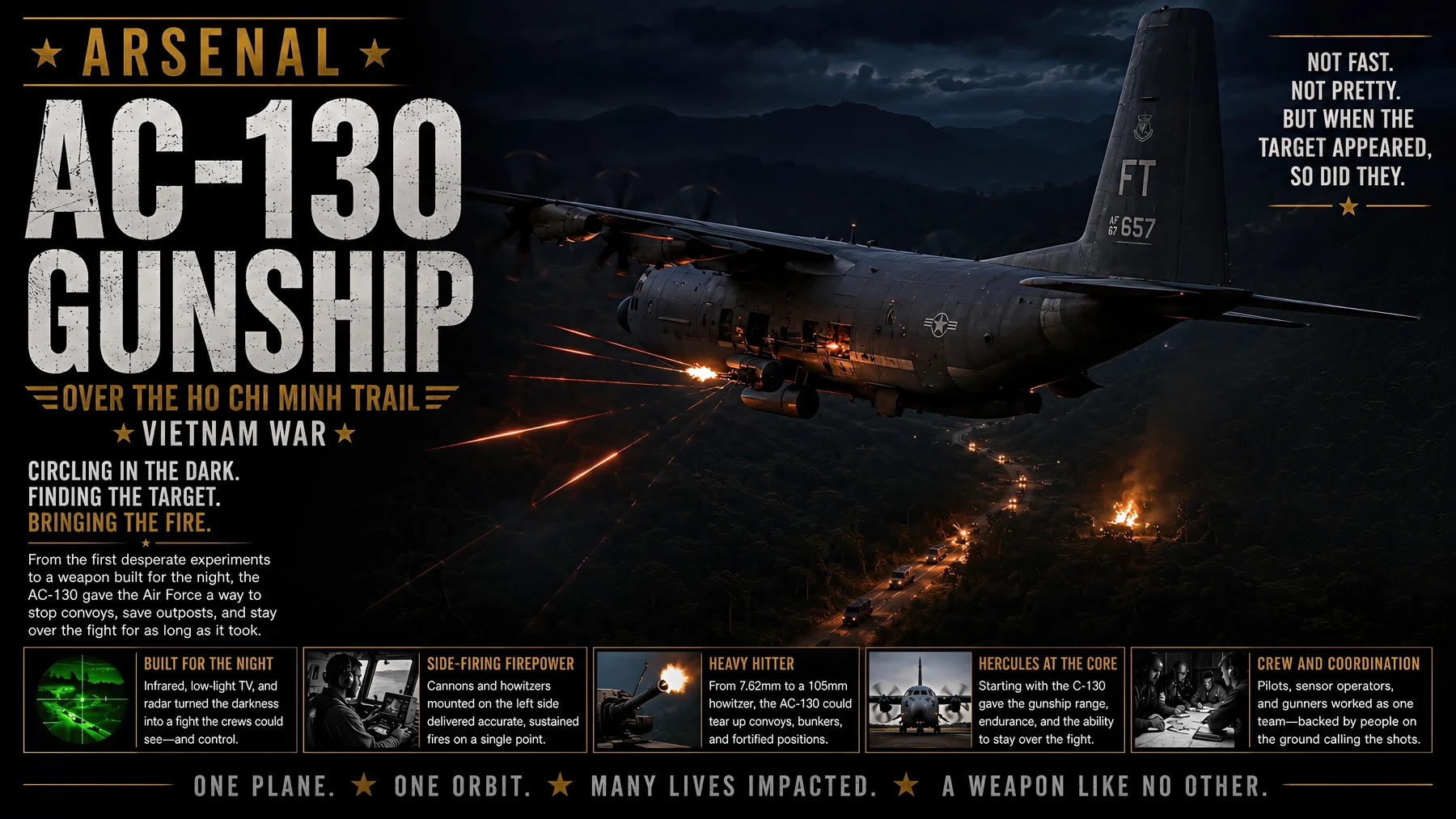
The jungle below is almost completely black, a broken patchwork of tree canopy and narrow dirt roads. Far above, an AC-130 gunship tips into its wide, circling turn, one wing dipped toward the Ho Chi Minh Trail. Inside the dim cargo bay, the air smells of hydraulic fluid and cordite. Green and white images bloom on the sensor screens as the infrared and low-light cameras pull ghosts out of the darkness: trucks, parked nose-to-tail under the trees, engines still hot.
The fire control officer calls out bearings and ranges over the intercom, voice steady and clipped. The pilot holds the orbit, flying a tight pylon turn so the left side of the aircraft always faces the target area. Gunners lean into their stations, hands on the controls of automatic cannons and a howitzer that points sideways from the fuselage. When the trigger call comes, the gunship seems to shudder as the guns open up in sequence.
Outside, streams of red tracer curve down in a slow, deliberate spiral, walking along the road and into the treeline. Secondary explosions mark fuel and ammunition cooking off inside the trucks. On the scopes, the convoy dissolves into scattered hot spots and flickering fires. Far below, anti-aircraft guns answer with orange bursts that climb angrily toward the sound of engines.
For the crew of this AC-130, this is one more night in a long campaign: circling in the dark, hunting supply convoys, and trying to turn a lumbering transport into one of the most feared weapons over the Trail. The machine they are riding did not appear by accident. It is the product of hard lessons about night, jungle, and an enemy determined to move under cover of both.
The Problem It Was Built To Solve
By the middle years of the Vietnam War, the United States Air Force faced a stubborn problem. North Vietnamese forces were feeding men, weapons, and supplies southward along a web of roads and tracks that came to be known collectively as the Ho Chi Minh Trail. Much of that network ran through heavy jungle and steep terrain in Laos and Cambodia, protected by darkness and camouflage. Fast jets could strike bridges and choke points in daylight, but the traffic kept coming at night, and every missed truck meant more firepower reaching the fight.
Early experiments with side-firing gunships had shown promise. Crews flying the smaller AC-47, a modified World War Two-era transport, discovered that by flying a steady circle and pointing machine guns out the side, they could keep a constant stream of fire on a single point on the ground. That made them ideal for defending outposts and hammering targets too close to friendly troops for traditional bombing runs. But the older airframe could only carry so much ammunition, its sensors were limited, and it lacked the endurance to stay on station for as long as commanders wanted.
The Air Force needed something more. It needed an aircraft that could loiter for hours over a battlefield or supply route, carry heavier guns and far more ammunition, and bring along a suite of sensors to find and track targets through cloud, smoke, and darkness. It also had to work within existing industrial realities: new airframes took years to design, test, and produce, and the war was burning now.
The solution was to start with what already existed in numbers: the rugged C-130 Hercules transport. It had the range, payload, and four-engine reliability to stay in the air and soak up modifications. By turning that cargo hauler into a flying gun platform, engineers and tacticians hoped to create a weapon tailored for close air support and night interdiction, able to stalk the Trail and guard isolated troops in the same long, circling orbit. The decision to turn the Hercules into a gunship would lead directly to the aircraft the crews over Laos simply called “Spectre.”
From Design Board To Production
Turning the C-130 Hercules into a gunship began as a practical wartime improvisation rather than a clean-sheet design. Engineers and tacticians looked at the problems over the Ho Chi Minh Trail and in besieged outposts and saw that fast jets were not the answer on their own. What they needed was time over the target, accuracy at night, and the ability to put a lot of fire into a very small area without relying on high-speed passes. The proven C-130 transport already offered long range, a wide cargo bay, and enough electrical power and structural strength to carry heavy guns and bulky sensors.
The early conversion work, often referred to under special project names, centered on cutting new windows and mounting guns down the port side of the fuselage. Designers added low-light television cameras, infrared sensors, and side-looking radar to find targets through darkness, haze, and jungle canopy. Inside, they built operator consoles so sensors and fire control could talk directly to the pilot and gunners. The idea was simple to describe but demanding to execute: everything had to work together while the aircraft flew a constant pylon turn, keeping its weapons pointed at a single point on the ground.
Tradeoffs came quickly. Heavy guns and ammunition loads ate into available payload and increased structural stress. Extra sensors and crew stations drew more electrical power and added complexity, which in turn demanded careful attention to reliability and maintenance. Balancing these factors meant choosing a mix of guns that could deal with trucks, bunkers, and troops without making the aircraft too heavy or fragile. Over several iterations, the design settled on a combination of rapid-firing automatic cannon for suppressing fire and a larger howitzer for smashing hardened targets.
At a glance, the AC-130 emerged as a side-firing gunship built in the United States on the C-130 Hercules airframe for the United States Air Force during the Vietnam War. It typically carried a crew of more than a dozen, from pilots and navigators to sensor operators and gunners. Its primary armament mixed smaller automatic cannon with a forty millimeter gun and, on many aircraft, a one hundred five millimeter howitzer. In service it traded high speed for the ability to loiter for hour after hour at medium altitude, circling the battlefield and stacking its firepower on call.
Inside The Weapon
Walking through an AC-130 on the ground, it is easy to forget that the airframe began life as a cargo hauler. The forward section remains recognizable: a flight deck with pilot and copilot side by side, a navigator’s station, and a flight engineer managing the health of the four turboprop engines and electrical systems. Behind them the familiar cargo bay has been transformed into a packed, dimly lit combat workspace. Instead of pallets and cargo nets, there are racks of electronics, sensor consoles with glowing screens, ammunition racks, and the breeches of guns pointing out through reinforced openings in the left side of the fuselage.
Crew positions are spread along this space in a way that reflects both the heritage of the transport and the demands of a flying weapons system. The pilots fly the orbit, keeping the aircraft in the correct bank and speed so the guns stay on target. The navigator and fire control officer work closely together, translating sensor data into precise coordinates and gun orders. Sensor operators sit at their consoles watching grainy, sometimes flickering images from infrared cameras and low-light television, calling out moving targets and confirming hits. Gunners stand at or near their weapons, monitoring feeds, handling misfires, and helping manage the enormous volume of ammunition that flows through the guns during a mission.
Major subsystems are all tuned to the needs of this mission. Armament includes the side-mounted guns themselves, along with their ammunition feeds, recoil systems, and sighting controls. Protection is mainly a matter of altitude, tactics, and some armor around critical areas rather than heavy plating over the whole airframe. Propulsion comes from the four turboprop engines that give the C-130 family its characteristic steady drone and allow the gunship to hold an orbit over a point almost as if it were hanging from the sky. Sensors and fire control are the heart of the weapon system, turning scattered heat signatures on the ground into carefully plotted aim points.
Life on board during a mission is a mix of routine and sudden violence. The cargo bay is kept dim to preserve night vision, and crew members move carefully around the equipment as the aircraft banks through its turns. Communication is constant, running on intercom nets that link pilots, controllers, and gunners in a continuous loop of updates and confirmations. Training emphasizes checklists and standard calls, but many veterans remembered how quickly reality could diverge from neat classroom diagrams once enemy fire began to climb toward the orbit. The sound of the guns, the jolt of recoil through the airframe, and the sight of explosions far below all reminded them that this was still a transport at heart, pushed into a very different role and held together by the skill and focus of the people inside it.
Baptism Of Fire
The AC-130’s first real proving ground came over the same jungle roads where our opening scene unfolds. As the campaign to cut the Ho Chi Minh Trail intensified, gunships were tasked to fly long, lonely orbits over sections of the route identified by reconnaissance and trail-watching sensors. On a typical night, a crew might check in just after dusk, take handoff from a ground radar or forward air controller, and then start building a picture of movement along the roads and river crossings below. Convoys tended to move in short bursts between hiding places, so the gunship’s value lay in watching patiently until signs of life appeared on the infrared scopes.
When they did, the transition from quiet scanning to violent action could be abrupt. Sensor operators would call out “hot trucks” or “engines running,” fire control would refine the aim point, and the pilot would trim the aircraft into that steady pylon turn that kept the guns fixed on the target. Once cleared to fire, the smaller automatic cannon stitched the road and verges, driving drivers from their cabs and disrupting any attempt to scatter. The forty millimeter and one hundred five millimeter guns followed, smashing vehicles under the canopy and collapsing revetments that had been dug alongside the trail. Many crews remembered how the infrared view would suddenly blossom with secondary explosions as fuel and ammunition went up.
These missions did not go unopposed. North Vietnamese forces responded by adding more anti-aircraft guns along likely choke points, moving guns frequently, and timing movements to exploit bad weather and moonless nights. The AC-130s, flying predictable orbits, became desirable targets. Crews learned to shift altitude and vary patterns, and planners worked to keep them under the umbrella of fighter cover and suppression of enemy air defenses where possible. Nevertheless, the losses and damage they suffered underscored the risk of bringing a slow, heavily loaded aircraft into defended airspace. The baptism of fire over the Trail was therefore not just a story of effectiveness against trucks, but a harsh teacher in how far a gunship could be pushed against a determined opponent.
Over time, reports from the Trail and from the defense of remote outposts built a reputation around the AC-130 that extended beyond raw damage claims. Infantry on the ground came to trust that once a gunship was overhead, the night itself seemed to tilt in their favor. Commanders valued the ability to hold a piece of sky and pour accurate fire into a single ravine, ridge, or road junction for as long as fuel and ammunition lasted. In return, the crews understood that each orbit tied them more tightly to the fate of those below, whether they were guarding a perimeter or hunting convoys whose wreckage would never make it into official summaries.
Strengths And Weaknesses
From the perspective of those who flew, maintained, and fought under the AC-130, its strengths were immediately obvious. It combined endurance, firepower, and precision in a way that few other aircraft could match. The ability to circle a point for hours meant that it could respond quickly to shifting threats within its orbit instead of cycling in and out like a fast jet on a timed run. Sensors and fire control let crews pick out single vehicles, gun pits, or even small groups of troops and engage them with bursts of fire rather than broad, area-effect bombing. For ground units under pressure, the psychological impact of hearing that steady drone and seeing the spiraling arcs of tracer fire could be as important as the physical damage inflicted.
Commanders appreciated that the gunship could bridge roles. It served as a close air support platform for besieged firebases and an interdiction tool over the Trail, sometimes in the same night. Maintainers valued the underlying toughness of the C-130 airframe, already well known in transport service, and the relatively familiar engines and systems that kept downtime manageable despite the extra complexity. In combat, the combination of different gun calibers allowed crews to match fire to target, using lighter bursts where friendlies were close and reserving the heavier guns for more isolated or hardened positions.
Those same qualities carried clear limitations. The aircraft’s size and speed made it vulnerable to concentrated anti-aircraft fire and, in later conflicts, to more sophisticated surface-to-air missiles. It needed air superiority, or at least a heavily suppressed air defense environment, to operate safely. Weather and terrain could mask targets or force altitudes that reduced the effectiveness of the guns. Complex sensors and fire control gear required careful maintenance and meant that not every aircraft could be kept at peak readiness, especially in austere forward locations. Enemies adapted by moving under heavier canopy, dispersing convoys, and using decoys or short bursts of movement to complicate target detection.
Compared with fast jets and attack helicopters, the AC-130 was slower to arrive from distant bases but far more persistent once overhead. It could not match a jet’s speed or an attack helicopter’s ability to duck behind terrain, yet it offered a steadier, more constant presence. Opponents learned to fear nights when a gunship was known to be in the area, but they also drew comfort from thick clouds, heavy rain, and the knowledge that even a powerful weapon system has edges beyond which it becomes too risky to send.
Variants And Evolution
The first AC-130s that entered service during the Vietnam War were relatively simple conversions compared to what would follow. Early aircraft carried combinations of twenty millimeter Vulcan cannons and forty millimeter guns, along with the initial generation of low-light and infrared sensors. Experience over the Trail and around besieged bases quickly showed where improvements were needed. Crews asked for better target identification, more reliable fire control, and refinements to gun layouts that would ease ammunition handling and maintenance under the pressures of combat.
Subsequent variants methodically incorporated these lessons. Additional sensor types were added or upgraded, including more capable infrared systems and radar optimized for spotting moving targets on the ground. Fire control computers became more sophisticated, helping to account for aircraft motion, ballistic trajectories, and environmental conditions in real time. Gun arrangements shifted as designers experimented with different mixes of calibers to balance rate of fire, destructive power, and the sheer weight of ammunition that could be carried. In some later versions, smaller guns were replaced by medium-caliber weapons, and precision-guided munitions were introduced to complement traditional side-firing cannon.
As the strategic environment changed, so did the gunship’s missions. After Vietnam, AC-130 variants appeared in smaller conflicts and operations where air superiority and limited enemy air defenses allowed them to exploit their strengths. Whether providing overwatch during urban fighting, supporting special operations forces deep inside hostile territory, or striking fleeting targets at night, they continued to evolve through software, sensor, and weapon upgrades rather than constant redesign of the basic airframe. Export or license-built equivalents never proliferated widely, in part because the concept depended on the specific combination of airframe, doctrine, and support network that the United States Air Force and its special operations community had developed.
Legacy And Where To See It Today
The legacy of the AC-130 gunship reaches well beyond the jungles of Southeast Asia. It helped solidify the idea that airpower could be more than fast strikes and high-altitude bombing. Instead, it demonstrated that a patient, persistent aircraft with the right sensors and weapons could serve almost as an aerial artillery battery, closely tied to the needs of troops on the ground. Later doctrines for close air support and special operations aviation drew heavily on the lessons gunship crews had recorded about communication, target discrimination, and coordination in complex environments.
Technically, the integration of advanced sensors, fire control computers, and side-firing guns anticipated later trends in networked warfare. Crews learned to fuse information from multiple sources, including ground observers, airborne controllers, and their own instruments, into a single, coherent picture of the battlefield. This practice influenced broader thinking about how to connect aircraft, ground forces, and command centers in real time. Even as new platforms and unmanned systems emerged, the idea of a human crew looking at live sensor feeds, making judgments, and applying highly accurate fire remained central to many operations.
For those who want to see the outline of a gunship in person, preserved examples stand at air parks and museums associated with the Hercules story and with special operations units. Visitors can walk around the distinctive profile of the C-130 airframe and, in some displays, see the reinforced openings where the guns once pointed. Inside, the cramped spaces and equipment racks give a sense of how many people and machines had to work together to keep the orbit stable and the fire controlled. Photographs and video, including coverage collected by projects like Trackpads, help show the gunship in its natural element: banking in the night sky, tracers spiraling downward.
Within the broader story told by Dispatch: U.S. Military History Magazine, the AC-130 connects naturally to accounts of convoys on the Trail, ground units holding remote outposts, and the evolving partnership between pilots and infantry in later conflicts. It sits alongside other Arsenal features on transport aircraft turned into weapons, and complements Beyond the Call stories where air support made the difference between survival and loss. Above all, its legacy reminds readers and listeners that every orbit, every burst of fire, and every burning truck involved crews who accepted the risks of flying slow and low in dangerous skies, and opponents on the ground who faced a weapon they could hear long before they could see it.