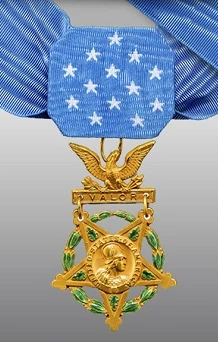
Medal of Honor
October 22, 2015
Kirkuk Province, Iraq
- Rank at action
- Sergeant First Class
- Service
- U.S. Army
- Conflict
- Operation Inherent Resolve
- Unit or command
- U.S. Army special operations assault force
- Presentation date
- September 11, 2020
The Citation
Sources ↓Sergeant First Class Thomas P. Payne distinguished himself by conspicuous gallantry and intrepidity, above and beyond the call of duty, on October 22, 2015, during a daring nighttime hostage rescue in Kirkuk Province, Iraq, in support of Operation INHERENT RESOLVE. Sergeant Payne led a combined assault team charged with clearing one of two buildings known to house the hostages. With speed, audacity, and courage, he led his team as they quickly cleared the assigned building, liberating 38 hostages. Upon hearing a request for additional assaulters to assist with clearing the other building, Sergeant Payne, on his own initiative, left his secured position, exposing himself to enemy fire as he bounded across the compound to the other building from which entrenched enemy forces were engaging his comrades. Sergeant Payne climbed a ladder to the building’s roof, which was partially engulfed in flames, and engaged enemy fighters below with grenades and small arms fire. He then moved back to ground level to engage the enemy forces through a breach hole in the west side of the building. Knowing time was running out for the hostages trapped inside the burning building, Sergeant Payne moved to the main entrance, where heavy enemy fire had thwarted previous attempts to enter. He knowingly risked his own life by bravely entering the building under intense enemy fire, enduring smoke, heat, and flames to identify the armored door imprisoning the hostages. Upon exiting, Sergeant Payne exchanged his rifle for bolt cutters, and again entered the building, ignoring the enemy rounds impacting the walls around him as he cut the locks on a complex locking mechanism. His courageous actions motivated the coalition assault team members to enter the breach and assist with cutting the locks. After exiting to catch his breath, he reentered the building to make the final lock cuts, freeing 37 hostages. Sergeant Payne then facilitated the evacuation of the hostages, even though ordered to evacuate the collapsing building himself, which was now structurally unsound due to the fire. Sergeant Payne then reentered the burning building one last time to ensure everyone had been evacuated. He consciously exposed himself to enemy automatic gunfire each time he entered the building. His extraordinary heroism and selfless actions were key to liberating 75 hostages during a contested rescue mission that resulted in 20 enemies killed in action. Sergeant First Class Payne’s gallantry under fire and uncommon valor are in keeping with the highest traditions of military service and reflect great credit upon himself, the United States Special Operations Command, and the United States Army.
Sources & record notes
General Order comparison: pending. Current-profile review does not mean that the underlying original order has been examined.
- Thomas Patrick Payne — official service cross-reference ↗U.S. Army · Checked 2026-08-21
official-service action, presentation, and recipient cross-reference
- Thomas Patrick Payne — current citation source ↗Congressional Medal of Honor Society · Checked 2026-08-21
current identity, action metadata, and full citation transcription
Transcription, metadata & provenance notes
- Award ID
- MOH-AW-000027
- Transcription status
- Current-source full text
- Last source check
- 2026-08-21
- Archive transcription SHA-256
- 081c6b676a7581f49a7721a55122b4ac2d696c060bc2558b914c4ef9a627e5b5
Nonbreaking spaces and line wrapping normalized; wording otherwise retained.
Former excerpt replaced with the complete current Society citation; official U.S. Army page retained as a service cross-reference.