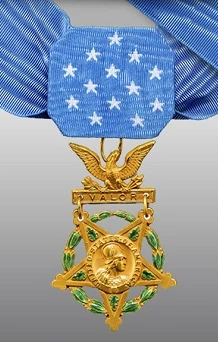
- Rank at action
- First Lieutenant
- Service
- U.S. Army Air Corps
- Conflict
- World War II
- Unit or command
- 346th Fighter Squadron, 350th Fighter Group, 12th Air Force
- Presentation date
- September 24, 1945
He piloted a fighter-bomber aircraft in a series of low-level strafing missions, destroying 14 grounded enemy aircraft and leading attacks which wrecked 10 others during a critical period of the Allied drive in northern Italy. On the morning of 24 April, he volunteered to lead 2 other aircraft against the strongly defended enemy airdrome at Ghedi. Ordering his fellow pilots to remain aloft, he skimmed the ground through a deadly curtain of antiaircraft fire to reconnoiter the field, locating 8 German aircraft hidden beneath heavy camouflage. He rejoined his flight, briefed them by radio, and then led them with consummate skill through the hail of enemy fire in a low-level attack, destroying 5 aircraft, while his flight accounted for 2 others. Returning to his base, he volunteered to lead 3 other aircraft in reconnaissance of Bergamo airfield, an enemy base near Ghedi and 1 known to be equally well defended. Again ordering his flight to remain out of range of antiaircraft fire, 1st Lt. Knight flew through an exceptionally intense barrage, which heavily damaged his Thunderbolt, to observe the field at minimum altitude. He discovered a squadron of enemy aircraft under heavy camouflage and led his flight to the assault. Returning alone after this strafing, he made 10 deliberate passes against the field despite being hit by antiaircraft fire twice more, destroying 6 fully loaded enemy twin-engine aircraft and 2 fighters. His skillfully led attack enabled his flight to destroy 4 other twin-engine aircraft and a fighter plane. He then returned to his base in his seriously damaged plane. Early the next morning, when he again attacked Bergamo, he sighted an enemy plane on the runway. Again he led 3 other American pilots in a blistering low-level sweep through vicious antiaircraft fire that damaged his plane so severely that it was virtually nonflyable. Three of the few remaining enemy twin-engine aircraft at that base were destroyed. Realizing the critical need for aircraft in his unit, he declined to parachute to safety over friendly territory and unhesitatingly attempted to return his shattered plane to his home field. With great skill and strength, he flew homeward until caught by treacherous air conditions in the Appennines Mountains, where he crashed and was killed. The gallant action of 1st Lt. Knight eliminated the German aircraft which were poised to wreak havoc on Allied forces pressing to establish the first firm bridgehead across the Po River; his fearless daring and voluntary self-sacrifice averted possible heavy casualties among ground forces and the resultant slowing on the German drive culminated in the collapse of enemy resistance in Italy.
Sources & record notes
General Order comparison: pending. Current-profile review does not mean that the underlying original order has been examined.
- Raymond Larry Knight — current Society profile ↗Congressional Medal of Honor Society · Checked 2026-08-30
current identity, service, action metadata, and citation comparison
Transcription, metadata & provenance notes
- Award ID
- MOH-AW-002471
- Transcription status
- Legacy full text · current reference profile matched
- Last source check
- 2026-08-30
- Recorded order reference (not verified against the original)
- 81
- Entered service at
- Houston, Tex.
- Archive transcription SHA-256
- e5effdfee3bf19919a87594d66d1cdac1f2f217e9e90369acff4f496e53c8e3a
Legacy transcription retained without substantive editing; rendered current reference profile variants documented in the Phase 10 evidence snapshot.
The inherited rank-1 Society candidate was confirmed by substantive comparison of identity, service, rank, unit or command, action context, and citation; candidate rank or successful rendering alone was not treated as verification. The current evidence expands or normalizes the inherited display name Raymond L. Knight to Raymond Larry Knight; both forms remain preserved. The controlled canonical unit or command is 346th Fighter Squadron, 350th Fighter Group, 12th Air Force; the current structured profile renders 346th Fighter Squadron, 350th Fighter Group, 12th Air Force, and the inherited wording Air Corps remains preserved as a separately attributed variant. The current authoritative evidence controls the action date as 1945-04-24 through 1945-04-25 and classifies the action under World War II; the inherited unnormalized date and conflict values remain preserved. The Society structured action-date field is retained separately as 1945-04-24. The controlled historical action place is Northern Po Valley, Italy; the current structured place Northern Po Valley, Italy and the complete inherited geocoder value Italy remain preserved. The inherited full citation remains canonical and checksum-protected; current rendered wording is preserved separately where transcribed. No underlying General Order was examined, so the exact-order gate remains pending and no General Order verification is claimed.