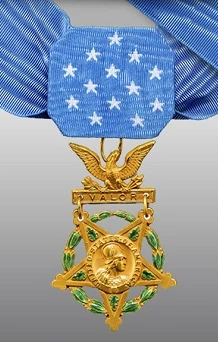
Medal of Honor
September 16–18, 1944
near Scarperia, Italy
- Rank at action
- Sergeant
- Service
- U.S. Army
- Conflict
- World War II
- Unit or command
- Weapons Platoon, Company B, 1st Battalion, 363d Infantry, 91st Infantry Division
- Presentation date
- July 19, 1945
The Citation
Sources ↓(then Pfc.) He practically single-handed protected the left flank of his company's position in the offensive to break the German's gothic line. Company B was the extreme left assault unit of the corps. The advance was stopped by heavy fire from Monticelli Ridge, and the company took cover behind an embankment. Sgt. Johnson, a mortar gunner, having expended his ammunition, assumed the duties of a rifleman. As leader of a squad of 7 men he was ordered to establish a combat post 50 yards to the left of the company to cover its exposed flank. Repeated enemy counterattacks, supported by artillery, mortar, and machinegun fire from the high ground to his front, had by the afternoon of 16 September killed or wounded all his men. Collecting weapons and ammunition from his fallen comrades, in the face of hostile fire, he held his exposed position and inflicted heavy casualties upon the enemy, who several times came close enough to throw hand grenades. On the night of 1617 September, the enemy launched his heaviest attack on Company B, putting his greatest pressure against the lone defender of the left flank. In spite of mortar fire which crashed about him and machinegun bullets which whipped the crest of his shallow trench, Sgt. Johnson stood erect and repulsed the attack with grenades and small arms fire. He remained awake and on the alert throughout the night, frustrating all attempts at infiltration. On 17 September, 25 German soldiers surrendered to him. Two men, sent to reinforce him that afternoon, were caught in a devastating mortar and artillery barrage. With no thought of his own safety, Sgt. Johnson rushed to the shell hole where they lay half buried and seriously wounded, covered their position by his fire, and assisted a Medical Corpsman in rendering aid. That night he secured their removal to the rear and remained on watch until his company was relieved. Five companies of a German paratroop regiment had been repeatedly committed to the attack on Company B without success. Twenty dead Germans were found in front of his position. By his heroic stand and utter disregard for personal safety, Sgt. Johnson was in a large measure responsible for defeating the enemy's attempts to turn the exposed left flank.
Sources & record notes
General Order comparison: pending. Current-profile review does not mean that the underlying original order has been examined.
- Oscar Godfrey Johnson Jr. — Congressional Medal of Honor Society recipient profile ↗Congressional Medal of Honor Society · Checked 2026-09-02
current identity, service, action metadata, and citation comparison
Transcription, metadata & provenance notes
- Award ID
- MOH-AW-003452
- Transcription status
- Legacy full text · current reference profile matched
- Last source check
- 2026-09-02
- Recorded order reference (not verified against the original)
- 58
- Entered service at
- Foster City, Mich.
- Archive transcription SHA-256
- b1168e92d398fbe9a5904ae71dd5b8f354f5d8cfbaa078129f042e7225623923
Legacy transcription retained without substantive editing; rendered current reference profile comparison is documented in the Phase 10 evidence snapshot.
The current Society structured rank field and the citation narrative preserve rank-at-action and later-rank context as source-attributed variants.