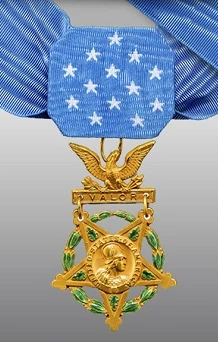
Medal of Honor
October 2, 2012
Kapisa Province, Afghanistan
- Rank at action
- Second Lieutenant
- Service
- U.S. Army
- Conflict
- War on Terrorism (Afghanistan)
- Unit or command
- Company C, 2d Battalion, 12th Infantry Regiment
- Presentation date
- June 18, 2026
The Citation
Sources ↓Second Lieutenant Nicholas Dockery distinguished himself by acts of gallantry and intrepidity above and beyond the call of duty on October 2, 2012, while serving as a Platoon Leader, 2d Battalion, 12th Infantry Regiment, 4th Brigade, 4th Infantry Division in Kapisa Province, Afghanistan. On this day, Second Lieutenant Nicholas Dockery’s platoon and associated Afghan forces were ambushed by an estimated 150 Taliban fighters. Ordered to eliminate the threat, Lieutenant Dockery planned and led an assault on the enemy forces. Lieutenant Dockery traversed 100 yards of open terrain under enemy fire to reach U.S. forces in need of assistance. Hearing a U.S. soldier had been wounded, Lieutenant Dockery fought his way to soldiers who were taking cover in a building that was occupied by enemy fighters. Realizing the immediate danger, he organized and led the forces in clearing six rooms of the multi-level compound, killing one enemy fighter and detaining two others. When an enemy grenade landed nearby, he shoved a team member behind cover preventing him from being killed or wounded by the resulting blast. Attempting to regain momentum after the blast, Lieutenant Dockery led a four-man team to clear the compound’s courtyard before the enemy used a rocket-propelled grenade, resulting in an explosion that incapacitated two soldiers. Although dazed and wounded himself, Lieutenant Dockery went to the aid of the wounded soldiers who were fully exposed to enemy fire. After helping one soldier to his feet, he engaged and killed two enemy fighters who were attempting to approach the other injured soldier. Lieutenant Dockery provided first aid and used his own body to shield the soldier from further injury, saving his life. Air support assets could not differentiate between friendly and enemy positions, so Lieutenant Dockery marked his position on the building’s roof, exposing himself to enemy fire on multiple occasions while providing covering fire to friendly forces evacuating the wounded. He was the last individual to leave the battlefield. Second Lieutenant Dockery’s conspicuous gallantry and intrepidity at the risk of his life, above and beyond the call of duty, are in keeping with the highest traditions of military service and reflect great credit upon himself, his unit, and the United States Army.
Sources & record notes
General Order comparison: pending. Current-profile review does not mean that the underlying original order has been examined.
- Nicholas Dockery — official service cross-reference ↗U.S. Army · Checked 2026-08-21
official-service action, presentation, and recipient cross-reference
- Nicholas Dockery — current citation source ↗Congressional Medal of Honor Society · Checked 2026-08-21
current identity, action metadata, and full citation transcription
Transcription, metadata & provenance notes
- Award ID
- MOH-AW-000028
- Transcription status
- Current-source full text
- Last source check
- 2026-08-21
- Archive transcription SHA-256
- 1940fac57e649bd849c9104f363daa5045c552a10dfe61715414259a62bcaaf1
Superscript ordinal markup normalized; one evident source typo (“solider”) corrected to “soldier” for display.
Former excerpt replaced with the complete current Society citation; official U.S. Army page retained as a service cross-reference.