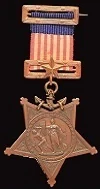
Medal of Honor
March 31, 1899
off the coast of Jamaica, Jamaica
- Rank at action
- Chief Master-of-Arms
- Service
- U.S. Navy
- Conflict
- Interim 1899 - 1910
- Unit or command
- U.S.S. New York
The Citation
Sources ↓On board the U.S.S. New York off the coast of Jamaica, 31 March 1899. Showing gallant conduct, Stokes jumped overboard and assisted in the rescue of Peter Mahoney, watertender, U.S. Navy.
Sources & record notes
General Order comparison: pending. Current-profile review does not mean that the underlying original order has been examined.
- John S Stokes — current Society profile ↗Congressional Medal of Honor Society · Checked 2026-08-31
current identity, service, action metadata, and citation comparison
Transcription, metadata & provenance notes
- Award ID
- MOH-AW-002697
- Transcription status
- Legacy full text · current reference profile matched
- Last source check
- 2026-08-31
- Recorded order reference (not verified against the original)
- 525
- Later or highest recorded rank
- Boatswain
- Accredited to
- New York
- Archive transcription SHA-256
- e19033d735f5d6823724d9674db37e084c8991e14660223b03a5c980a0874d67
Legacy transcription retained without substantive editing; rendered current reference profile variants documented in the Phase 10 evidence snapshot.
Controlled Society search recovered the current profile outside the inherited candidate set. Identity, service, rank, unit, action context, and citation were substantively compared; every inherited candidate remains preserved.