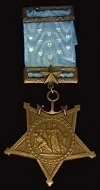
Medal of Honor
1942-04-04 through 1942-04-08
Coral Sea
- Rank at action
- Lieutenant
- Service
- U.S. Navy
- Conflict
- World War II
- Unit or command
- Bombing Squadron 5, U.S.S. Yorktown
The Citation
Sources ↓For distinguished and conspicuous gallantry and intrepidity at the risk of his life above and beyond the call of duty, while pilot of an airplane of Bombing Squadron 5, Lt. Powers participated, with his squadron, in 5 engagements with Japanese forces in the Coral Sea area and adjacent waters during the period 4 to 8 May 1942. Three attacks were made on enemy objectives at or near Tulagi on 4 May. In these attacks he scored a direct hit which instantly demolished a large enemy gunboat or destroyer and is credited with 2 close misses, 1 of which severely damaged a large aircraft tender, the other damaging a 20,000-ton transport. He fearlessly strafed a gunboat, firing all his ammunition into it amid intense antiaircraft fire. This gunboat was then observed to be leaving a heavy oil slick in its wake and later was seen beached on a nearby island. On 7 May, an attack was launched against an enemy airplane carrier and other units of the enemy's invasion force. He fearlessly led his attack section of 3 Douglas Dauntless dive bombers, to attack the carrier. On this occasion he dived in the face of heavy antiaircraft fire, to an altitude well below the safety altitude, at the risk of his life and almost certain damage to his own plane, in order that he might positively obtain a hit in a vital part of the ship, which would insure her complete destruction. This bomb hit was noted by many pilots and observers to cause a tremendous explosion engulfing the ship in a mass of flame, smoke, and debris. The ship sank soon after. That evening, in his capacity as Squadron Gunnery Officer, Lt. Powers gave a lecture to the squadron on point-of-aim and diving technique. During this discourse he advocated low release point in order to insure greater accuracy; yet he stressed the danger not only from enemy fire and the resultant low pull-out, but from own bomb blast and bomb fragments. Thus his low-dive bombing attacks were deliberate and premeditated, since he well knew and realized the dangers of such tactics, but went far beyond the call of duty in order to further the cause which he knew to be right. The next morning, 8 May, as the pilots of the attack group left the ready room to man planes, his indomitable spirit and leadership were well expressed in his own words, "Remember the folks back home are counting on us. 1 am going to get a hit if 1 have to lay it on their flight deck.'' He led his section of dive bombers down to the target from an altitude of 18,000 feet, through a wall of bursting antiaircraft shells and into the face of enemy fighter planes. Again, completely disregarding the safety altitude and without fear or concern for his safety, Lt. Powers courageously pressed home his attack, almost to the very deck of an enemy carrier and did not release his bomb until he was sure of a direct hit. He was last seen attempting recovery from his dive at the extremely low altitude of 200 feet, and amid a terrific barrage of shell and bomb fragments, smoke, flame and debris from the stricken vessel.
Sources & record notes
General Order comparison: pending. Current-profile review does not mean that the underlying original order has been examined.
- John James Powers — Congressional Medal of Honor Society recipient profile ↗Congressional Medal of Honor Society · Checked 2026-09-01
current identity, service, action metadata, and citation comparison
Transcription, metadata & provenance notes
- Award ID
- MOH-AW-002995
- Transcription status
- Legacy full text · current reference profile matched
- Last source check
- 2026-09-01
- Archive transcription SHA-256
- 10c4362500b07b922859cab56c02805802330965cbde4b4cb52982cdd18355f0
Legacy transcription retained without substantive editing; rendered current reference profile comparison is documented in the Phase 10 evidence snapshot.
The current Society structured field says April 4–8, 1942, while the citation repeatedly says May 4–8, 1942. The structured field is retained as captured and the conflict is explicitly documented.