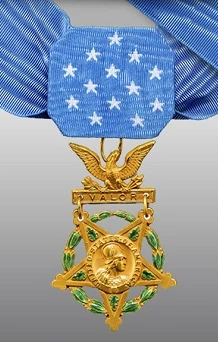
Medal of Honor
April 23, 1944–April 24, 1944
near Padiglione, Italy
- Rank at action
- Private First Class
- Service
- U.S. Army
- Conflict
- World War II
- Unit or command
- Company A, 30th Infantry, 3d Infantry Division
- Presentation date
- October 2, 1944
The Citation
Sources ↓For conspicuous gallantry and intrepidity at risk of life above and beyond the call of duty. At the start of his company's attack on strongly held enemy positions in and around Spaccasassi Creek, near Padiglione, Italy, on the night of 23-24 April 1944, Pfc. Squires, platoon messenger, participating in his first offensive action, braved intense artillery, mortar, and antitank gun fire in order to investigate the effects of an antitank mine explosion on the leading platoon. Despite shells which burst close to him, Pfc. Squires made his way 50 yards forward to the advance element, noted the situation, reconnoitered a new route of advance and informed his platoon leader of the casualties sustained and the alternate route. Acting without orders, he rounded up stragglers, organized a group of lost men into a squad and led them forward. When the platoon reached Spaccasassi Creek and established an outpost, Pfc. Squires, knowing that almost all of the noncommissioned officers were casualties, placed 8 men in position of his own volition, disregarding enemy machinegun, machine-pistol, and grenade fire which covered the creek draw. When his platoon had been reduced to 14 men, he brought up reinforcements twice. On each trip he went through barbed wire and across an enemy minefield, under intense artillery and mortar fire. Three times in the early morning the outpost was counterattacked. Each time Pfc. Squires ignored withering enemy automatic fire and grenades which struck all around him, and fired hundreds of rounds of rifle, Browning automatic rifle, and captured German Spandau machinegun ammunition at the enemy, inflicting numerous casualties and materially aiding in repulsing the attacks. Following these fights, he moved 50 yards to the south end of the outpost and engaged 21 German soldiers in individual machinegun duels at point-blank range, forcing all 21 enemy to surrender and capturing 13 more Spandau guns. Learning the function of this weapon by questioning a German officer prisoner, he placed the captured guns in position and instructed other members of his platoon in their operation. The next night when the Germans attacked the outpost again he killed 3 and wounded more Germans with captured potato-masher grenades and fire from his Spandau gun. Pfc. Squires was killed in a subsequent action.
Sources & record notes
General Order comparison: pending. Current-profile review does not mean that the underlying original order has been examined.
- John C Squires — current Society profile ↗Congressional Medal of Honor Society · Checked 2026-08-31
current identity, service, action metadata, and citation comparison
Transcription, metadata & provenance notes
- Award ID
- MOH-AW-002688
- Transcription status
- Legacy full text · current reference profile matched
- Last source check
- 2026-08-31
- Recorded order reference (not verified against the original)
- 78
- Later or highest recorded rank
- Sergeant
- Entered service at
- Louisville, Ky.
- Archive transcription SHA-256
- 0c32e2f6b2514d543b289fc14fd6e8a17cb88ef906e71c64e2f51f95bc2dcdda
Legacy transcription retained without substantive editing; rendered current reference profile variants documented in the Phase 10 evidence snapshot.
Current reference profile was substantively compared against the inherited identity, service, rank, unit or command, action context, and citation. Candidate rank or successful page rendering alone was not treated as verification.