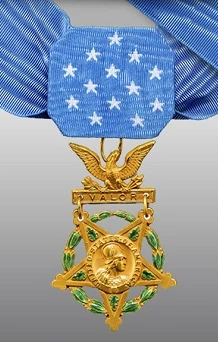
- Rank at action
- Staff Sergeant
- Service
- U.S. Army
- Conflict
- Vietnam War
- Unit or command
- Company A, 2d Battalion, 2d Infantry, 1st Infantry Division
For conspicuous gallantry and intrepidity in action at the risk of his life above and beyond the call of duty. S/Sgt. Bondsteel distinguished himself while serving as a platoon sergeant with Company A, near the village of Lang Sau. Company A was directed to assist a friendly unit which was endangered by intense fire from a North Vietnamese Battalion located in a heavily fortified base camp. S/Sgt. Bondsteel quickly organized the men of his platoon into effective combat teams and spearheaded the attack by destroying 4 enemy occupied bunkers. He then raced some 200 meters under heavy enemy fire to reach an adjoining platoon which had begun to falter. After rallying this unit and assisting their wounded, S/Sgt. Bondsteel returned to his own sector with critically needed munitions. Without pausing he moved to the forefront and destroyed 4 enemy occupied bunkers and a machine gun which had threatened his advancing platoon. Although painfully wounded by an enemy grenade, S/Sgt. Bondsteel refused medical attention and continued his assault by neutralizing 2 more enemy bunkers nearby. While searching one of these emplacements S/Sgt. Bondsteel narrowly escaped death when an enemy soldier detonated a grenade at close range. Shortly thereafter, he ran to the aid of a severely wounded officer and struck down an enemy soldier who was threatening the officer's life. S/Sgt. Bondsteel then continued to rally his men and led them through the entrenched enemy until his company was relieved. His exemplary leadership and great personal courage throughout the 4-hour battle ensured the success of his own and nearby units, and resulted in the saving of numerous lives of his fellow soldiers. By individual acts of bravery he destroyed 10 enemy bunkers and accounted for a large toll of the enemy, including 2 key enemy commanders. His extraordinary heroism at the risk of his life was in the highest traditions of the military service and reflect great credit on him, his unit, and the U.S. Army.
Sources & record notes
General Order comparison: pending. Current-profile review does not mean that the underlying original order has been examined.
- James Leroy Bondsteel — current Society profile ↗Congressional Medal of Honor Society · Checked 2026-08-30
current identity, service, action metadata, and citation comparison
Transcription, metadata & provenance notes
- Award ID
- MOH-AW-002011
- Transcription status
- Legacy full text · current reference profile matched
- Last source check
- 2026-08-30
- Later or highest recorded rank
- Master Sergeant
- Entered service at
- Detroit, Mich.
- Archive transcription SHA-256
- 79713000215626ca16e379588d1d4c9009af70f3c8db7712829d2ca0212fdd90
Legacy transcription retained without substantive editing; rendered current reference profile variants documented in the Phase 10 evidence snapshot.
The profile's structured and explanatory rank renderings are retained separately: Staff Sergeant (highest rank: Master Sergeant) The current profile records later or highest rank Master Sergeant; it is stored separately from rank at time of action. The current historical action-place wording replaces only the controlled canonical geocoder field; the complete inherited place remains preserved. The current authoritative profile classifies the action under Vietnam War; the inherited Not yet classified value remains preserved in the audit record.