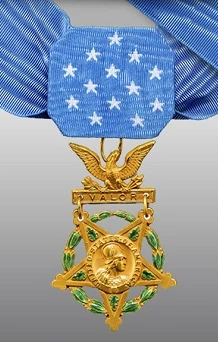
- Rank at action
- Staff Sergeant
- Service
- U.S. Army
- Conflict
- World War II
- Unit or command
- Company I, 120th Infantry, 30th Infantry Division
- Presentation date
- April 6, 1945
For conspicuous gallantry and intrepidity at the risk of his life above and beyond the call of duty on 12 October 1944. When Company I was advancing on the town of Bardenberg, Germany, they reached a point approximately two-thirds of the distance through the town when they were pinned down by fire from a nest of enemy machineguns. This enemy strong point was protected by a lone machinegun strategically placed at an intersection and firing down a street which offered little or no cover or concealment for the advancing troops. The elimination of this protecting machinegun was imperative in order that the stronger position it protected could be neutralized. After repeated and unsuccessful attempts had been made to knock out this position, S/Sgt. Pendleton volunteered to lead his squad in an attempt to neutralize this strongpoint. S/Sgt. Pendleton started his squad slowly forward, crawling about 10 yards in front of his men in the advance toward the enemy gun. After advancing approximately 130 yards under the withering fire, S/Sgt. Pendleton was seriously wounded in the leg by a burst from the gun he was assaulting. Disregarding his grievous wound, he ordered his men to remain where they were, and with a supply of handgrenades he slowly and painfully worked his way forward alone. With no hope of surviving the veritable hail of machinegun fire which he deliberately drew onto himself, he succeeded in advancing to within 10 yards of the enemy position when he was instantly killed by a burst from the enemy gun. By deliberately diverting the attention of the enemy machine gunners upon himself, a second squad was able to advance, undetected, and with the help of S/Sgt. Pendleton's squad, neutralized the lone machinegun, while another platoon of his company advanced up the intersecting street and knocked out the machinegun nest which the first gun had been covering. S/Sgt. Pendleton's sacrifice enabled the entire company to continue the advance and complete their mission at a critical phase of the action.
Sources & record notes
General Order comparison: pending. Current-profile review does not mean that the underlying original order has been examined.
- Jack James Pendleton — current Society profile ↗Congressional Medal of Honor Society · Checked 2026-08-30
current identity, service, action metadata, and citation comparison
Transcription, metadata & provenance notes
- Award ID
- MOH-AW-001939
- Transcription status
- Legacy full text · current reference profile matched
- Last source check
- 2026-08-30
- Recorded order reference (not verified against the original)
- 24
- Entered service at
- Yakima, Wash.
- Archive transcription SHA-256
- 13d92a9188a20a43717a933d9049cef195dadbe7945e8d536b91bdf7096a082c
Legacy transcription retained without substantive editing; rendered current reference profile variants documented in the Phase 10 evidence snapshot.
The current authoritative source expands or normalizes the inherited name from Jack J. Pendleton to Jack James Pendleton; both renderings remain preserved. The current profile supplies rank at time of action as Staff Sergeant; the inherited rank field remains preserved as None. The current historical action-place wording replaces only the controlled canonical geocoder field; the complete inherited place remains preserved. The current authoritative profile classifies the action under World War II; the inherited unclassified value remains preserved in the audit record.