The Trackpads collection

FIND YOUR NEXT DISCOVERY.

Search the people, battles, citations, stories, books and audio behind military history.

Type at least two letters or numbers.Full search & filters

Medal of Honor Recipient

George Lafayette Mabry Jr.

U.S. Army · World War II

MOH-RC-001925Source-based record

The award

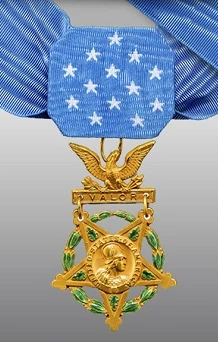
Representative medal image: Army design with a neck ribbon. Not a portrait or a photograph of this recipient’s own medal.
Army Medal of HonorRecorded presentation: 1945

Portrait not yet available. Representative medal shown.

About this image

Representative form selected from the recorded presentation year (1945), not authenticated medal-object provenance.

Medal imagery and historical designs →

Medal of Honor

November 20, 1944

Hurtgen Forest near Schevenhutte, Germany

Rank at action
Lieutenant Colonel
Service
U.S. Army
Conflict
World War II
Unit or command
2d Battalion, 8th Infantry, 4th Infantry Division
Presentation date
September 1, 1945

The Citation

Sources ↓
He was commanding the 2d Battalion, 8th Infantry, in an attack through the Hurtgen Forest on 20 November 1944. During the early phases of the assault, the leading elements of his battalion were halted by a minefield and immobilized by heavy hostile fire. Advancing alone into the mined area, Col. Mabry established a safe route of passage. He then moved ahead of the foremost scouts, personally leading the attack, until confronted by a boobytrapped double concertina obstacle outs, he disconnected the explosives and cut a path through the wire. Upon moving through the opening, he observed 3 enemy in foxholes whom he captured at bayonet point. Driving steadily forward he paced the assault against 3 log bunkers which housed mutually supported automatic weapons. Racing up a slope ahead of his men, he found the initial bunker deserted, then pushed on to the second where he was suddenly confronted by 9 onrushing enemy. Using the butt of his rifle, he felled 1 adversary and bayoneted a second, before his scouts came to his aid and assisted him in overcoming the others in hand-to-hand combat. Accompanied by the riflemen, he charged the third bunker under pointblank small arms fire and led the way into the fortification from which he prodded 6 enemy at bayonet point. Following the consolidation of this area, he led his battalion across 300 yards of fire-swept terrain to seize elevated ground upon which he established a defensive position which menaced the enemy on both flanks, and provided his regiment a firm foothold on the approach to the Cologne Plain. Col. Mabry's superlative courage, daring, and leadership in an operation of major importance exemplify the finest characteristics of the military service.

Sources & record notes

General Order comparison: pending. Current-profile review does not mean that the underlying original order has been examined.

  1. George Lafayette Mabry Jr. — current Society profile ↗Congressional Medal of Honor Society · Checked 2026-08-30

    current identity, service, action metadata, and citation comparison

Transcription, metadata & provenance notes
Award ID
MOH-AW-001933
Transcription status
Legacy full text · current reference profile matched
Last source check
2026-08-30
Recorded order reference (not verified against the original)
77
Later or highest recorded rank
Major General
Entered service at
Sumter, S.C.
Archive transcription SHA-256
b4b6423c8f1aae2be0aaadd95f50704386224a820b91150964cd4ec02fc53ec9

Legacy transcription retained without substantive editing; rendered current reference profile variants documented in the Phase 10 evidence snapshot.

The current authoritative source expands or normalizes the inherited name from George L. Mabry Jr. to George Lafayette Mabry Jr.; both renderings remain preserved. The current profile supplies rank at time of action as Lieutenant Colonel; the inherited rank field remains preserved as None. The current profile records later or highest rank Major General; it is stored separately from rank at time of action. The current historical action-place wording replaces only the controlled canonical geocoder field; the complete inherited place remains preserved. The current authoritative profile classifies the action under World War II; the inherited unclassified value remains preserved in the audit record.