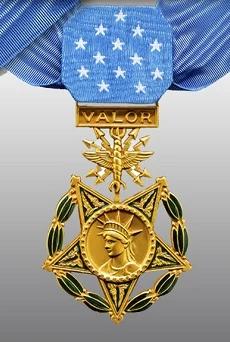
Medal of Honor
August 26, 1967
North Vietnam
- Rank at action
- Major
- Service
- U.S. Air Force
- Conflict
- Vietnam War
- Unit or command
- Misty Super FAC's F-100 Squadron, Phu Cat Air Base
- Presentation date
- March 6, 1976
The Citation
Sources ↓On 26 August 1967, Col. Day was forced to eject from his aircraft over North Vietnam when it was hit by ground fire. His right arm was broken in 3 places, and his left knee was badly sprained. He was immediately captured by hostile forces and taken to a prison camp where he was interrogated and severely tortured. After causing the guards to relax their vigilance, Col. Day escaped into the jungle and began the trek toward South Vietnam. Despite injuries inflicted by fragments of a bomb or rocket, he continued southward surviving only on a few berries and uncooked frogs. He successfully evaded enemy patrols and reached the Ben Hai River, where he encountered U.S. artillery barrages. With the aid of a bamboo log float, Col. Day swam across the river and entered the demilitarized zone. Due to delirium, he lost his sense of direction and wandered aimlessly for several days. After several unsuccessful attempts to signal U.S. aircraft, he was ambushed and recaptured by the Viet Cong, sustaining gunshot wounds to his left hand and thigh. He was returned to the prison from which he had escaped and later was moved to Hanoi after giving his captors false information to questions put before him. Physically, Col. Day was totally debilitated and unable to perform even the simplest task for himself. Despite his many injuries, he continued to offer maximum resistance. His personal bravery in the face of deadly enemy pressure was significant in saving the lives of fellow aviators who were still flying against the enemy. Col. Day's conspicuous gallantry and intrepidity at the risk of his life above and beyond the call of duty are in keeping with the highest traditions of the U.S. Air Force and reflect great credit upon himself and the U.S. Armed Forces.
Sources & record notes
General Order comparison: pending. Current-profile review does not mean that the underlying original order has been examined.
- George Everette "Bud" Day — current Society profile ↗Congressional Medal of Honor Society · Checked 2026-08-26
current identity, service, action metadata, and citation comparison
Transcription, metadata & provenance notes
- Award ID
- MOH-AW-000437
- Transcription status
- Legacy full text · current reference profile matched
- Last source check
- 2026-08-26
- Later or highest recorded rank
- Brigadier General (posthumously)
- Entered service at
- Sioux City, Iowa
- Accredited to
- Iowa
- Archive transcription SHA-256
- 81ff4362aabec2e73cc85ae41d2432de5dc5f42bbe62361811e8db877b134ae6
Legacy transcription retained without substantive editing; current rendered profile variants documented in the Phase 10 evidence snapshot.
Major is retained as the rank at the time of action, Colonel as the presentation rank, and Brigadier General posthumously as the highest/later rank. The canonical nickname-bearing profile was resolved through archival reference search outside the inherited top-five candidates.