The Trackpads collection

FIND YOUR NEXT DISCOVERY.

Search the people, battles, citations, stories, books and audio behind military history.

Type at least two letters or numbers.Full search & filters

Medal of Honor Recipient

George Andrew Davis Jr.

U.S. Air Force · Korean War

MOH-RC-001984Source-based record

The award

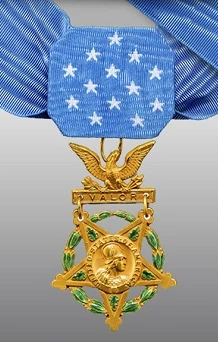
Representative medal image: Army design with a neck ribbon. Not a portrait or a photograph of this recipient’s own medal.
Army Medal of HonorAction-era reference: 1952

Portrait not yet available. Representative medal shown.

About this image

Presentation date is not usable for design selection. This is an action-era reference; a later presentation or replacement medal may differ. Air Force personnel received the Army design before the separate Air Force design was introduced.

Medal imagery and historical designs →

Medal of Honor

February 10, 1952

Sinuiju-Yalu River area, Korea

Rank at action
Major
Service
U.S. Air Force
Conflict
Korean War
Unit or command
4th Fighter Group, 334th Fighter Squadron, 5th Air Force

The Citation

Sources ↓
Maj. Davis distinguished himself by conspicuous gallantry and intrepidity at the risk of his life above and beyond the call of duty. While leading a flight of 4 F-86 Saberjets on a combat aerial patrol mission near the Manchurian border, Maj. Davis' element leader ran out of oxygen and was forced to retire from the flight with his wingman accompanying him. Maj. Davis and the remaining F-86's continued the mission and sighted a formation of approximately 12 enemy MIG-15 aircraft speeding southward toward an area where friendly fighter-bombers were conducting low level operations against the Communist lines of communications. With selfless disregard for the numerical superiority of the enemy, Maj. Davis positioned his 2 aircraft, then dove at the MIG formation. While speeding through the formation from the rear he singled out a MIG-15 and destroyed it with a concentrated burst of fire. Although he was now under continuous fire from the enemy fighters to his rear, Maj. Davis sustained his attack. He fired at another MIG-15 which, bursting into smoke and flames, went into a vertical dive. Rather than maintain his superior speed and evade the enemy fire being concentrated on him, he elected to reduce his speed and sought out still a third MIG-15. During this latest attack his aircraft sustained a direct hit, went out of control, then crashed into a mountain 30 miles south of the Yalu River. Maj. Davis' bold attack completely disrupted the enemy formation, permitting the friendly fighter-bombers to successfully complete their interdiction mission. Maj. Davis, by his indomitable fighting spirit, heroic aggressiveness, and superb courage in engaging the enemy against formidable odds exemplified valor at its highest.

Sources & record notes

General Order comparison: pending. Current-profile review does not mean that the underlying original order has been examined.

  1. George Andrew Davis Jr. — current Society profile ↗Congressional Medal of Honor Society · Checked 2026-08-30

    current identity, service, action metadata, and citation comparison

Transcription, metadata & provenance notes
Award ID
MOH-AW-001994
Transcription status
Legacy full text · current reference profile matched
Last source check
2026-08-30
Later or highest recorded rank
Lieutenant Colonel
Entered service at
Lubbock, Tex.
Archive transcription SHA-256
dbcc20c3cabd8b445d6feb48c6910fbaf44051b426319fd5c868ac6922ef511d

Legacy transcription retained without substantive editing; rendered current reference profile variants documented in the Phase 10 evidence snapshot.

The profile's structured and explanatory rank renderings are retained separately: Major (highest rank: Lieutenant Colonel) The current profile records later or highest rank Lieutenant Colonel; it is stored separately from rank at time of action. The current source records 4th Fighter Group, 334th Fighter Squadron, 5th Air Force; the inherited unit field 334th Fighter Squadron, 4th Fighter Group, 5th Air Force remains preserved as a source variant. The current historical action-place wording replaces only the controlled canonical geocoder field; the complete inherited place remains preserved. The current authoritative profile classifies the action under Korean War; the inherited Not yet classified value remains preserved in the audit record.