The Trackpads collection

FIND YOUR NEXT DISCOVERY.

Search the people, battles, citations, stories, books and audio behind military history.

Type at least two letters or numbers.Full search & filters

Medal of Honor Recipient

Freeman Victor Horner

U.S. Army · World War II

MOH-RC-001922Source-based record

The award

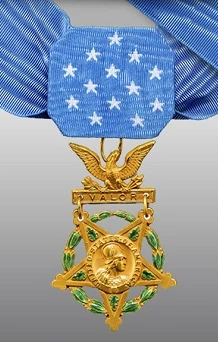
Representative medal image: Army design with a neck ribbon. Not a portrait or a photograph of this recipient’s own medal.
Army Medal of HonorRecorded presentation: 1945

Portrait not yet available. Representative medal shown.

About this image

Representative form selected from the recorded presentation year (1945), not authenticated medal-object provenance.

Medal imagery and historical designs →

Medal of Honor

November 16, 1944

Wurselen, Germany

Rank at action
Staff Sergeant
Service
U.S. Army
Conflict
World War II
Unit or command
2d Platoon, Company K, 2d Battalion, 119th Infantry, 30th Infantry Division
Presentation date
October 30, 1945

The Citation

Sources ↓
S/Sgt. Horner and other members of his company were attacking Wurselen, Germany, against stubborn resistance on 16 November 1944, when machinegun fire from houses on the edge of the town pinned the attackers in flat, open terrain 100 yards from their objective. As they lay in the field, enemy artillery observers directed fire upon them, causing serious casualties. Realizing that the machineguns must be eliminated in order to permit the company to advance from its precarious position, S/Sgt. Horner voluntarily stood up with his submachine gun and rushed into the teeth of concentrated fire, burdened by a heavy load of ammunition and hand grenades. Just as he reached a position of seeming safety, he was fired on by a machinegun which had remained silent up until that time. He coolly wheeled in his fully exposed position while bullets barely missed him and killed 2 hostile gunners with a single, devastating burst. He turned to face the fire of the other 2 machineguns, and dodging fire as he ran, charged the 2 positions 50 yards away. Demoralized by their inability to hit the intrepid infantryman, the enemy abandoned their guns and took cover in the cellar of the house they occupied. S/Sgt. Horner burst into the building, hurled 2 grenades down the cellar stairs, and called for the Germans to surrender. Four men gave up to him. By his extraordinary courage, S/Sgt. Horner destroyed 3 enemy machinegun positions, killed or captured 7 enemy, and cleared the path for his company's successful assault on Wurselen.

Sources & record notes

General Order comparison: pending. Current-profile review does not mean that the underlying original order has been examined.

  1. Freeman Victor Horner — current Society profile ↗Congressional Medal of Honor Society · Checked 2026-08-30

    current identity, service, action metadata, and citation comparison

Transcription, metadata & provenance notes
Award ID
MOH-AW-001930
Transcription status
Legacy full text · current reference profile matched
Last source check
2026-08-30
Recorded order reference (not verified against the original)
95
Later or highest recorded rank
Major
Entered service at
Shamokin, Pa.
Archive transcription SHA-256
05fc71e2963476fc3f1ad700edd7cf9cc8f1d3b85847ec531824c8893b6711f1

Legacy transcription retained without substantive editing; rendered current reference profile variants documented in the Phase 10 evidence snapshot.

The current authoritative source expands or normalizes the inherited name from Freeman V. Horner to Freeman Victor Horner; both renderings remain preserved. The current profile supplies rank at time of action as Staff Sergeant; the inherited rank field remains preserved as None. The current profile records later or highest rank Major; it is stored separately from rank at time of action. The current source records 2d Platoon, Company K, 2d Battalion, 119th Infantry, 30th Infantry Division; the inherited unit field Company K, 119th Infantry, 30th Infantry Division remains preserved as a source variant. The current historical action-place wording replaces only the controlled canonical geocoder field; the complete inherited place remains preserved. The current authoritative profile classifies the action under World War II; the inherited unclassified value remains preserved in the audit record.