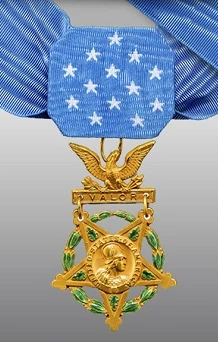
- Rank at action
- Major
- Service
- U.S. Army
- Conflict
- Vietnam War
- Unit or command
- Company A, 173d Support Battalion, 173d Airborne Brigade
For conspicuous gallantry and intrepidity in action at the risk of his life above and beyond the call of duty. Chaplain Watters distinguished himself during an assault in the vicinity of Dak To. Chaplain Watters was moving with one of the companies when it engaged a heavily armed enemy battalion. As the battle raged and the casualties mounted, Chaplain Watters, with complete disregard for his safety, rushed forward to the line of contact. Unarmed and completely exposed, he moved among, as well as in front of the advancing troops, giving aid to the wounded, assisting in their evacuation, giving words of encouragement, and administering the last rites to the dying. When a wounded paratrooper was standing in shock in front of the assaulting forces, Chaplain Watters ran forward, picked the man up on his shoulders and carried him to safety. As the troopers battled to the first enemy entrenchment, Chaplain Watters ran through the intense enemy fire to the front of the entrenchment to aid a fallen comrade. A short time later, the paratroopers pulled back in preparation for a second assault. Chaplain Watters exposed himself to both friendly and enemy fire between the two forces in order to recover two wounded soldiers. Later, when the battalion was forced to pull back into a perimeter, Chaplain Watters noticed that several wounded soldiers were lying outside the newly formed perimeter. Without hesitation and ignoring attempts to restrain him, Chaplain Watters left the perimeter three times in the face of small arms, automatic weapons, and mortar fire to carry and to assist the injured troopers to safety. Satisfied that all of the wounded were inside the perimeter, he began aiding the medics ... applying field bandages to open wounds, obtaining and serving food and water, giving spiritual and mental strength and comfort. During his ministering, he moved out to the perimeter from position to position redistributing food and water, and tending to the needs of his men. Chaplain Watters was giving aid to the wounded when he himself was mortally wounded. Chaplain Watters' unyielding perseverance and selfless devotion to his comrades was in keeping with the highest traditions of the U.S. Army.
Sources & record notes
General Order comparison: pending. Current-profile review does not mean that the underlying original order has been examined.
- Charles Joseph Watters — current Society profile ↗Congressional Medal of Honor Society · Checked 2026-08-30
current identity, service, action metadata, and citation comparison
Transcription, metadata & provenance notes
- Award ID
- MOH-AW-002152
- Transcription status
- Legacy full text · current reference profile matched
- Last source check
- 2026-08-30
- Entered service at
- Fort Dix, N.J.
- Archive transcription SHA-256
- a76bbd48e9f47a2d4ed204c444326493f8db560cef9488508f68bfa91f905910
Legacy transcription retained without substantive editing; rendered current reference profile variants documented in the Phase 10 evidence snapshot.
The controlled action rank is Major. The inherited rank is Chaplain; the current profile also records Major; profile and citation also identify his role as Chaplain. Action, presentation, role, and later/highest ranks remain separately attributed. The current structured profile and rendered citation use different rank, role, or unit wording. Those official-source variants are preserved separately rather than silently collapsed. The current historical action-place wording replaces only the controlled canonical geocoder field; the complete inherited place remains preserved. The current authoritative profile classifies the action under Vietnam War; the inherited Not yet classified value remains preserved in the audit record.