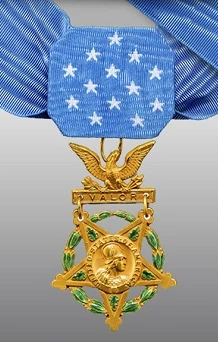
Medal of Honor
January 8, 1945–January 9, 1945
Rimling, France
- Rank at action
- Technical Sergeant
- Service
- U.S. Army
- Conflict
- World War II
- Unit or command
- 397th Infantry, 100th Infantry Division
The Citation
Sources ↓He was in command of a antitank platoon when about 200 enemy infantrymen and 12 tanks attacked his battalion, overrunning part of its position. After losing his guns, TSgt. Carey, acting entirely on his own initiative, organized a patrol and rescued two of his squads from a threatened sector, evacuating those who had been wounded. He organized a second patrol and advanced against an enemy-held house from which vicious fire issued, preventing the free movement of our troops. Covered by fire from his patrol, he approached the house, killed two snipers with his rifle, and threw a grenade in the door. He entered alone and a few minutes later emerged with 16 prisoners. Acting on information he furnished, the American forces were able to capture an additional 41 Germans in adjacent houses. He assembled another patrol, and, under covering fire, moved to within a few yards of an enemy tank and damaged it with a rocket. As the crew attempted to leave their burning vehicle, he calmly shot them with his rifle, killing three and wounding a fourth. Early in the morning of 9 January, German infantry moved into the western part of the town and encircled a house in which TSgt. Carey had previously posted a squad. Four of the group escaped to the attic. By maneuvering an old staircase against the building, TSgt. Carey was able to rescue these men. Later that day, when attempting to reach an outpost, he was struck down by sniper fire. The fearless and aggressive leadership of TSgt. Carey, his courage in the face of heavy fire from superior enemy forces, provided an inspiring example for his comrades and materially helped his battalion to withstand the German onslaught.
Preserved earlier transcription
Cheyenne, Wyo. Birth: Canadian, Okla. G.O. No.: 53, July 1945. Citation: He was in command of an antitank platoon when about 200 enemy infantrymen and 12 tanks attacked his battalion, overrunning part of its position. After losing his guns, T/Sgt. Carey, acting entirely on his own initiative, organized a patrol and rescued 2 of his squads from a threatened sector, evacuating those who had been wounded. He organized a second patrol and advanced against an enemy-held house from which vicious fire issued, preventing the free movement of our troops. Covered by fire from his patrol, he approached the house, killed 2 snipers with his rifle, and threw a grenade in the door. He entered alone and a few minutes later emerged with 16 prisoners. Acting on information he furnished, the American forces were able to capture an additional 41 Germans in adjacent houses. He assembled another patrol, and, under covering fire, moved to within a few yards of an enemy tank and damaged it with a rocket. As the crew attempted to leave their burning vehicle, he calmly shot them with his rifle, killing 3 and wounding a fourth. Early in the morning of 9 January, German infantry moved into the western part of the town and encircled a house in which T/Sgt. Carey had previously posted a squad. Four of the group escaped to the attic. By maneuvering an old staircase against the building, T/Sgt. Carey was able to rescue these men. Later that day, when attempting to reach an outpost, he was struck down by sniper fire. The fearless and aggressive leadership of T/Sgt. Carey, his courage in the face of heavy fire from superior enemy forces, provided an inspiring example for his comrades and materially helped his battalion to withstand the German onslaught.
Sources & record notes
General Order comparison: pending. Current-profile review does not mean that the underlying original order has been examined.
- Charles F. Carey Jr. — Congressional Medal of Honor Society recipient profile ↗Congressional Medal of Honor Society · Checked 2026-09-01
current identity, service, action metadata, and citation comparison
Transcription, metadata & provenance notes
- Award ID
- MOH-AW-002821
- Transcription status
- Current Society citation · legacy wording preserved
- Last source check
- 2026-09-01
- Archive transcription SHA-256
- 1c11ef4fa0cbb81090214b90beea530f65630048d9d098779d1069594b73f493
Current rendered Society citation adopted as the canonical display wording; the complete legacy transcription and checksum remain preserved in the award and evidence records.
Legacy citation field contains biographical and General Order preamble; replace only the citation body while retaining the legacy field as provenance. No General Order verification is claimed.