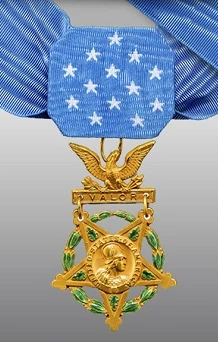
- Rank at action
- Private First Class
- Service
- U.S. Army
- Conflict
- Vietnam War
- Unit or command
- 1st Platoon, Company A, 2d Battalion, 503d Infantry, 173d Airborne Brigade
For conspicuous gallantry and intrepidity in action at the risk of his life above and beyond the call of duty. Pfc. Lozada, U.S. Army, distinguished himself at the risk of his life above and beyond the call of duty in the battle of Dak To. While serving as a machine gunner with 1st platoon, Company A, Pfc. Lozada was part of a 4-man early warning outpost, located 35 meters from his company's lines. At 1400 hours a North Vietnamese Army company rapidly approached the outpost along a well defined trail. Pfc. Lozada alerted his comrades and commenced firing at the enemy who were within 10 meters of the outpost. His heavy and accurate machine gun fire killed at least 20 North Vietnamese soldiers and completely disrupted their initial attack. Pfc. Lozada remained in an exposed position and continued to pour deadly fire upon the enemy despite the urgent pleas of his comrades to withdraw. The enemy continued their assault, attempting to envelop the outpost. At the same time enemy forces launched a heavy attack on the forward west flank of Company A with the intent to cut them off from their battalion. Company A was given the order to withdraw. Pfc. Lozada apparently realized that if he abandoned his position there would be nothing to hold back the surging North Vietnamese soldiers and that the entire company withdrawal would be jeopardized. He called for his comrades to move back and that he would stay and provide cover for them. He made this decision realizing that the enemy was converging on 3 sides of his position and only meters away, and a delay in withdrawal meant almost certain death. Pfc. Lozada continued to deliver a heavy, accurate volume of suppressive fire against the enemy until he was mortally wounded and had to be carried during the withdrawal. His heroic deed served as an example and an inspiration to his comrades throughout the ensuing 4-day battle. Pfc. Lozada's actions are in the highest traditions of the U.S. Army and reflect great credit upon himself, his unit, and the U.S. Army.
Sources & record notes
General Order comparison: pending. Current-profile review does not mean that the underlying original order has been examined.
- Carlos James Lozada — current Society profile ↗Congressional Medal of Honor Society · Checked 2026-08-30
current identity, service, action metadata, and citation comparison
Transcription, metadata & provenance notes
- Award ID
- MOH-AW-002091
- Transcription status
- Legacy full text · current reference profile matched
- Last source check
- 2026-08-30
- Entered service at
- New York, N.Y.
- Archive transcription SHA-256
- f284e28a15fdf4676d1ee9a7a4fd4d5595ae389def7576dbf80ba4daba424dd7
Legacy transcription retained without substantive editing; rendered current reference profile variants documented in the Phase 10 evidence snapshot.
The current authoritative unit wording is 1st Platoon, Company A, 2d Battalion, 503d Infantry, 173d Airborne Brigade; the inherited unit Company A, 2d Battalion, 503d Infantry, 173d Airborne Brigade remains preserved as a source variant. The current historical action-place wording replaces only the controlled canonical geocoder field; the complete inherited place remains preserved. The current authoritative profile classifies the action under Vietnam War; the inherited Not yet classified value remains preserved in the audit record.