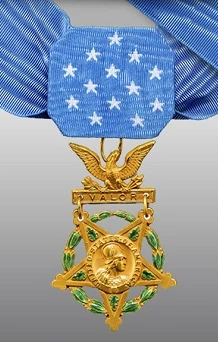
Medal of Honor
November 16–29, 1944
Woippy, France, through Metz to Kerprich Hemmersdorf, Germany
- Rank at action
- Staff Sergeant
- Service
- U.S. Army
- Conflict
- World War II
- Unit or command
- Company G, 377th Infantry, 95th Infantry Division
- Presentation date
- September 1, 1945
The Citation
Sources ↓For performing a series of heroic deeds from 1629 November 1944, during his company's relentless drive from Woippy, France, through Metz to Kerprich Hemmersdorf, Germany. As he led a rifle squad on 16 November at Woippy, a crossfire from enemy machineguns pinned down his unit. Ordering his men to remain under cover, he went forward alone, entered a building housing 1 of the guns and forced S Germans to surrender at bayonet point. He then took the second gun single-handedly by hurling grenades into the enemy position, killing 2, wounding 3 more, and taking 2 additional prisoners. At the outskirts of Metz the next day, when his platoon, confused by heavy explosions and the withdrawal of friendly tanks, retired, he fearlessly remained behind armed with an automatic rifle and exchanged bursts with a German machinegun until he silenced the enemy weapon. His quick action in covering his comrades gave the platoon time to regroup and carry on the fight. On 19 November S/Sgt. Miller led an attack on large enemy barracks. Covered by his squad, he crawled to a barracks window, climbed in and captured 6 riflemen occupying the room. His men, and then the entire company, followed through the window, scoured the building, and took 75 prisoners. S/Sgt. Miller volunteered, with 3 comrades, to capture Gestapo officers who were preventing the surrender of German troops in another building. He ran a gauntlet of machinegun fire and was lifted through a window. Inside, he found himself covered by a machine pistol, but he persuaded the 4 Gestapo agents confronting him to surrender. Early the next morning, when strong hostile forces punished his company with heavy fire, S/Sgt. Miller assumed the task of destroying a well-placed machinegun. He was knocked down by a rifle grenade as he climbed an open stairway in a house, but pressed on with a bazooka to find an advantageous spot from which to launch his rocket. He discovered that he could fire only from the roof, a position where he would draw tremendous enemy fire. Facing the risk, he moved into the open, coolly took aim and scored a direct hit on the hostile emplacement, wreaking such havoc that the enemy troops became completely demoralized and began surrendering by the score. The following day, in Metz, he captured 12 more prisoners and silenced an enemy machinegun after volunteering for a hazardous mission in advance of his company's position. On 29 November, as Company G climbed a hill overlooking Kerprich Hemmersdorf, enemy fire pinned the unit to the ground. S/Sgt. Miller, on his own initiative, pressed ahead with his squad past the company's leading element to meet the surprise resistance. His men stood up and advanced deliberately, firing as they went. Inspired by S/Sgt. Miller's leadership, the platoon followed, and then another platoon arose and grimly closed with the Germans. The enemy action was smothered, but at the cost of S/Sgt. Miller's life. His tenacious devotion to the attack, his gallant choice to expose himself to enemy action rather than endanger his men, his limitless bravery, assured the success of Company G.
Sources & record notes
General Order comparison: pending. Current-profile review does not mean that the underlying original order has been examined.
- Andrew Miller — Congressional Medal of Honor Society recipient profile ↗Congressional Medal of Honor Society · Checked 2026-09-01
current identity, service, action metadata, and citation comparison
Transcription, metadata & provenance notes
- Award ID
- MOH-AW-003337
- Transcription status
- Legacy full text · current reference profile matched
- Last source check
- 2026-09-01
- Recorded order reference (not verified against the original)
- 74
- Entered service at
- Two Rivers, Wis.
- Archive transcription SHA-256
- 58c8559830c0e5eaed3683354a0a0c0173d617ecd3af4b0c6aa065a53cfb408c
Legacy transcription retained without substantive editing; rendered current reference profile comparison is documented in the Phase 10 evidence snapshot.
The Army World War II profile is selected by branch, unit, and the November 16–29 action range, distinct from the Marine Corps recipient of the same name.