In Action
The desert is already bright, but the air is cool as hundreds of soldiers crouch in trenches scraped into the floor of Frenchman Flat. Ahead of them, dominating the narrow road like a railroad gun on wheels, sits a weapon that looks almost unreal: a 280-millimeter cannon stretched between two massive tractors, its long barrel elevated toward a point in the empty Nevada sky. The loudspeakers crackle through the countdown, and somewhere back among the bleachers and bunkers, generals, scientists, and foreign observers raise their binoculars and wait.
When the firing signal comes, the report is less theatrical than some expect—just a deep, hard bang and a rolling echo off the desert hills. The shell itself is invisible, a black dot knifing through the sky toward a target seven miles away. Nineteen seconds later, the morning changes. A blinding white flash washes the flats, followed by a rising fireball and a boiling stem of dust and debris that dwarfs the trench line and the giant gun alike.
This is Shot Grable, May 1953, the first and only time the United States Army fires a live nuclear artillery shell. The troops in the trenches are here to prove that field forces can fight on a battlefield where atomic weapons are used. The cannon crew is here to prove that such a weapon can be delivered on call, by soldiers in uniform, without waiting for bombers or rockets. The blast rolling across Frenchman Flat is not just a test shot; it is the proof of concept for an entirely new idea of artillery.
The Problem It Was Built To Solve
The M65 atomic cannon did not begin as a stunt for the desert test range. It began as an answer to a very specific fear: that in a future war with the Soviet Union, the United States Army would face massed enemy forces on the ground without having its own direct control over nuclear firepower. In the late 1940s, atomic weapons lived almost entirely in the hands of the strategic bomber force. To commanders who had just watched heavy artillery shape the battlefields of Italy, France, and Germany, that felt uncomfortably distant.
They knew what big guns could do. German railway pieces like the K5—nicknamed “Anzio Annie” by Allied troops—had hurled huge shells at invasion beaches and supply hubs, sometimes from beyond the reach of counter-battery fire. American heavy howitzers had pounded fortifications and shattered road junctions, but they still relied on tons of conventional explosives and long hours of sustained fire to achieve decisive effects. Against the imagined tide of Soviet armor and infantry pouring through the Fulda Gap or across the North German Plain, that might not be enough.
At the same time, the United States was learning how quickly nuclear technology was spreading. The Soviet Union’s first atomic test, the Berlin crisis, and then the outbreak of the Korean War underscored how volatile the early Cold War really was. Army planners wanted a way to bring atomic fire support down to the level of corps and field army commanders, something that looked and felt like artillery, could be moved on roads, and could be slotted into existing doctrines for supporting infantry and armor.
Out of that mix of fear, ambition, and institutional rivalry came the requirement for a gun that could throw an atomic shell far enough to be tactically useful, yet be operated by a conventional gun crew. The M65 would be the hardware embodiment of that idea: a nuclear weapon you could tow behind a pair of trucks and emplace like a heavy field piece.
From Design Board To Production
The Army’s push for an atomic cannon moved quickly from idea to steel. In the late 1940s, ordnance engineers took a hard look at what wartime railway guns had done and asked how the same long-range punch could be given a nuclear warhead and mounted on something mobile enough for field armies. Design work centered at ordnance arsenals that already knew heavy artillery, scaling up a 240-millimeter gun concept until it could throw a specially designed atomic shell. The challenge was not just the barrel, but the whole system: a carriage that could absorb massive recoil, move on public roads, and still be set up and fired with the kind of precision nuclear gunnery demanded.
Engineers settled on a long-barreled 280-millimeter gun tube mated to a rigid carriage that could be hoisted between two giant prime movers. The tractors at each end would carry the weight and steer the weapon like an enormous articulated truck, while outriggers and jacks would stabilize it in firing position. Tradeoffs were everywhere. The gun had to be strong enough to fire a heavy shell at high velocity, but the carriage could not be so heavy that bridges and roads became impassable. The prime movers needed enough power and speed to keep up with field formations, yet they also had to handle delicate maneuvering in cramped firing sites.
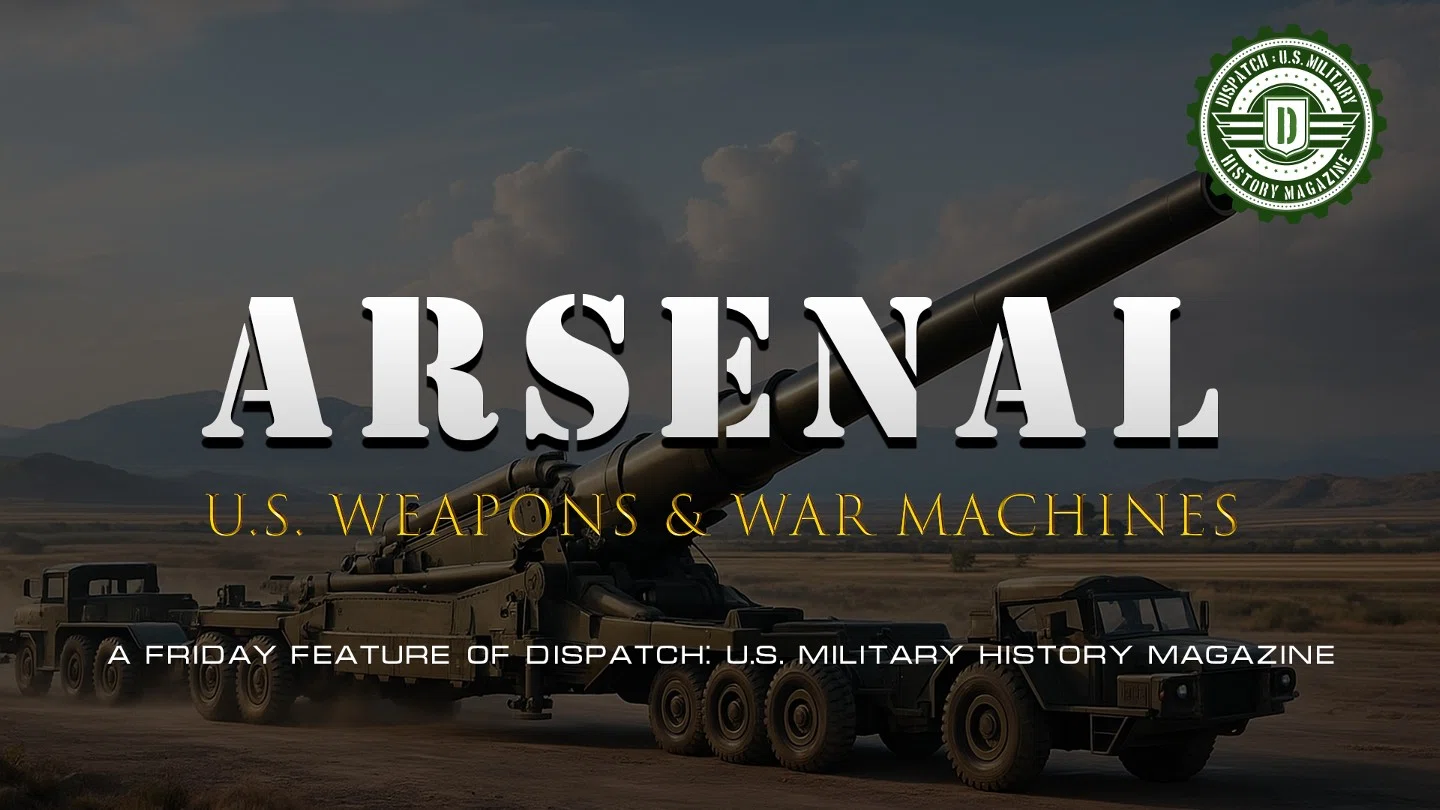
At a glance, the M65 was a towed 280-millimeter heavy gun of the United States, built for the United States Army in the early Cold War. It served with specialized heavy artillery units, each weapon demanding a crew of roughly two dozen soldiers to emplace, load, aim, and maintain it. Its primary armament was the 280-millimeter gun capable of firing both conventional high-explosive and nuclear shells to a range of roughly twenty miles, all mounted on a road-worthy carriage carried between two multi-axle prime movers. The whole rig stretched more than eighty feet and weighed tens of tons, yet it was designed to cruise on highways at military convoy speeds.
Prototypes were tested in the early 1950s, leading to a limited production run that created a handful of batteries rather than massed regiments. Each gun was a strategic asset in its own right, earmarked for deployment to Europe and potentially to other theaters where a demonstration of atomic artillery might deter Soviet forces. By the time Shot Grable took place in Nevada, the M65 was already more than a paper project; it was a fielded system awaiting the moment when commanders might call for nuclear fire on a timetable measured in minutes instead of hours.
Inside The Weapon
Seen from the side on a highway, the M65 looked like a piece of mobile architecture: a long central beam holding the gun, slung between two tractor-like vehicles with multiple axles and big road tires. In travel mode, the barrel sat low and level, secured with braces, while the prime movers handled steering from both ends. To go into action, the convoy halted at a surveyed firing point. The crew unpinned the gun, swung it clear, lowered the carriage onto its own wheels and jacks, and let the tractors pull clear. What had been one long vehicle became a freestanding artillery piece pointed toward its assigned target azimuth.
Around the gun, crews worked in a tight choreography. A section leader and gun commander managed the emplacement, ensuring the carriage was leveled and the trails and jacks were locked down. Gunners handled the elevating and traversing mechanisms, cranking the massive barrel into its firing solution based on data from the fire direction center. Other crewmen worked the breech, ramming in the enormous separate-loading charges and then the shell itself, while safety personnel checked that everyone was clear before the firing signal. Communication ran by field telephone and shouted commands, drilled until everyone knew the sequence by heart, because mistakes with a weapon like this could destroy more than just the target.
The gun’s heart was its breech and recoil system. When fired, the 280-millimeter shell tore down the barrel at high speed, and the recoil cylinders absorbed and checked the backward force so the carriage did not leap off the ground. The breech had to seal perfectly, both for safety and for consistent ballistics. In nuclear firing, the shell itself carried a specially designed warhead, handled under strict procedures and checked and rechecked before loading. For conventional shots, the process felt more like that of any heavy gun, but the size of the components meant more strain on every movement.
Life around the M65 was dominated by scale and precision. The prime movers had their own drivers and mechanics, who worried about fuel, tires, and transmissions that had to cope with steep grades and tight turns. The gun crew lived in the shadow of their weapon, spending long hours on maintenance, lubrication, bore inspection, and the slow, deliberate process of shifting the whole piece a few degrees to adjust azimuth. In training, the weapon behaved like a demanding but predictable giant: loud, slow to emplace, but accurate and impressive when the shell went downrange. In the Nevada desert, with a nuclear warhead on board, every member of the crew knew they were sitting at the intersection of traditional artillery craft and the terrifying new world of atomic firepower.
Baptism Of Fire
Shot Grable in May 1953 became the M65’s defining moment, even though it took place on a test range rather than a battlefield. The Nevada Test Site was laid out to resemble a forward area, with trenches, vehicles, and simple structures that could stand in for a town or command post. The gun crew followed a carefully rehearsed sequence, but the tension was real. A misfire or malfunction would play out in front of cameras, generals, and foreign observers who represented allies that might one day depend on atomic artillery. The stakes were reputational as much as technical.
The mission was set up like a tactical fire mission. The gun was laid on a target several miles away, representing an enemy formation or key road junction. Fire direction data, weather conditions, and the timing of the shot were calculated with the same care as any major artillery preparation, then cross-checked against the needs of the nuclear experiment. When the shell left the barrel and streaked toward the impact point, crews, observers, and test controllers watched for more than just yield and blast radius. They wanted to see whether the whole system, from survey parties to gun crew, could deliver on demand.
When the warhead detonated, the bright flash and rising cloud proved that the artillerymen had done their part. Instruments and test structures recorded overpressure, thermal effects, and radiation. Troops in trenches endured the blast, then climbed out to move across the blasted ground as part of exercises in operating on an atomic battlefield. For the M65, the key result was simple. The gun had fired a live nuclear shell and put it close enough to the aim point to be considered a success.
In the years that followed, M65 batteries deployed to Europe and other key theaters as very visible symbols of American atomic power. They took part in field exercises, road marches, and more conventional firing demonstrations, always with the possibility in the background that one day the gun might fire in anger rather than as a test. That day never came, but the image of the long barrel in the desert and the nuclear cloud rising beyond it fixed the atomic cannon in the public imagination as a weapon that had proven itself in the only nuclear way that mattered.
Strengths And Weaknesses
On paper, the M65’s greatest strength was simple. It gave Army commanders a way to call for a nuclear strike with something that looked like traditional artillery, under their own control, without waiting for bombers or missiles. In training and in the Nevada test, crews showed that the gun was accurate and reliable enough to put a shell into the desired zone at ranges that made tactical sense. For planners, that meant the threat of an incoming armored column or a massed headquarters could be met with a single round that might halt an offensive or shatter a key node. The psychological effect of such a capability mattered almost as much as the physics.
At the same time, the weapon carried heavy burdens. The full rig was enormous, demanding careful route planning, strong bridges, and open roads. Emplacing the gun took time, survey work, and a well drilled crew. That made it less flexible than smaller howitzers and mortars that could be dragged into woods, villages, or rough ground. Once set up, the gun had limited traverse, so shifting fire across a broad front could mean moving the entire carriage, a slow and obvious process for an enemy watching from the air.
Opponents, at least in planning, were expected to see the M65 as a high value target. Its size and distinctive outline would make it stand out in aerial reconnaissance photographs. If a future conflict had broken out in Europe, Soviet pilots and artillery planners would likely have searched hard for any sign of an atomic gun, knowing that destroying it would both remove a threat and score a propaganda victory. Compared to later missile and warhead systems that could hide in forests or move on more ordinary vehicles, the atomic cannon’s visibility became a major weakness.
In practice, crews appreciated the accuracy and solid engineering of the gun but also felt the weight of its symbolism. They trained on long loading drills, precise gunnery, and convoy discipline, knowing that their piece would never be just another tube on the line. It was a flagship weapon, with all the attention, ceremony, and vulnerability that role implied.
Variants And Evolution
The M65 system itself did not spawn a family of widely differing variants in the way that tanks or fighter aircraft did. Its basic layout, a single long 280 millimeter gun between two heavy prime movers, remained largely consistent across the small number of pieces built. Changes tended to be incremental refinements in vehicles, fire control equipment, and handling procedures rather than sweeping redesigns. The real evolution came not from the gun carriage but from the nuclear artillery concept it represented.
As nuclear weapons became smaller and technology advanced, designers found ways to fit atomic warheads into shells for more common calibers such as eight inch and even smaller artillery. At the same time, rocket and missile systems matured, offering ways to deliver nuclear warheads at longer ranges without the need for giant barrels and elaborate carriages. Those systems could be more easily concealed, dispersed, and moved quickly. They suited a world in which survivability and flexibility on a nuclear battlefield were gaining importance.
Export or licensed versions of the atomic cannon concept never took hold. Other nations watched the M65, but most chose to follow paths that emphasized missiles and adaptable artillery rather than investing in their own versions of a nuclear railway gun on wheels. In the United States, operational experience, test data, and evolving doctrine all pushed the Army toward more compact nuclear delivery systems. The M65’s role as a bridge between traditional heavy artillery and the missile age became clear even as its direct successors took very different forms.
By the end of its service life, the atomic cannon had already been overtaken by the weapons it had helped justify. Its firing tables, test records, and crew procedures remained part of the institutional memory of nuclear artillery units, but the future belonged to systems that could move faster, hide better, and deliver nuclear fire from platforms that did not attract every pair of eyes on the battlefield.
Legacy And Where To See It Today
Although its career was brief and its nuclear shot count could be summed up with a single test in Nevada, the M65 atomic cannon left a legacy out of proportion to its numbers. It demonstrated that nuclear firepower could be integrated into ground force planning, not just held in the hands of strategic bomber crews. It also forced soldiers, planners, and political leaders to confront what it really meant to fight under the shadow of atomic weapons at the corps and field army level. The image of a gun crew in helmets and fatigues loading an atomic shell into a breech blurred the line between conventional and nuclear war in a way that remains unsettling.
In technical and doctrinal terms, the atomic cannon paved the way for a generation of nuclear artillery and missile systems that followed. The lessons learned about handling warheads in the field, securing specialized ammunition, and folding nuclear fire missions into artillery doctrine all informed later decisions. Even as the Army moved to smaller shells and rockets, the M65’s example helped define how nuclear weapons would be treated as part of a wider arsenal rather than a separate strategic branch.
For those who want to see the hardware up close, preserved M65 guns stand on display at several American sites, often paired with their prime movers so visitors can appreciate their full scale. Museum curators have positioned them as landmarks in the story of the early Cold War, where visitors can walk around the long barrel, study the massive carriage, and read about the Nevada shot that made history. Photo collections and video archives, including material featured through Trackpads and Dispatch, bring the weapon to life in period color, convoying along highways, setting up on test ranges, and sitting under the desert sun.
For readers and listeners following Dispatch, the atomic cannon connects naturally to other stories. Beyond the Call features veterans of Korea and later Cold War service whose careers unfolded under the new nuclear umbrella. Living History interviews with artillerymen and museum staff help explain how guns like the M65 fit into changing doctrines. As Arsenal continues to explore the machines of war, the atomic cannon stands as a reminder that behind every spectacular piece of hardware are the crews who served it and the opponents who had to plan to fight under its shadow. You can also hear narrated versions of Arsenal features as part of the Trackpads podcast feeds and Dispatch audio editions.