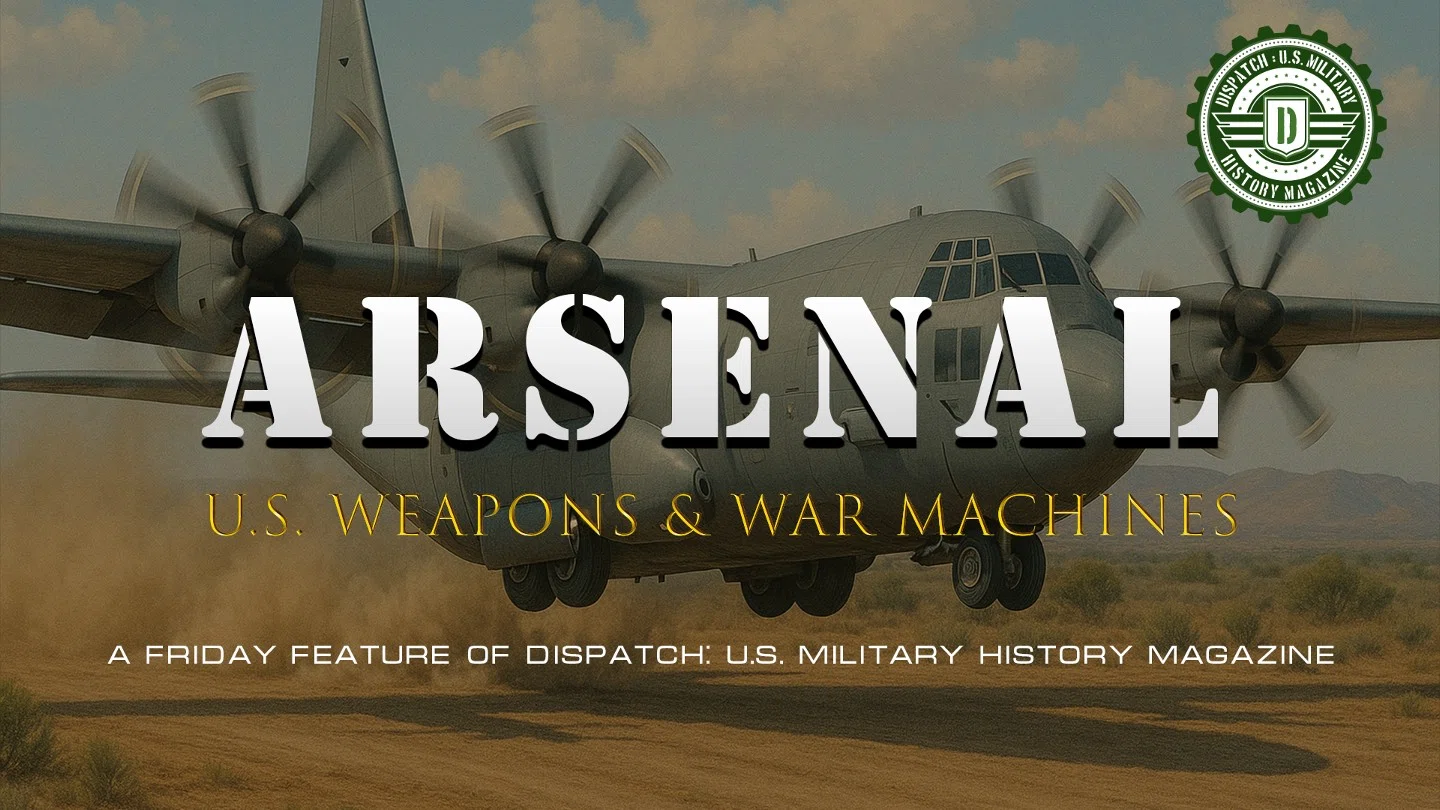
In Action
The runway at Khe Sanh is just a dark slash in the mist until the last seconds. The C-130 drops through low cloud, heavy with fuel, ammunition, and rations for a garrison that has been living on the edge for weeks. The pilots sit high over the nose, eyes flicking between shaky instrument needles and the pale strip of pierced steel planking that suddenly appears ahead, bracketed by green hills and muzzle flashes. In the cargo bay, the loadmaster braces his boots against the deck as the aircraft shudders in the slipstream, his gloved hand on the release for the pallet waiting at the edge of the ramp.
The Hercules roars in over the perimeter at treetop height. Tracers climb to meet it, red and white threads converging on the gray fuselage. The crew can feel the base below them in the flicker of artillery bursts and the streaks of rockets, but there’s no time to look. At a signal from the cockpit, the ramp is down, the drogue chute snaps free into the slipstream, and a heartbeat later the main extraction chute yanks the load out in a violent lurch. The pallets slam onto the scarred runway and skid toward the waiting Marines as the aircraft claws back into the sky, still under fire, lighter now by many tons.
For the men on the ground, those few seconds mean food, ammunition, and the ability to hold out one more day. For the crew, it is one more trip in a long line of missions that define what the Hercules was built to do: bring heavy loads into places that were never meant to see an airplane of this size, and to do it again tomorrow.
The Problem It Was Built To Solve
The Hercules was born from a simple but unforgiving problem: modern armies were moving faster and farther than ever before, but their supplies still had to crawl over bad roads, mountain passes, and jungle tracks. Experience from the Second World War and the Korean War had shown that big intercontinental transports could move vast quantities of cargo between major bases, but getting those supplies the last few hundred miles to forward troops was another matter entirely. Existing tactical transports could not carry enough weight, could not go far enough, or demanded more runway and maintenance than front-line airstrips could offer.
The United States Air Force wanted a flying truck that combined strategic reach with true front-line toughness. The new aircraft would need to haul troops, vehicles, artillery, fuel, and medical evacuees. It had to work from short, rough, sometimes muddy strips hacked out of jungle or scraped onto desert hardpan. It needed a rear loading ramp so jeeps, guns, and pallets could roll straight on and off, and it had to be strong enough to survive hard landings, steep approaches, and repeated abuse. On top of that, Cold War planning demanded that airborne units be able to disperse rapidly, jumping or unloading directly near threatened points rather than being tied to a handful of large, vulnerable air bases.
Designers also had to think beyond purely military needs. Senior leaders saw that any future conflict would blur the lines between combat operations and humanitarian crises: refugees to evacuate, disaster zones to reach, besieged allies to resupply. The answer would be a turboprop-powered tactical airlifter with the climb performance to clear mountains, the low-speed control to creep onto primitive strips, and the volume to carry real combat loads. When the aircraft that became the C-130 first flew in the mid-1950s and entered service soon after, it promised to close the gap between high-level airlift and the muddy boots at the far end of the supply chain—and to give commanders a machine that could appear almost anywhere on the map, carrying almost anything that could fit through its ramp.
From Design Board To Production
The Hercules began life on paper in the early 1950s as the United States Air Force looked for a rugged, medium transport that could do what the big intercontinental freighters could not: land heavy loads on short, rough strips right behind the front lines. Tactical Air Command issued a demanding specification, and Lockheed’s engineers responded with a stubby-nosed, high-wing turboprop that many within the company initially doubted. The prototype YC-130 made its first flight in August 1954, meeting or exceeding the Air Force’s requirements for payload, takeoff distance, and maneuverability. Within just two years, production C-130As were entering service, an unusually fast transition from drawing board to operational squadron.
Development was shaped by a series of tradeoffs that defined the aircraft’s character. Four turboprop engines offered better low-speed thrust and short-field performance than jets, at the cost of ultimate top speed. A tall, boxy fuselage and high wing created a generous cargo hold and good ground clearance, but locked in the aircraft’s distinctive “barn door” profile. Designers chose a rear loading ramp, strong floor, and simple cargo handling system that could work with pallets, vehicles, and paratroopers alike. They also built in high-lift flaps and sturdy landing gear so the aircraft could get in and out of strips that barely qualified as runways. Over time, improved variants added more powerful engines, stretched fuselages, and updated avionics, but the basic airframe remained recognizably the same.
At a glance, the C-130 Hercules is a United States four-engine turboprop tactical airlifter built by Lockheed for the United States Air Force and other services. It typically carries a crew of five-two pilots, a navigator or combat systems officer, a flight engineer, and a loadmaster-and can haul roughly twenty tons of cargo, around ninety fully equipped troops, or dozens of stretcher patients depending on configuration. In level flight it cruises at roughly three hundred and fifty to three hundred and seventy miles per hour, with a combat radius long enough to link distant theater bases and forward strips without refueling.
Production quickly spread from the early A models into an extended family. As Cold War commitments grew, the Air Force and Navy ordered specialized variants for aerial refueling, search and rescue, signals intelligence, weather reconnaissance, and gunship roles. Export versions carried the Hercules to allied air arms around the world, and a civil derivative, the L-100, brought the same rough-field capability to cargo work in remote regions. By the late twentieth century, thousands of Hercules aircraft had been built, and a new generation, the C-130J, carried the design into the digital avionics age while preserving its core role: a go-anywhere airlifter that could still use the kind of strips it was designed for in the 1950s.
Inside The Weapon
Walking up to a Hercules on the ramp, the first impression is of a big, purposeful machine that sits low enough for easy loading but high enough that its four propellers clear rocks and debris. A tall rear loading ramp dominates the back of the fuselage, framed by a broad cargo door that can be opened in flight for airdrops or on the ground for vehicles to drive straight in. Along the sides, paratroop doors and small windows hint at its role in airborne operations. The high wing and tall fin give the aircraft a solid, almost workmanlike stance, emphasizing function over elegance. For the crews who serve around it, the Hercules is more workhorse than showpiece.Wikipedia
Inside, the cargo compartment is a single long tunnel of riveted structure, tie-down rings, and roller tracks. Seats can be rigged along the sidewalls for troops, swung up out of the way for pallets, or removed to make space for vehicles and outsized loads. The loadmaster owns this space, moving through the bay with a checklist in one hand and a headset cord trailing from the other, talking to the cockpit over the interphone. During an airdrop or combat landing, the loadmaster’s world shrinks to the cargo, the timer on his watch, and the shouted calls from the front: stand by, green light, load away. In rough weather, the cargo bay is noisy, cold, and alive with the vibration of the airframe, but the routines stay the same.
Forward of the cargo bay, a short ladder leads up to the flight deck. Here the pilots sit side by side behind wide windows that offer a commanding view of the runway and low-level terrain. Between and behind them, the flight engineer and navigator manage power settings, fuel, and navigation, especially on older models with more analog instrumentation. On later variants, glass cockpit displays and integrated navigation systems ease the crew’s workload, but the basic roles remain: pilots fly the aircraft, the navigator keeps it on track, the engineer manages systems, and everyone watches for threats, weather, and terrain. Radios, radar, and sometimes defensive systems fill racks around them, giving the crew tools to operate in everything from peacetime relief flights to heavily defended combat zones.
The Hercules’ subsystems are built for punishment. Its turboprop engines are designed to keep producing power even in hot, high, or dusty conditions, driving large propellers that bite into the air at low speeds where jets would struggle. The landing gear is tall and strongly braced, meant to absorb hard arrivals on rough surfaces and to support the aircraft while loading heavy vehicles. Fuel tanks in the wings and fuselage feed long-endurance missions, while rugged environmental systems try to keep the cargo bay at least tolerable across extremes of heat and cold. In the back, cargo handling gear allows pallets to be locked down for takeoff, then released smoothly for airdrop, whether over a besieged base like Khe Sanh or a flooded town in need of relief supplies decades later.
Training teaches crews ideal procedures, but veterans often recall how the aircraft behaves when those ideals collide with reality. Short, sloping strips, poor lighting, and threats from small arms or missiles push pilots into steep tactical approaches and rapid turnarounds. Loadmasters improvise with damaged pallets, awkward vehicles, and frightened evacuees while trying to keep within weight and balance limits. Maintenance teams learn the aircraft’s quirks, from hard-to-reach components to systems that shrug off abuse better than the manual suggests. Through it all, the Hercules remains a known quantity: noisy, sometimes drafty, but dependable, with a reputation for bringing its crews home even when they ask more of it than the designers originally imagined.
Baptism Of Fire
The siege at Khe Sanh in early 1968 is often held up as the Hercules’ crucible, the moment when all of its design promises were tested at once. Surrounded by North Vietnamese forces and battered by artillery, the base depended on airlift for everything from rations and ammunition to medical evacuation. Big jet transports could not risk the short, damaged runway under constant fire, but C-130 crews kept coming, flying in low through cloud and smoke, landing or skimming the strip to push out loads under conditions that would have grounded most other aircraft. Each trip meant threading a path through enemy guns, working in tight formation with fighter cover and forward air controllers, and trusting the aircraft to climb away even when heavily loaded.
The Hercules also proved itself in countless smaller actions that never made headlines. In Southeast Asia it carried paratroopers to night drops, moved artillery batteries between firebases, and hauled fuel bladders into clearings that barely qualified as landing zones. Special operations crews used modified C-130s to insert and extract teams under cover of darkness, sometimes at low level and without lights. Elsewhere during the Cold War, Hercules transports ferried peacekeeping troops into tense airfields, brought supplies into isolated Arctic stations, and evacuated civilians from collapsing regimes. In each case, the pattern was similar: the aircraft went where it was needed, often on short notice, operating from imperfect runways or improvised strips at the edges of conflict.
As decades passed, new theaters added fresh chapters. Hercules squadrons flew into desert strips during operations in Southwest Asia, bringing ammunition, water, and repair parts to forward bases far from major hubs. In the Balkans and later in Iraq and Afghanistan, they carried troops, armored vehicles, and helicopters’ spare parts into dusty or icy airfields where the margin for error was thin. Humanitarian missions followed earthquakes, famines, and hurricanes, with the same aircraft that had flown into combat now landing amid broken infrastructure to unload food, water, and medical teams. The baptism of fire that began in places like Vietnam never really ended; it broadened into a long record of showing up wherever heavy cargo, rough fields, and urgent need came together.
Strengths And Weaknesses
Ask crews what they value most about the Hercules and the answer usually starts with one word: dependable. Pilots praise its low-speed handling and the confidence that comes from knowing the aircraft can get in and out of short or uneven strips with a meaningful load on board. Loadmasters appreciate a cargo bay big enough to take vehicles, pallets, or rows of troops without constant reconfiguration, and a ramp and floor strong enough to accept awkward loads. Maintainers talk about engines and systems that have stood up to decades of hard use in heat, cold, and dust, with a global network of spares and experience behind them. Commanders see an airframe that can be re-roled from combat resupply to disaster relief with minimal fuss.
That reputation has its caveats. The Hercules is not a fast aircraft by modern standards, and in heavily defended airspace its speed and predictable approach patterns make it vulnerable to missiles and guns, especially if enemy air defenses have not been suppressed. Crews must rely on tactics like low-level ingress, defensive systems, and careful planning to reduce risk. Inside, the cargo bay can be noisy, drafty, and uncomfortable on long flights, which weighs on troops and evacuees alike. Older variants burdened crews with dense panels of analog instruments and manual calculations that demanded constant attention. Compared with larger strategic transports, the Hercules cannot move the same tonnage per flight, and compared with smaller theater aircraft, it can feel like a big target on the tightest strips.
Enemies quickly learned to respect and exploit these factors. In Vietnam and later conflicts, anti-aircraft gunners focused on approach paths and timing patterns, knowing that the presence of C-130s signaled valuable supplies or key troop movements. In more recent wars, the proliferation of man-portable air defense missiles has forced tactics to evolve further. Even so, the core trade remains acceptable to many operators: accept some exposure and slower speed in exchange for an aircraft that can reliably bring heavy loads to places that would otherwise be cut off. That balance of strengths and weaknesses has defined the Hercules’ operational story across generations.
Variants And Evolution
From early in its life, the Hercules proved to be a flexible platform ripe for adaptation. Engineers and operators realized that the same sturdy airframe and roomy fuselage that made for a good transport could also host sensors, weapons, and specialized equipment. One of the most famous offshoots is the gunship family, where side-firing cannon and sophisticated targeting systems turned C-130s into persistent close air support platforms circling over battlefields at night. Search and rescue variants carried extra fuel, rafts, and specialized gear to find and recover downed aircrews over sea or land. Weather reconnaissance models flew into storms to collect data, trusting the aircraft’s strength to withstand turbulence and icing.
Special operations versions evolved with low-light and low-level navigation systems, terrain-following radar, and aerial refueling capability, allowing them to insert and sustain teams deep in hostile territory. Tanker variants refueled helicopters and fighters in midair, extending the reach of units far from fixed bases. Maritime patrol models gained radar and sensors to watch sea lanes and support naval forces. Alongside these military variants, civilian and export versions served in roles from remote cargo hauling to firefighting, where large tanks of retardant or water turned the Hercules into an aerial fire engine. Each new role drove small changes in avionics, structure, and interior fittings, layering capability onto the same fundamental design.
The most visible step in evolution came with the introduction of the C-130J and related modernized models. These aircraft added more efficient engines with six-bladed propellers, digital “glass” cockpits, and refined systems that cut crew workload and improved performance. Yet even with these upgrades, the underlying concept remained unchanged: a four-engine turboprop with a rear ramp, high wing, and short-field focus. The fact that new variants continue to roll off the production line while older models still serve in second and third air forces around the world speaks to how well the original solution matched the enduring problem of tactical airlift.
Legacy And Where To See It Today
The Hercules’ legacy can be measured in both hardware and habits. On the hardware side, it set a standard for tactical transports that influenced later designs around the world, proving that turboprop-powered airlifters could offer a sweet spot of payload, range, and rough-field performance. Its success encouraged air forces to think of airlift not just as a way to move units between major bases, but as a tool to shape the battlefield daily, pushing supplies, reinforcements, and medical evacuation closer to the front. Training, doctrine, and planning cells grew around the assumption that a dependable tactical transport would be available, and in many forces that assumption still carries the outline of a C-130.
The aircraft’s human legacy is just as strong. Generations of pilots, loadmasters, and maintainers have built their careers around the Hercules, carrying memories of night drops, emergency evacuations, and dusty landings into their later service and civilian lives. Troops who rode in its cargo bay often recall the din of the engines, the smell of hydraulic fluid, and the feeling of stepping down the ramp into some distant airfield or disaster zone. For civilians in crisis, the sight of a gray Hercules landing with food, water, and medical teams has become a familiar symbol that help has arrived. Its presence at humanitarian missions reinforces the idea that military airlift can serve both warfighting and relief roles without changing airframes.
Today, preserved Hercules aircraft sit at air museums and on base flight lines worldwide, their ramps open for visitors to walk up into the cargo bay and imagine a fully loaded mission. Others serve as gate guards, painted in historic markings at the entrances to air bases. For visual records, photo and video archives, including those featured across Trackpads and Dispatch, capture the aircraft in flight, on rough strips, and parked amid rows of tents and vehicles in far-off theaters. Arsenal readers who want to connect this story to others can look to Beyond the Call features where airborne and special operations units appear, to Living History interviews with former aircrew and maintainers, and to companion Arsenal pieces on gunships, tankers, and other airlifters that worked beside the Hercules. Behind each of those machines stand crews and opponents whose lives turned on whether this big, noisy transport could arrive on time and do its job.
You can also hear narrated versions of Arsenal features as part of the Trackpads podcast feeds and Dispatch audio editions.
go, no more citiatons i nthe text