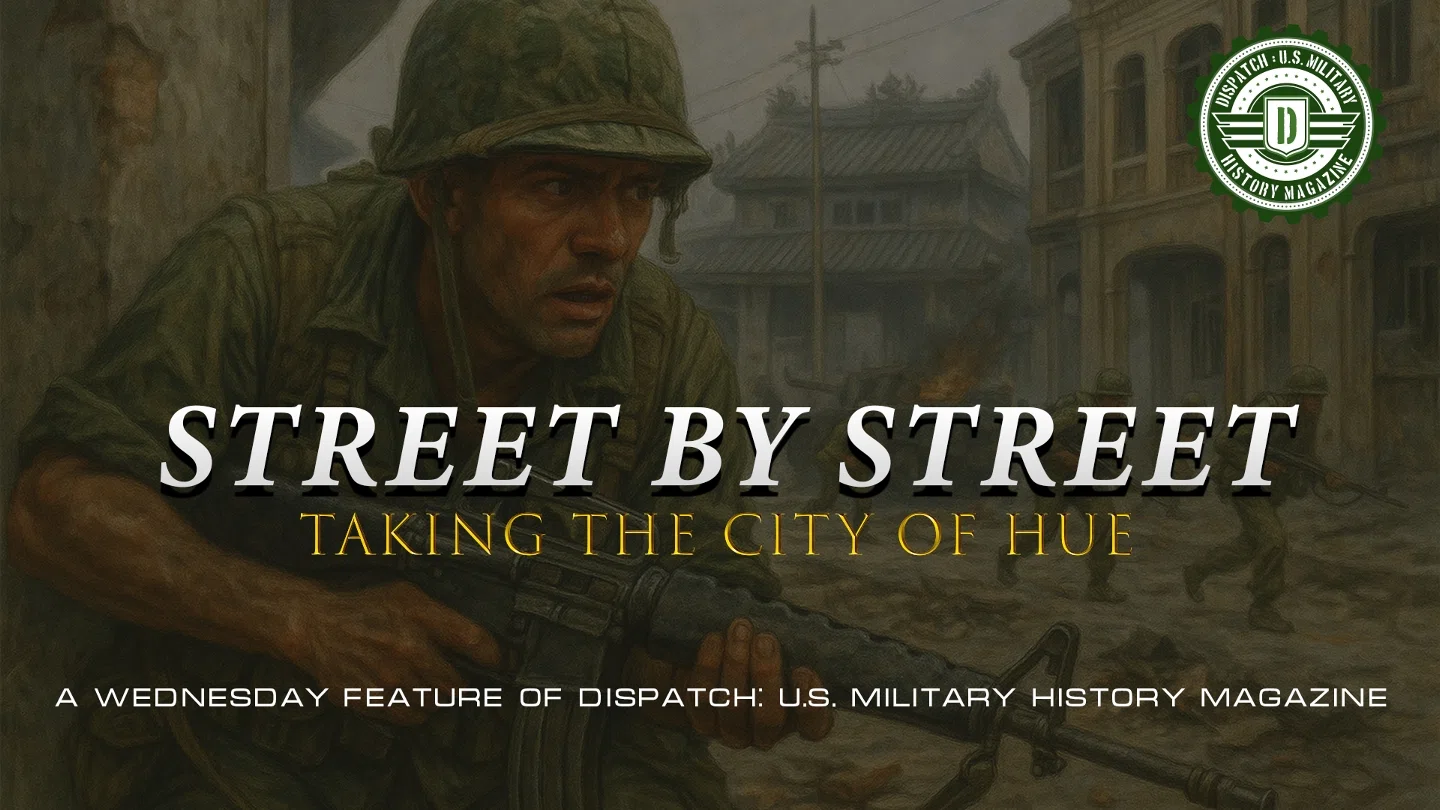
First Steps Into Burning Hue
The Marines who rolled toward Hue on the first days of the Tet Offensive expected another patrol, not a city in revolt. Rain hung low over the Perfume River as convoys crept along Highway 1, passing refugees with carts and bicycles who spoke of gunfire, flags, and dead men in the streets. When the first Marine squads stepped off near the university and the southern neighborhoods, they found shattered shopfronts, blown-out windows, and the distant crack of rifle fire echoing off tile roofs and stone walls. Hue had been known as a quiet cultural and religious center, the former imperial capital, a place of pagodas and scholars rather than a battlefield.
Almost at once, the usual rules of the war stopped making sense. Jungle tactics meant little in tight alleys where every doorway might hide a rifle and every upper floor could mask a machine gun. Radio traffic crackled with partial reports of North Vietnamese flags over government buildings, ambushes near the bridges, and a Citadel on the far side of the river that might already be in enemy hands. Marines and soldiers moved in short dashes from wall to wall, learning the feel of urban combat one doorway at a time. By the time the first squads dug in among courtyards and courthouses, it was clear that this was more than a local flare-up. Hue was under attack on both banks, and the fight in front of them was only the beginning of a far larger struggle for the city.
If Hue Falls, the War Shifts
The battle for Hue unfolded inside the wider shock of the Tet Offensive, a coordinated series of attacks across South Vietnam in early 1968. For commanders in I Corps, the northernmost tactical zone, Hue was more than another provincial city. It sat astride Highway 1 near the border, housed important South Vietnamese government offices and an American advisory presence, and carried enormous symbolic weight as the old imperial capital. To lose Hue, even temporarily, would signal to villagers, troops, and the watching world that the North Vietnamese Army and Viet Cong could seize and hold a major city deep inside the South.
American and South Vietnamese leaders also understood the practical stakes. The enemy’s hold on Hue threatened supply routes along the coast, endangered nearby bases, and offered the North a platform for further attacks in the region. Inside the city, the situation was complicated by the presence of civilians, religious sites, and a walled Citadel full of narrow streets, ancient buildings, and potential firing positions. United States Marine Corps units on the ground, South Vietnamese forces trying to regain control, and later arriving United States Army units all faced the same dilemma: how to root out entrenched, determined defenders without turning the city entirely to rubble. As the first days of the battle unfolded, it became clear that what happened in Hue would not stay local. The struggle for this one city would shape perceptions of the war, influence strategy, and leave scars that extended far beyond its walls.
From Quiet Garrison to City Under Siege
In the months before Tet, Hue looked and felt far removed from the images many Americans had of the Vietnam War. The city sat near the northern frontier, but its streets held more students and monks than soldiers, and the imperial Citadel loomed over riverside neighborhoods like a memory from another age. American presence in the city was limited: advisors, support staff, and a small security footprint. Most of the uniformed burden of defense fell on South Vietnamese units stationed in and around Hue, with American Marine bases and fire support further along the coast and just inland. The war’s violence seemed to circle around Hue rather than cut through it.
That appearance of calm rested on fragile assumptions. Allied planners believed that any enemy attempt to seize a major urban center would be short-lived, quickly broken by firepower, mobility, and air support. Tet, a major holiday, was expected to bring a lull in fighting, not a storm. Intelligence reports warned of heightened enemy activity, but no one fully grasped the scale or coordination of what was coming. North Vietnamese and Viet Cong forces, meanwhile, had quietly infiltrated the city and surrounding hamlets, caching weapons, mapping routes, and preparing assault teams that knew the neighborhoods intimately. When the offensive began, they struck at government buildings, police stations, and key intersections with a plan to seize Hue in one blow.
Weather and terrain compounded the shock. Low clouds and rain limited air support in the opening days, muting one of the strongest advantages available to the allies. The Perfume River and the moats around the Citadel split the battlefield, complicating movement and communication between units north and south of the water. American and South Vietnamese commanders had to shift from a campaign mindset built around patrols, firebases, and rural outposts to the hard arithmetic of block-by-block fighting. Units that thought of Hue as a rear area suddenly found themselves pulling together ad hoc assault teams, coordinating with local armor and artillery, and rushing into a city where the enemy had already chosen the ground.
Block by Block Toward the Citadel
The initial days of the fight saw Marines and South Vietnamese troops clawing for control of the southern half of Hue, even as the Citadel and many key positions north of the river remained in enemy hands. South of the Perfume River, Marine companies pushed through university grounds, government buildings, and residential areas, discovering that standard infantry tactics did not survive first contact with dense concrete and brick. Moving in the open streets meant exposure to interlocking fields of fire from rooftops, courtyards, and upper windows. Units learned quickly that the safest path was often through a wall, not around it, blowing holes with demolitions and recoilless rifles and advancing room to room instead of across intersections.
Each block became a miniature battle. Marines hugged the sides of buildings, covering windows while assault teams slipped to a door and blew it in. Inside, stairwells had to be cleared one step at a time, and grenades bounced off tile floors and plaster walls in close, deafening bursts. Snipers on church towers and taller structures watched for the slightest movement, pinning down patrols until tanks and armored vehicles could be brought up to blast them out. South Vietnamese forces fought to retake their own government compounds and neighborhoods, often under fire from positions that had been friendly just days before. The sound of tank guns, machine guns, and small arms echoed constantly, mingled with the cries of civilians trying to flee or huddling in place.
Across the river, the Citadel and surrounding districts formed a separate, equally brutal front. North Vietnamese regulars used the thick stone walls, narrow lanes, and historic buildings as strongpoints, turning cultural landmarks into firing positions. South Vietnamese units inside the Citadel fought to hold what they could while American commanders planned how to reinforce them and break into enemy-held sectors without destroying the city’s most significant historic core. Artillery and air strikes had to be used carefully, sometimes withheld entirely in certain areas, which meant that assault troops shouldered even more of the risk. Coordination between Marine units on the south bank, Army forces arriving from other sectors, and South Vietnamese elements in the north became a complex, high-stakes puzzle.
As days passed, the pattern of the battle hardened into a grind. A few buildings would be taken at great cost, only for a counterattack to erupt from an adjacent block or from tunnels and hidden routes. The weather remained poor, keeping some aircraft grounded and making streets slick with rain and rubble. Commanders wrestled with how to speed the advance without sacrificing entire companies in frontal assaults. On the ground, small-unit leaders improvised new methods for urban movement, communication, and fire support, often learning from their own mistakes in real time. By the time American and South Vietnamese forces had secured much of the southern city and were turning their full attention toward the Citadel, it was clear that this was no brief flare. Hue had become a long, grinding fight in which every block had to be earned, and the outcome was still far from certain.
Walls, Firepower, and a Relentless Push
What finally began to tilt the battle in Hue was a combination of adaptation, reinforcement, and a hard decision about how much of the city could be spared. On the ground, Marine and South Vietnamese units shifted fully to urban tactics, using tanks, recoilless rifles, and the distinctive Ontos vehicles as mobile bunker-busters, firing directly into strongpoints that had stopped infantry attacks cold. Instead of rushing intersections, assault teams moved through buildings, breaching walls from room to room so that the enemy never knew from which direction the next squad would appear. Junior leaders learned to coordinate armor, infantry, and supporting fire at the scale of a single block, treating each cluster of buildings as a separate objective that needed its own small plan.
Higher headquarters also came to terms with the reality that Hue could not be retaken on the cheap. More Marine battalions were committed, and United States Army units were drawn into the fight to help seal off approaches and apply pressure on enemy positions in and around the city. Rules limiting firepower eased in key areas as it became clear that the North Vietnamese and Viet Cong had turned entire streets and religious complexes into fortresses. Artillery and air strikes, still constrained in the most sensitive locations, were used more aggressively elsewhere to blast apart defensive belts that had eaten up assault companies day after day. Inside the Citadel, South Vietnamese forces, reinforced and supported by American advisers and fire support, pushed slowly through ancient courtyards and tight lanes, paying heavily for every gain but steadily grinding down the defenders.
The enemy, for all their advantages in preparation and initial surprise, began to feel the cost of holding a city under constant assault. Their supply lines into Hue grew strained, their casualties mounted, and their ability to shift units between sectors eroded as allied forces tightened the cordon. Positions that had been carefully arranged kill zones were shattered brick by brick, leaving surviving defenders with fewer places to fall back. By late February, the combined pressure told. One by one, key strongpoints fell, and the North Vietnamese grip on Hue loosened. The very qualities that had made the city such a powerful symbol now worked against the defenders. There were only so many places to hide when every wall, every tower, and every courtyard had been mapped, attacked, and attacked again.
A Ruined City and a Shaken War
By the time the last organized resistance in Hue was broken, the city was transformed. Entire neighborhoods had been pounded to rubble, their streets choked with collapsed masonry, burned-out vehicles, and the remnants of a proud cultural center caught between determined attackers and equally determined defenders. Civilians had suffered terribly, not only from the crossfire but from terror and executions carried out during the period of enemy control. For South Vietnam, retaking Hue meant the preservation of an important symbol and a key northern city, but the victory came at a staggering cost in lives and destruction. For the Marines and soldiers who fought there, the memory of house-to-house combat, snipers among sacred buildings, and friends lost over a single doorway left marks that lasted long after they left the city behind.
At the operational level, the recapture of Hue was part of a broader pattern in which Tet failed to deliver the knockout blow its planners had hoped for. In military terms, the North Vietnamese and Viet Cong suffered heavy losses, and many of their gains were temporary. Yet the very fact that they had seized Hue, held parts of it for weeks, and turned a supposedly secure cultural capital into a battlefield shocked audiences far from the Perfume River. Images of devastated streets, shattered temples, and American and South Vietnamese casualties cut against earlier assurances that the war was being brought under control. Hue became one of the clearest examples of how tactical and operational outcomes could diverge from strategic and political effects.
For the United States Marine Corps and Army, Hue also forced a hard reevaluation of urban warfare. Lessons about combined arms in cities, the need for specialized training, and the limits of firepower when fighting among civilians would echo in later operations in other wars and other countries. The battle demonstrated that even well-trained forces could be caught off guard when fighting shifted into dense urban terrain that favored careful preparation and close-range defense. Today, staff rides, classroom discussions, and museum exhibits return to Hue as a case study in how a single city fight can reshape doctrine, expectations, and public perception all at once. The men who fought through its streets and into the old Citadel did more than retake a city. They helped write a new, costly chapter in the history of urban combat that continues to influence how militaries think about these battles in the present.