Up the Black Volcano Under Fire
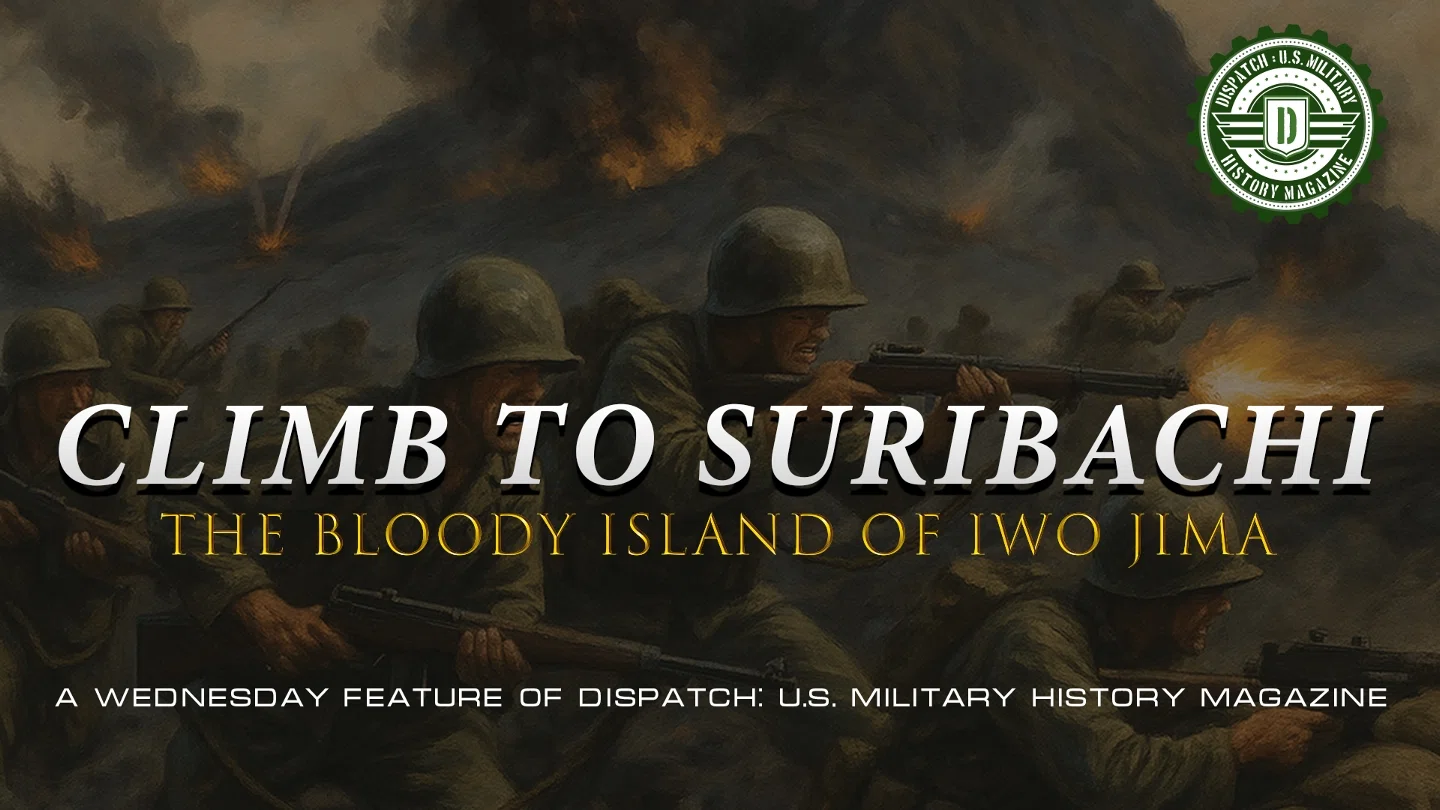
The cone of Mount Suribachi looked close from the black sand at the southern tip of Iwo Jima, but every Marine who had clawed across that beach knew it was farther and steeper than it seemed. The volcano rose out of the island like a dark fist, its slopes cut with old lava flows and fresh shell scars, its surface a mix of loose ash and jagged rock that gave way under climbing boots. On the morning of February 23rd, 1945, a small patrol from the 28th Marine Regiment began working its way up those slopes, silhouetted against a smoky sky while the battle still roared around the base.
Behind them, the southern beaches were a mess of wrecked landing craft, burning vehicles, bulldozed sand, and long rows of foxholes scraped into volcanic grit. Naval gunfire still cracked from offshore, and the muffled thump of bombs rolled across the island as aircraft hit Japanese positions farther north. On the lower ground around Suribachi’s base, Marines were still rooting out bunkers and caves that had survived days of bombardment. The men climbing felt exposed and very aware that enemy eyes might be watching from unseen firing ports and tunnels.
They moved slowly, pausing at ledges and folds in the ground, testing each route up like mountaineers who also happened to be riflemen. The weight of their gear, the sharp smell of cordite in the air, and the constant awareness that a single hidden machine gun could scythe down the entire patrol drove home how precarious this moment really was. Yet step by step, the Marines gained the crater rim. When they finally reached the top and drove a small American flag into the rocky soil, a shout went up from ships at sea and from Marines scattered across the lower slopes.
From a distance, some could barely make out the cloth snapping in the wind, but they knew what it meant. For a few heartbeats, amid the explosions and the radio chatter, they saw a symbol that said the volcano dominating the southern end of Iwo Jima was finally in American hands. What they did not know was that this first flag, and the larger one raised soon afterward, would become one of the most enduring images of the Pacific war, even as the deadliest fighting on the island still lay ahead.
Why Eight Square Miles Mattered So Much
Stepping back from that moment on Suribachi’s rim, the question is why such a small, ugly, eight-square-mile island was worth so much blood. Iwo Jima sat alone in the Volcano Islands chain, roughly halfway between the B-29 bomber fields in the Mariana Islands and the Japanese home islands. For air planners, it was a hard lump of rock positioned right under the main bomber route. For the United States, that meant a potential emergency landing field for damaged aircraft and a base for fighters escorting long-range raids. For Japan, it meant a forward outpost that could warn of incoming bombers and harass them on their way.
By early 1945, the broader Pacific war had shifted decisively. The United States Navy had shattered much of Japan’s carrier force and seized key stepping stones across the Central Pacific. Long-range bombing of the home islands was underway, and Tokyo’s leaders understood that every mile lost brought American airpower closer. Japanese forces on Iwo Jima were ordered to hold, bleed the invaders, and delay that advance for as long as possible. There would be no large-scale evacuation, no easy surrender, and no attempt to meet the Americans on the beaches in open battle where naval guns could do their worst.
Instead, Japanese engineers and infantry had spent months turning the island into a buried fortress. Tunnels honeycombed the rock beneath Suribachi and the northern high ground. Artillery and machine guns were sited to fire from concealed positions, with overlapping fields of fire into the beaches and landing zones. For the Marines tasked with taking Iwo Jima, this meant that the usual pattern of Pacific island assaults would be turned inside out. The enemy would not die quickly under bombardment; he would wait underground, then fight room by room for every yard of ground.
The stakes reached far beyond the Marines of the 3rd, 4th, and 5th Divisions clawing their way inland. Every B-29 crewman flying over the Pacific, every planner looking toward the eventual invasion of Japan, and every family following the war back home had a connection to what happened on Iwo Jima. If the island fell, it could save thousands of aviators and tighten the noose on Japan’s war effort. If it became a drawn-out slaughter that drained Marine divisions and ships for too little gain, it might force a painful rethinking of how to fight the last phase of the Pacific campaign. That is why one flag on a crater rim mattered: it was a visible signal in the middle of a brutal, grinding test of strategy, endurance, and will.
Orders, Tunnels, and a Deadly Trap
The road to Suribachi began long before the first amtracs rolled through Iwo Jima’s surf. In 1944, as United States forces fought through the Marshalls and Marianas, planners were already studying the Volcano Islands chain for its position astride the bomber routes. Iwo Jima’s airfields and radar sites gave Japan a set of eyes and claws reaching out into the path of the B-29s, and its rugged terrain offered natural foundations for a fortress. As the Marianas bases came online and bombing of the home islands increased, the island’s importance only grew. The decision was made: Iwo Jima had to be taken, even if everyone involved understood it would not fall cheaply.
On the Japanese side, the responsibility for defending this black rock fell to Lieutenant General Tadamichi Kuribayashi. He had no illusions about winning a campaign in the Central Pacific, but he believed he could make the United States pay so heavily that it might reconsider an invasion of the home islands. Rejecting earlier patterns of beach-front banzai charges, he ordered his men into the rock itself, directing the construction of an intricate tunnel system linking bunkers, gun positions, and command posts. Suribachi became a hollowed-out gun platform, and the northern high ground bristled with concealed firing points that could survive even violent bombardment.
American and Marine planners responded with a familiar but continually refined amphibious playbook. The operation to seize Iwo Jima, code-named Detachment, massed three Marine divisions under a naval umbrella of battleships, cruisers, carriers, and countless support vessels. Intelligence estimates, shaped by earlier battles, suggested a brutal fight but still undercounted both the depth of Japanese defenses and their commander’s determination to trade space for casualties. Days of air strikes and naval shelling preceded the landings, but much of their violence washed over positions hidden deep within the island.
By the time the assault waves formed up offshore on February 19th, the men of the 3rd, 4th, and 5th Marine Divisions were veterans of other hard islands. Tarawa, Saipan, Peleliu, and other names were still fresh in memory, each with its own grim lessons about coral reefs, fortified airfields, and determined defenders. Those experiences shaped everything from the way the landing beaches were organized to how tanks, engineers, and infantry would work together once ashore. What no one yet knew was that Iwo Jima would take those hard-earned lessons and demand even more, hour after hour, yard by yard, from the waterline up to Suribachi’s rim and beyond.
Across the Sand and Into the Teeth of Fire
When the first landing craft dropped their ramps on Iwo Jima’s southeastern beaches, the Marines found themselves stepping into volcanic ash instead of firm sand. The ground behaved like a pit of dry coffee grounds, swallowing boots and bogging vehicles as men tried to sprint forward. For the first few minutes, there was an eerie sense that the bombardment might have worked; enemy fire was scattered and lighter than expected. Then Japanese guns, mortars, and machine guns began to speak in carefully timed volleys, raking the beachhead from Suribachi’s flanks and from strongpoints hidden in the bluffs and terraces inland.
Assault battalions struggled to move off the tide line, building thin, fragile lines of foxholes while bulldozers and engineers clawed at the ash to make crude roads. Tanks bogged and burned, some knocked out by anti-tank guns firing from invisible positions. Casualties piled up not just from direct hits but from shrapnel and ricochets bouncing unpredictably in the loose ground. Radio nets crackled with calls for smoke, supporting fires, and reinforcements as company commanders tried to keep their units moving rather than letting them congeal into a target-rich clump on the open beach.
To the left of the landing area, the 28th Marines received their mission: drive across the island’s narrow waist to cut off Mount Suribachi from the rest of Iwo Jima. This meant advancing under fire from above while also dealing with a maze of pillboxes and caves at the volcano’s base. Flame tanks and infantry flamethrower teams became critical tools, their fire poured into vents and firing slits to clear positions that had survived everything the big ships offshore could throw. Each bunker fight was a small, savage battle of its own, with grenades, demolitions, and close-quarters shooting in smoke and choking fumes.
Inside their tunnels, Japanese defenders fought by a carefully worked-out script. Many weapons stayed silent during the initial bombardment and first waves, preserving ammunition and hiding their exact locations. When Marines moved into killing zones between well-sited positions, the guns opened up with sudden, concentrated bursts, then fell silent again as crews shifted through underground passages. This pattern made it feel less like attacking an enemy line and more like fighting the island itself, a hostile piece of ground that erupted with fire whenever movement seemed possible.
By the second and third day, the Marines had carved out a tenuous lodgment at the southern end of Iwo Jima, but they were paying a staggering price for every hundred yards. The push toward Suribachi tightened, with the 28th Marines gradually hemming in the volcano’s base while other regiments fought to expand the beachhead and secure the first airfield. All the while, Suribachi loomed in the background of every photograph and every memory, a constant reminder that as long as the volcano remained in Japanese hands, the men on the beaches and low ground were under the eyes and guns of an enemy who refused to break.
It was only after this brutal, methodical encirclement that the moment described in the opening scene became possible. The patrol climbing toward the crater rim did so on ground that had been bought with days of relentless combat and hundreds of casualties, each small advance paid for in blood. Even as the first flag went up, Marines below were still engaged in clearing the last pockets on the slopes and shifting their attention toward the island’s northern plateau. The fight for Suribachi, steep and dramatic as it was, turned out to be just the opening act of a larger and even more grinding battle across the ridges and ravines beyond.
Two Flags and a Relentless Push North
If there was a single moment that seemed to tilt the emotional balance of Iwo Jima, it was the raising of the flags on Suribachi. The first, a smaller flag carried up by the patrol, signaled to men on the beaches and in the surf that the volcano dominating their southern flank was no longer an enemy strongpoint. The second, larger flag raised later that day, was visible from more ships offshore and from more of the island, a bold splash of color against the smoke. These acts did not silence the remaining guns in Suribachi’s tunnels all at once, but they shifted the psychology of the fight. Marines could look up and see a tangible sign that something was finally going their way on a battlefield that often felt like it was trying to kill them with every step.
Yet what truly turned Iwo Jima from a question mark into a brutal but inevitable American victory was not one dramatic moment but a chain of decisions and methods carried out day after day. Combined arms tactics, refined over earlier campaigns, kept grinding at the Japanese defenses. Infantry, tanks, engineers, artillery, and naval gunfire learned to work together against the tunnel system, sealing some positions, burning others out, and methodically reducing strongpoints that could not be bypassed. Company and platoon leaders made dozens of small, on-the-spot choices about when to push forward, when to pause for fire support, and how to use terrain folds and shell craters as cover. These decisions, multiplied across the island, saved lives and kept momentum from stalling.
On the Japanese side, Kuribayashi’s plan inflicted exactly the kind of casualties he had predicted, but it also locked his garrison into a fight they could not escape. His refusal to waste lives on early, doomed charges preserved combat power for days of stubborn resistance. At the same time, the lack of resupply, the relentless bombardment, and the isolation of individual tunnel complexes meant that every position destroyed was gone for good. There would be no orderly withdrawal to another defensive line deeper in the theater, no chance to trade Iwo Jima for time somewhere else. The battle’s turning point was the realization, on both sides, that the Marines would not break and that Japanese forces had no path to anything but annihilation.
As Marines secured Suribachi and pushed toward the central and northern airfields, air and naval support kept up a constant pressure, preventing the defenders from reorganizing for large counterattacks. Medical evacuation chains pulled wounded men off the island as fast as the ash and weather allowed, keeping units from collapsing entirely under their losses. Logistics crews kept ammunition, water, and fuel flowing across those treacherous beaches. In the end, Iwo Jima turned not on a single heroic charge but on the ability to sustain that grind, guided by leaders who understood that the only way through this volcanic fortress was forward, no matter how terrible the bill became.
From Sulfur Island to a Lasting National Memory
When organized resistance finally collapsed on Iwo Jima after weeks of fighting, the island looked like the surface of another planet. Ridges and ravines were chewed up by shells, airfields were cratered and then patched, and the black sand beaches were scarred by tracks and wreckage. The cost had been staggering. Marine divisions were gutted, with rifle companies reduced to a fraction of their strength. Japanese garrisons had been virtually wiped out, with only small numbers captured alive. For the men who walked among the caves and tunnels afterward, the battle’s end did not feel like a clean victory so much as the end of a long, punishing ordeal.
Tactically and operationally, however, the consequences were clear. The airfields on Iwo Jima quickly became a crucial emergency haven for damaged bombers. Crews that might have been lost over the Pacific instead limped in to land on the island they had once flown past with enemy guns firing from below. Fighter squadrons operating from Iwo Jima extended the reach and protection of long-range bombing raids against Japan, tightening the air campaign in the months before the war’s end. In planning for future operations, including Okinawa and a possible invasion of the home islands, commanders had to reckon with the cost of taking such heavily defended ground, and with what Iwo Jima suggested about how determined the defense of Japan itself might be.
Culturally and symbolically, the image of Marines raising the flag on Suribachi took on a life far beyond the volcanic rock where it was captured. Photographs and sculptures based on that moment turned a snapshot of a small unit’s task into a national emblem of sacrifice and determination. For generations of Marines and for countless visitors to memorials, that scene has come to stand for all those who fought and died not just on Iwo Jima, but across the Pacific war. At the same time, those who study the battle are reminded that the famous flag raising happened early and that the worst of the island-wide fighting was still ahead, a sobering counterweight to the clean lines of a statue.
Today, when historians, veterans, and students walk through museum exhibits or stand at the Marine Corps War Memorial, Iwo Jima offers more than a single iconic image. It offers a hard lesson in the realities of amphibious warfare against a determined, well-embedded enemy, and in the human cost of seizing even a small island when both sides are committed to seeing the battle through. It underscores how decisions made in planning rooms and headquarters translate into exhausted men crawling through ash under fire, and how moments of triumph sit side by side with grief. That is why the climb to Suribachi, and the fight that raged around it, still matters: it forces us to reckon honestly with what it took to reach the end of the Pacific war and with the lives that were spent to get there.