Last Light on the Union Left
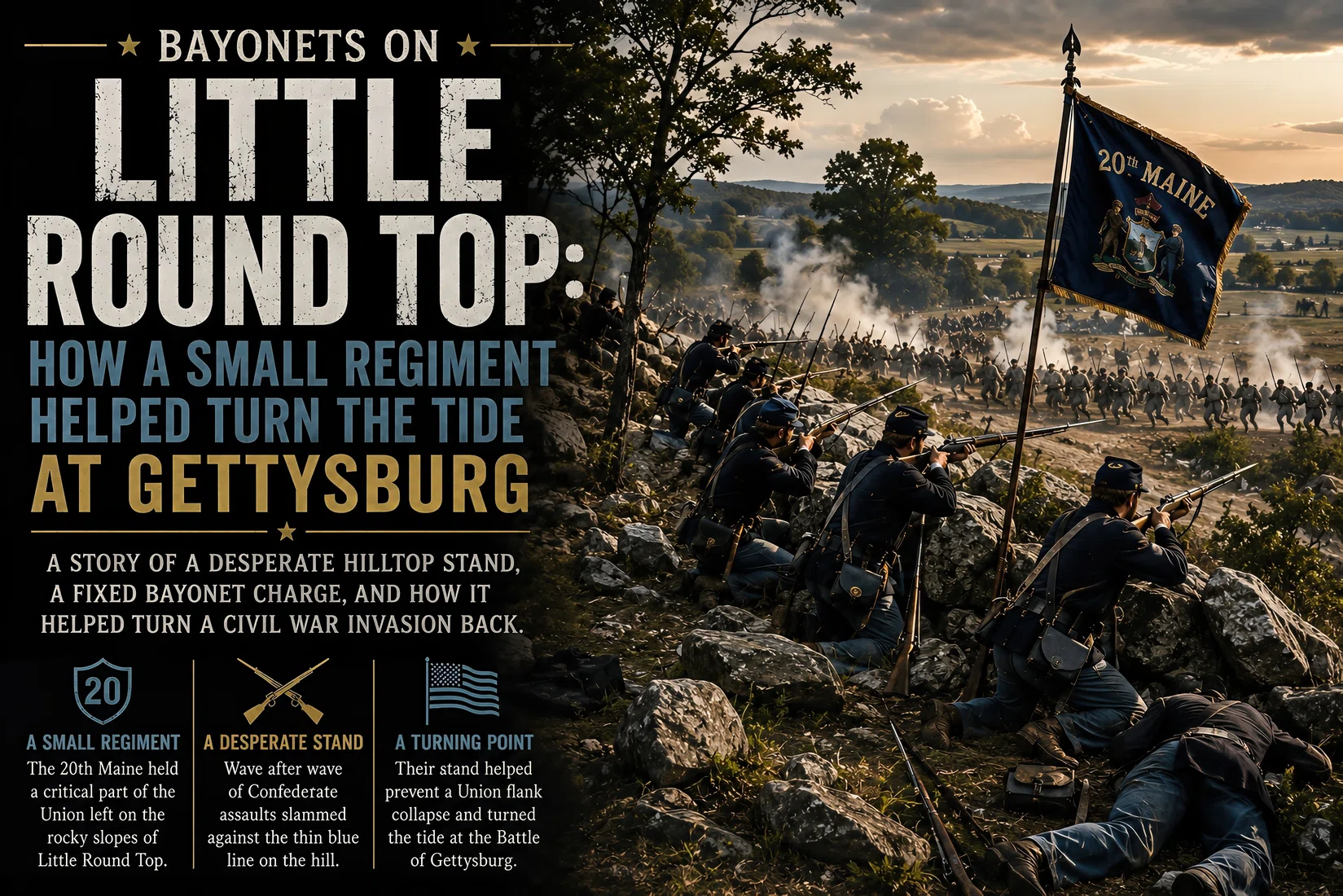
Late on July 2nd, 1863, the heat over Gettysburg hung like a curtain as blue-coated soldiers of the 20th Maine Infantry climbed the rocky slope of Little Round Top. Dust, smoke, and shouted orders rolled together on the wind. The men knew they were being sent to the far end of the Union line, the extreme left flank, a place where a gap could become a disaster in minutes. Scrambling over boulders and stunted trees, they formed a thin line along the hillside, muskets resting on stone and earth, eyes searching the woods below for gray figures moving through the haze. The American Civil War had already produced countless hard fights, but this hill felt different to the men who now shouldered its defense.
Below them, Confederate troops probed and shifted, looking for a seam to break. Each volley from the slope cracked back across the ravine, powder smoke drifting in ragged sheets. Officers shouted along the line as companies adjusted a few paces at a time to cover open ground, stepping around wounded comrades and fallen branches. The rocky flank was no parade-ground position; it was a jumble of cover and dead ground, where visibility changed with every few yards of movement. Yet the instructions were simple enough to understand even through the chaos: hold this hill, because there is nothing behind it but open country and a long line of men already fighting for their lives.
Wave after wave of Confederates pushed up, their figures appearing and vanishing between boulders and tree trunks. The Maine men fired, reloaded, and fired again until their shoulders ached and cartridge boxes thinned. Officers walked the line to steady hands and voices, reminding their soldiers that if they gave way, the whole Union position might be rolled up from the flank. As light began to fade and ammunition ran low, the line on Little Round Top reached a point where one more assault might break it entirely. On that rocky Pennsylvania hill, a small regiment prepared to decide whether the Union left would bend, break, or somehow hold.
If the Flank Fails, the Line Collapses
To understand the weight on those soldiers’ shoulders, it helps to pull back from the rocks of Little Round Top and look at the larger field. Gettysburg was not a minor skirmish; it was the centerpiece of General Robert E. Lee’s second invasion of the North. His Army of Northern Virginia had pushed into Pennsylvania, aiming to threaten Northern cities, draw the Union Army of the Potomac into battle on ground of his choosing, and possibly shake political will in Washington. Opposing him, Union forces under Major General George G. Meade were still settling into new leadership and searching for a clear opportunity to halt Lee’s momentum. The fields, ridges, and town streets around Gettysburg became that opportunity, and that risk.
By the second day of the battle, Union troops held a defensive arc south of the town, anchored on high ground like Cemetery Hill, Cemetery Ridge, and the twin knobs of Little and Big Round Top. If that line stayed intact, it offered fields of fire, interior roads, and a strong position from which to absorb and repel Confederate assaults. If any part of it crumbled, especially a flank, the advantage could flip quickly. A breakthrough on the Union left would not just mean one brigade pushed back; it could allow Confederate divisions to get behind Union positions, strike artillery batteries from the rear, and force Meade’s army into a chaotic retreat east toward the Maryland border.
Little Round Top was more than a picturesque hill. It was a key piece of terrain guarding the Union left from being turned. On and around it, regiments from places like Maine, Pennsylvania, New York, and Michigan dug in as quickly as they could, extending a line already strained by heavy fighting in places such as the Wheatfield and the Peach Orchard. Across the valley, Alabamians and Texans in Confederate gray prepared to attack, told that if they could seize that ground, they might roll up the entire Union position like a carpet. The stakes on that rocky slope were measured not only in yards of hillside but in the survival of an army and the fate of an invasion.
If the Confederate push broke through on the left, Lee’s forces might gain the high ground and turn the Union line from a shield into a trap. Such a reversal could have opened paths toward Baltimore, Washington, or deeper into Pennsylvania, strengthening Southern hopes of foreign recognition or a negotiated peace. Instead, the fight on Little Round Top would help decide whether Gettysburg became the climax of a Confederate advance or the opening of a long retreat. That is why one thin blue line on a rough hill, manned by tired infantrymen with nearly empty cartridge boxes, deserves to stand as a headline moment in United States military history.
Marches, Misjudgments, and a Bare Hill
The road to Little Round Top began weeks earlier, when Lee’s army slipped north after its victory at Chancellorsville, moving through the Shenandoah Valley into Maryland and Pennsylvania. The goal was more than just supplies; it was a chance to strike Union territory, unsettle Northern opinion, and perhaps force a political shift. The Union Army of the Potomac, under new commander George Meade, marched hard to stay between Lee and key cities. Their clash at Gettysburg on July 1st was not a planned set-piece but a meeting engagement, sparked by cavalry and infantry colliding west of town. By evening, battered Union troops had fallen back to higher ground south of Gettysburg, forming a rough fishhook-shaped line that promised strength if it could be fully manned.
On July 2nd, that line was still settling when a critical gap opened. The Union commander of the Third Corps, General Daniel Sickles, was unhappy with his assigned position near the base of Little Round Top and along Cemetery Ridge. Seeking better ground as he saw it, he pushed his corps forward to a salient around the Peach Orchard. This move left the southern end of the Union line dangerously thin and, for a time, left Little Round Top itself without strong infantry support. The hill, so obviously commanding when viewed on a map or from its crest, was nearly overlooked amid the confusion of shifting corps and divisional boundaries.
It took the eye of a staff officer, Gouverneur Warren, to recognize the danger. From the crest of Little Round Top, he saw Confederate forces massing in the woods and fields opposite the Union left, clearly preparing to strike where the line bent and thinned. Warren urgently sent messengers to nearby Union units, pleading for troops to occupy the hill before the assault arrived. The soldiers who answered that call included a brigade under Strong Vincent from the Fifth Corps, among them a volunteer regiment from Maine commanded by Colonel Joshua Lawrence Chamberlain.
Vincent’s brigade was hurried into position along the southern face of Little Round Top, companies scrambling over boulders as officers pointed out sectors of fire rather than carefully marked trenches or prepared works. Regiments from Pennsylvania, New York, and Michigan took their places, while the 20th Maine was sent to the extreme left, ordered to refuse its flank and prevent any Confederate force from slipping around the hill. The instructions were stark and memorable: they were to hold that ground at all hazards. The men may not have known every detail of the wider battle plan, but they understood enough. If they failed, the Union flank might fold, and the entire position at Gettysburg could unravel.
Gray Ranks Climbing the Rocky Slope
The Confederate assault that crashed into Little Round Top did not arrive as a neat line on a parade field. It came as waves of Alabamians and other regiments fighting uphill through rocks, scrub, and broken ground, pushed forward under the larger attack of Lieutenant General James Longstreet’s corps. Units like the 15th and 47th Alabama found themselves lunging up the slope in brutal heat, trying to keep formation as they navigated ravines and boulder-strewn gullies. From their perspective, the hill represented both an opportunity and a punishment: seize it, and the Union flank might be rolled; fail, and they would be spent in a bloody, exhausting climb under fire.
On the crest and forward slopes, Union soldiers fired down into the advancing gray ranks, using every scrap of cover the terrain offered. The line was not a straight wall but a series of angled segments, with Chamberlain’s 20th Maine bending back at the left to prevent a flanking move. Men loaded and fired as quickly as they could, cartridges slipping from sweaty fingers, ramrods clanging against barrels. Officers shouted corrections, shifted small groups to plug gaps, and tried to keep the line from fraying under the strain of repeated assaults. Wounded men were dragged behind rocks or lay where they fell, adding to the chaos and noise.
Assault followed assault. Confederates pushed close enough for volleys at short range, then were forced back by fire and the stubborn use of the rocky ground by the defenders. On the Union left, the 20th Maine’s refused line took the brunt of attacks that tried to curl around the flank and fire along the blue-coated ranks from the side. Chamberlain and his officers shifted companies, wheeling and adjusting like a door on a hinge to keep the enemy in front of their rifles. Each adjustment bought a little more time, but the cost in ammunition and energy grew with every rush up the hill.
Elsewhere on Little Round Top, the fight claimed leaders as well as rank-and-file. Strong Vincent, the brigade commander who had personally placed units along the slope, was mortally wounded while encouraging his men. Artillery officers, like Lieutenant Charles Hazlett, hauled guns up the rugged ground and paid with their lives under sharpshooter and counter-battery fire. The hill became a mosaic of small, desperate fights, each company and gun crew focusing on the few yards of ground directly before them, often unaware of the full picture elsewhere on the ridge.
As the day wore on and cartridges ran low, the 20th Maine reached a crisis. Reports along the line made it clear that ammunition was nearly exhausted, and there were no fresh reserves waiting just behind the crest. Yet the Confederate attacks showed no sign of ending on their own. If the regiment stayed in place and simply tried to ride out another charge, the thin line might be pushed back or broken. At that moment, on the far left of the Union army, the decision was made for a move as risky as it was unconventional on a rocky hillside: a downhill bayonet charge to seize the initiative. With that order, the battle for Little Round Top reached its hinge, and the thin blue line prepared to move forward rather than backward.
A Bayonet Charge Seals the Flank
When the 20th Maine’s ammunition scraped toward empty, Chamberlain faced a choice that commanders dread: retreat and risk disaster, or attempt something so aggressive that it might buy survival. On a wooded, rock-choked hillside, he chose to attack. The order went down the line for a bayonet charge, and officers repeated it with a mix of urgency and disbelief. Men fixed cold steel to hot barrels, many of them knowing they had only a few cartridges left, if any. Instead of bracing for another uphill assault, the thin Union line prepared to surge downhill into the face of those who had been hammering them all afternoon.
The regiment’s maneuver was not a simple straight run. Chamberlain had his line wheel forward like a swinging gate, with the right pressing ahead first and the refused left pivoting to sweep the slope. As the blue-coated soldiers advanced, they shouted and fired what little ammunition remained, relying as much on momentum, surprise, and the sight of hundreds of leveled bayonets as on bullets. Confederates caught in the middle of their own uphill push suddenly found the defenders rushing at them, closing distance across the same rocks that had slowed the earlier attacks. The psychological shock mattered as much as the physical blow.
On the lower slopes, some Confederate soldiers tried to stand and trade fire; others, seeing the line coming on with bayonets fixed, began to fall back or break for cover. Men who had expected to grind the last strength out of a static Union defense were instead being chased downhill. In the confusion, small groups were cut off and captured, while others slipped away through the rocks and trees. The 20th Maine’s charge rolled the attacking force back far enough to break the momentum of repeated assaults on that flank, giving the Union line breathing room at the very edge of its position.
Elsewhere along Little Round Top, other Union regiments and artillery batteries had made their own hard stands, trading blood and exhaustion for time and ground. Vincent’s brigade, though grievously hurt, held its assigned sector; gun crews on the crest had dragged artillery into place that added weight to the defense. Yet it was the sudden, unexpected transition from hanging on to surging forward on the far left that closed one of the most dangerous doors open to Lee’s army that day. A handful of companies, fighting on a rough hill far from the grand vistas of the main ridge, had turned initiative back in the Union’s favor at the critical minute.
A Rocky Knob and a Larger Turning Point
In the immediate aftermath, the ground around Little Round Top was a tangle of exhausted men, wounded comrades, and hastily tended positions. The Union line still held the hill and the southern anchor of its position at Gettysburg. Confederate assaults along that sector had spent themselves without gaining the high ground they needed to roll the flank. As night fell over the Pennsylvania hills, both armies braced for what the next day would bring, but the Union left was no longer hanging by quite so thin a thread. The rocky knob that had almost been overlooked now stood as one of the most secure points in Meade’s line.
Across the wider field, July 2nd ended with Lee’s grand design unfulfilled. His attacks had been fierce, inflicting heavy casualties and pressing the Union line in multiple places, yet they had not cracked the position. The following day’s decision to strike the Union center, remembered as Pickett’s Charge, would become another pivotal episode, ending in bloody repulse. When Lee’s army eventually began its retreat back toward Virginia, Gettysburg joined Vicksburg on the Mississippi as part of a grim turning in the war’s momentum. The invasion of the North had been halted, and the Confederacy’s room to maneuver shrank further.
Over time, Little Round Top took on a symbolic weight beyond its acreage. It became a place where visitors could stand among boulders and trees and picture a thin regiment of volunteers holding ground that commanders had briefly neglected and then rushed to secure. The story of the 20th Maine and its bayonet charge joined accounts of other regiments and leaders who fought there, creating a layered memory of improvisation, sacrifice, and terrain seized just in time. Officers and students have walked those slopes on staff rides, using the fight to talk about initiative, mission orders, and the critical importance of understanding ground.
For modern readers, veterans, and anyone curious about how battles turn, the fight on Little Round Top offers a clear lesson in scale. A single regiment on a rocky hill did not win the entire Battle of Gettysburg by itself, but its actions helped prevent a collapse that could have changed the outcome. Leadership at every level, from staff officers who spotted a gap to company commanders aligning a refused flank, mattered as much as numbers. The hill where a thin blue line held reminds us that in United States military history, turning points often rest on people making hard, fast choices under impossible pressure, with the fate of a much larger story resting quietly on their shoulders.
