Dawn Fire in the Cornfield
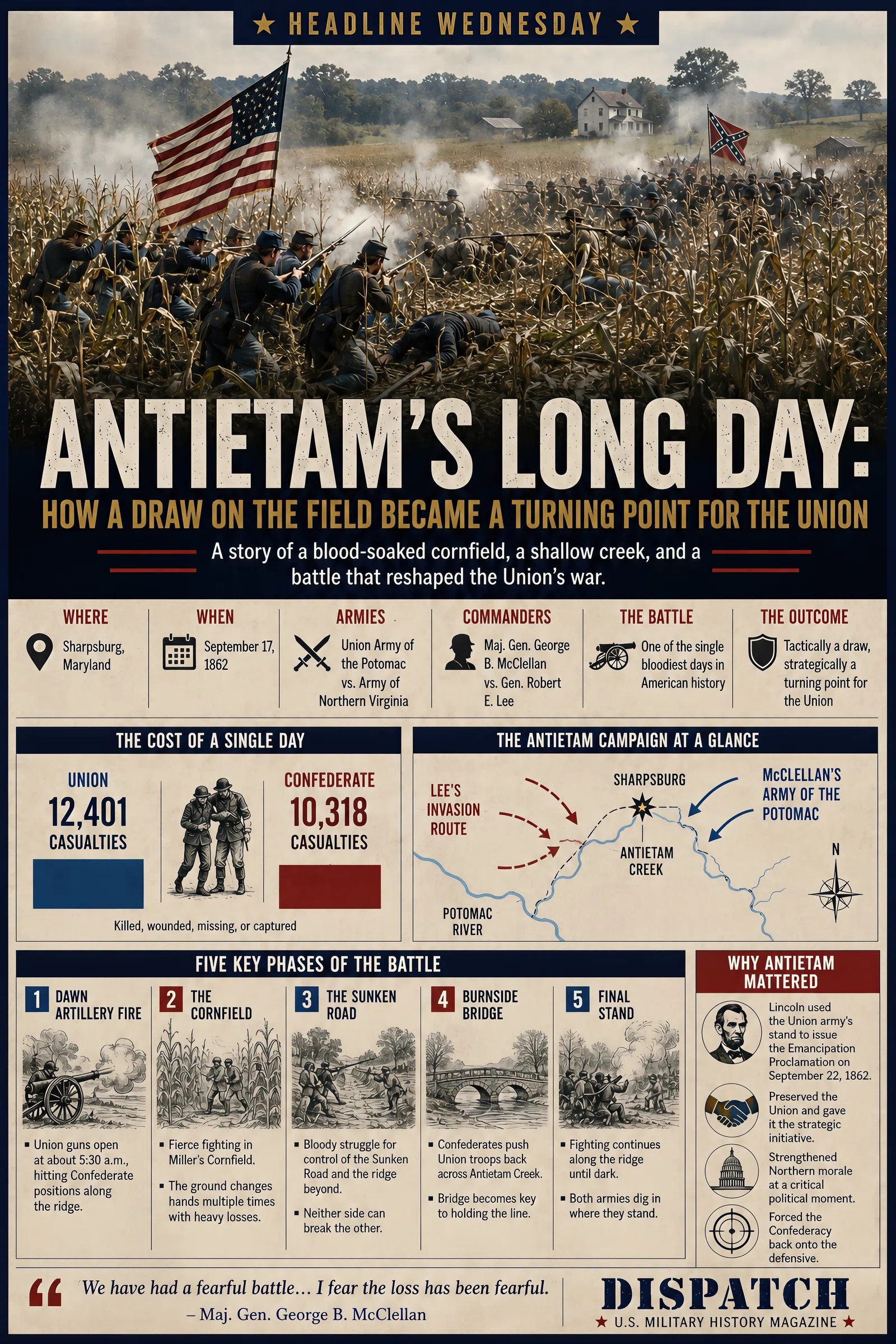
First light on September 17, 1862, found a quiet stillness over the rolling fields north of Sharpsburg, Maryland. Mist clung to the stalks of David Miller’s corn, tall and green but already tinged with autumn. In the half light, Union soldiers from the Army of the Potomac moved into position, boots sliding in the dew, canteens and bayonets clicking softly as officers tried to keep them aligned. Somewhere beyond the cornfield, across the fences and undulating ground, Confederate infantry from the Army of Northern Virginia waited in their own ragged lines, listening for the signal that would mark the start of another terrible day in a long war.
When the guns finally spoke, they did so without warning or ceremony. Union artillery on the ridges opened at close range, shells plunging into the corn just as blue-clad troops advanced into the rows. Almost at once, the cornfield became a maze of smoke, splintered stalks, and sudden death. Men could see only a few yards ahead, shapes appearing and vanishing in the white haze as volleys crashed back and forth. Officers shouted orders that no one could hear, flags dipped and rose again, and companies dissolved into clusters of survivors clinging to whatever cover they could find.
The fighting surged in waves, first driving Confederates back, then hurling the Federals out of the same patch of ground they had just taken. Regiments that had marched into the corn at full strength staggered out with only a fraction of their men still standing. The field itself became a landmark of horror, a place where the very plants seemed shredded by musket balls. Yet even as the battle raged around the Miller farm, the cornfield was only one part of a larger killing ground that stretched along Antietam Creek. The men locked in combat there were only beginning to grasp how much would be decided before the sun finally set.
If the Creek Line Breaks
To understand why the cornfield and the bends of Antietam Creek mattered so much, it helps to pull back from the smoke and noise. In the late summer of 1862, Confederate General Robert E. Lee carried the Army of Northern Virginia across the Potomac River and into Maryland. His victory at Second Manassas had given the Confederacy momentum, and this first major invasion of Union territory offered a chance to shift the entire course of the war. Lee hoped to feed and supply his army from northern farms, encourage pro-Southern sentiment in Maryland, and strike a blow that might convince Britain or France to recognize the Confederacy.
For the Union, the stakes could hardly be higher. Washington and Baltimore lay uncomfortably close to Lee’s line of march. Northern newspapers and politicians were watching every move of Major General George B. McClellan, whose Army of the Potomac had been rebuilt after earlier setbacks. If he failed to stop Lee, the Confederates might threaten key cities, disrupt rail lines, and undermine northern confidence in the Lincoln administration. Fall elections were looming, and war weariness was already spreading through many communities that had sent their sons to fight.
On the ground, those big political and strategic stakes turned into very simple realities. If the Confederate line along the ridges west of Antietam Creek held, Lee could claim that his army had faced the main Union force on northern soil and not been thrown back. If the Union attacks broke that line, they could crush much of the Confederate army against the Potomac and put an end to Lee’s first northern campaign in a single day. Every farm lane, fence line, and bridge became part of a fragile barrier between the Confederates and deeper penetration into the North.
The fields around Sharpsburg thus became more than just another battlefield. They were the thin edge where an emboldened Confederacy tested whether it could carry the war onto Union ground and perhaps force a political settlement. The soldiers who stepped off at dawn on both sides knew they were part of something large, even if they could not see beyond the next ridge. By the time the fighting reached the cornfield, the Sunken Road, and the stone bridge downstream, the struggle at Antietam had already become a contest over the future direction of the entire war.
Lost Orders and Rushed Marches
The road to Antietam really began weeks earlier on the fields of northern Virginia. In late August 1862, Lee’s army had fought and won at Second Manassas, leaving the Union Army of Virginia battered and pushing the war’s front line back toward Washington. In the aftermath, Union leadership pulled forces together under George McClellan, giving him another chance to command the main field army. Lee saw an opening. With his opponent reorganizing and northern morale shaken, he chose to carry the war across the Potomac into Maryland, hoping to keep the pressure on and perhaps trigger political shock waves in the Union states.
Lee’s plan for the Maryland Campaign was bold and risky. He divided his army, sending Stonewall Jackson and other columns to seize the large Union garrison at Harpers Ferry, while the rest of his forces screened and maneuvered to confuse McClellan. This dispersion offered a chance at big gains but left Confederate detachments spread along mountain passes and valley roads. Then came one of the most famous accidents of the war: a copy of Lee’s Special Orders, wrapped around cigars, was lost and found by Union soldiers in a Maryland field. McClellan suddenly held in his hand a detailed outline of Confederate movements and positions.
Armed with that information, McClellan moved west through the South Mountain gaps, fighting sharp actions at places like Fox’s and Turner’s Gaps. He drove Confederate defenders back toward the small town of Sharpsburg, crowding Lee against the Potomac. Yet McClellan’s nature worked against the advantage the lost order had given him. Cautious by habit and temperament, he overestimated Confederate strength and advanced in stages rather than lunging for a decisive blow. Lee, sensing his opponent’s hesitancy, chose to stand and fight despite being outnumbered, pulling scattered divisions together on the ridges west of Antietam Creek.
By the evening of September 16, the pieces were in place. Union forces probed across the creek, artillery batteries tested each other’s ranges, and skirmishers traded shots in fields that would be names on battle maps by morning. Hooker’s First Corps moved into position on the Union right, eyeing the cornfield and the woods beyond. On the Confederate side, men under Jackson, Hood, and others dug in along fence lines and in patches of timber, tired from days of marching but grimly ready. The stage was set for a contest neither side had originally planned, but neither side was willing to avoid.
Cornfield, Road, and Stone Bridge
When the first attacks smashed into the cornfield at dawn, they were just the opening act of a day-long struggle that rolled slowly down the Confederate line. Union forces struck from north to south in a series of separate blows rather than a single synchronized hammer. After the early morning bloodletting among Miller’s stalks, fresh Union units pushed toward a modest lane sunken by years of wagon traffic, a farm road that ran along a rise behind the center of Lee’s position. To the soldiers of the Army of the Potomac who would fight there, it would become the Bloody Lane.
Midmorning saw brigades charge up open slopes toward that shallow trench, only to be ripped apart by concentrated musketry from Confederate infantry sheltering in the roadbed. Flags dipped and rose again as regiments tried to cross the killing zone, some reaching the lip of the lane to fire point-blank into the men below. At one point, a gap opened in the Confederate line when units shifted or misunderstood orders, and Union troops briefly gained a vantage point along the ridge that allowed them to rake the lane from above. For a moment, it seemed the center might crack wide open, exposing Lee’s army to disaster.
While this savage contest raged in the center, the Union left was quiet, and the right had already spent itself in the cornfield and nearby woods. McClellan’s pattern of feeding in attacks one sector at a time meant that Confederate commanders could shuttle brigades and batteries to threatened points, patching holes and launching local counterattacks. Smoke and dust blurred the fields, and wounded men from both sides streamed toward barns and farmhouses turned into makeshift hospitals. Commanders on horseback tried to read the battlefield through this haze, judging where to commit their last reserves.
By early afternoon, attention shifted to the southern end of the field, where Antietam Creek bent near a graceful stone arch bridge. There, Union General Ambrose Burnside’s men faced the task of forcing a crossing under fire from Confederate troops posted on high ground above the far bank. Several assaults up the exposed slopes leading to the bridge were driven back, the narrow span itself becoming a focal point as files of blue crossed and recoiled. Time slipped away as staff officers argued over whether to find fords farther downstream or keep pressing the bridge direct.
At last, persistence and flank movements combined to pry the defenders loose, and Union troops surged across, pushing into the countryside beyond. The long-awaited breakthrough on the Union left seemed within reach. If they could roll up Lee’s right, the Confederate army might be trapped against the river with nowhere to go. Yet those same hours had given Lee time to summon help. A division under A. P. Hill, hard-marching from Harpers Ferry in dusty, red-stained uniforms, was closing in on the field. With daylight beginning to fade and both armies bleeding, Antietam stood on the brink of turning sharply one way or the other.
A Day That Would Not Tip
Late in the afternoon, Antietam balanced on a knife’s edge. On paper, the Union army had the numbers to break Lee’s line in several places. In reality, the battle had become a series of disconnected hammer blows, each landing hard but never quite in concert. In the north, the cornfield and the woods between it and the Dunker Church had seen several Union corps attack in turn, grinding themselves down against determined defenders and counterattacks. In the center, the Bloody Lane had finally been taken, and Union troops briefly looked out from the ridge behind it at what seemed to be open ground leading toward Sharpsburg and the Confederate rear.
This was one of the day’s great turning points, and one that never fully turned. Union artillery now had a better position to pound Confederate lines, and infantry units stood in places from which they might have driven deep into Lee’s army. Yet hesitation and fatigue set in. Confused reports, concerns about fresh Confederate reserves that did not exist, and McClellan’s instinct for caution led to pauses instead of bold exploitation. Orders took time to move, staff officers debated risks, and precious minutes slipped away. Opportunities to turn a local breakthrough into a collapse of the enemy line drained off into uncertainty.
On the southern flank, Burnside’s bridgehead across Antietam Creek represented another potential pivot. Once his men at last crossed and began to push beyond the bridge, they drove Confederate defenders back and seemed poised to roll up Lee’s right. Here, terrain mattered just as much as leadership. The slopes and folds of ground delayed attacks, made coordination difficult, and gave defenders small but important advantages. Even so, late in the day, Union troops edged closer to the outskirts of Sharpsburg, close enough that the possibility of cutting off Lee’s line of retreat came into view.
Then A. P. Hill’s division arrived from Harpers Ferry, having force-marched through the day in dusty columns. Still wearing captured Federal gear from the garrison they had just helped seize, Hill’s men slammed into Burnside’s exposed flank. Their sudden attack halted the Union advance and threw parts of Burnside’s command back toward the creek. It was not a dramatic, sweeping counterstroke that sent the entire Army of the Potomac reeling. Instead, it was just enough force, arriving just in time, to prevent the battle from turning into a Confederate disaster. Combined with Union caution at key moments, this late-arriving division and Lee’s stubborn, improvised defense turned what could have been a crushing defeat into a bloody stalemate.
A Draw That Changed the War
When darkness finally settled over Antietam Creek, the guns fell silent over a field that defied easy description. More than 20,000 men were killed, wounded, or missing, making September 17, 1862, the bloodiest single day in American military history. The Miller cornfield was matted down with stalks and bodies; the Bloody Lane was choked with fallen soldiers in gray and blue; the ground near the stone bridge bore the scars of repeated assaults. Exhausted units bivouacked amid the wreckage, surgeons worked by lantern light in barns and farmhouses, and both armies took stock of what they had spent in a single day’s fighting.
Tactically, the outcome was a draw. Lee still held his line west of the creek on the night of the seventeenth, battered but unbroken. McClellan did not renew his attacks on the eighteenth, wary of what he believed were large Confederate reserves. That evening and into the night, Lee began withdrawing the Army of Northern Virginia back across the Potomac into Virginia. The invasion of Maryland had ended. The Confederates had failed to secure the clear, morale-shifting victory they had hoped for on northern soil. The Union, in turn, had stopped the first major Confederate offensive into its territory, even if it had not destroyed the enemy army as some in Washington had wanted.
Strategically and politically, that distinction mattered enormously. President Abraham Lincoln, frustrated by McClellan’s caution yet aware of the significance of halting Lee’s advance, seized on Antietam as the solid ground he needed. Within days, he issued the preliminary Emancipation Proclamation, declaring that enslaved people in areas still in rebellion would be forever free as of January 1, 1863. This transformed the character of the conflict. The war for Union now explicitly became a war against slavery as well, reshaping domestic politics and undermining Confederate hopes for formal recognition from European powers that were wary of supporting a slaveholding cause.
For the soldiers who survived the cornfield, the road, and the bridge, the legacy was more personal. Antietam became a touchstone for the sheer cost of Civil War battles, a reminder of how quickly fields and farms could become charnel houses. For officers and students of military history, it offered lessons about the use of intelligence, the risks and rewards of dividing forces, the importance of coordinated attacks, and the consequences of caution at decisive moments. Staff rides, battlefield tours, and museum exhibits that cover Antietam still emphasize how much turned on choices made under pressure and how even a “draw” can alter the trajectory of a nation.
In that sense, the cornfield and the creek that stopped Lee’s first invasion did more than mark a grisly day. They became the ground on which the Union claimed enough of a victory to change the war’s purpose and direction. The men who fought there could not know it at dawn, but by nightfall they had helped set the stage for a broader struggle over both Union and freedom that still shapes how we understand that long, terrible conflict today.