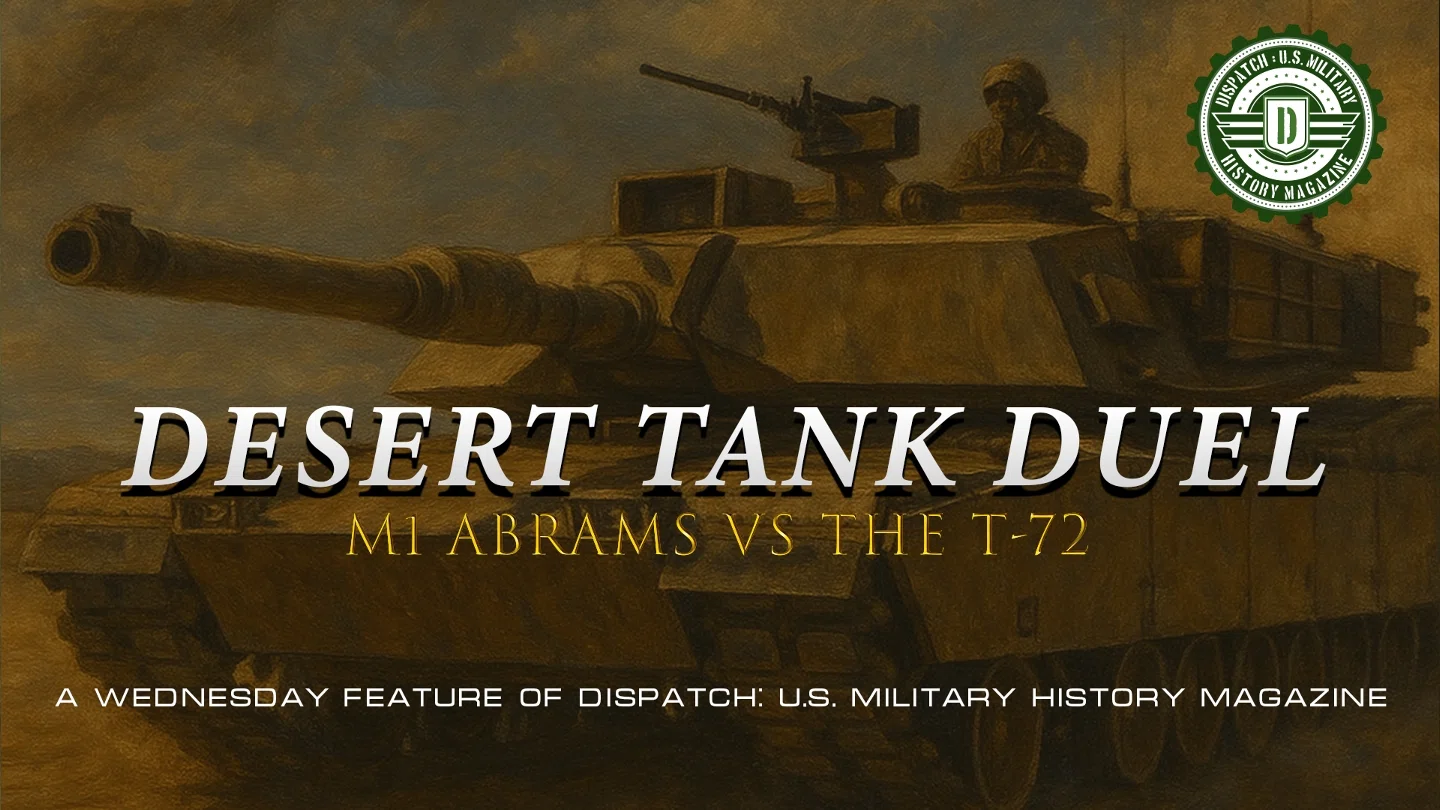
Thermal Sights in a Moonless Desert
The desert is black long before dawn when the line of M1 Abrams tanks grinds forward, engines rumbling low under the Kuwait night. To the naked eye there is almost nothing to see but a dark horizon and the faint glow of burning oil wells. Inside the turrets, though, gunners look through their thermal sights and watch the world bloom in ghostly white shapes: dunes, destroyed vehicles, and somewhere ahead, the hard angles of enemy tanks. The crews know they are on the edge of the first large armored clash of this war, and for the Abrams, it is the combat debut everyone has been training toward for years.
Ahead lies Iraqi defensive belts built around Soviet-designed T-72s and older models dug in on slight rises and in hull-down positions. The Americans move by phase line and grid reference, pushing through sand berms and minefields that mark the border between Saudi Arabia and occupied Kuwait. Radio nets hum with calm, practiced voices as platoons report contact, adjust formation, and confirm their positions in the darkness. When the first enemy tanks appear in the sights, they look like small bright rectangles against the cooler dunes, unaware that they are already being tracked.
Gunners call out range readings that would have stunned World War Two crews. Engagements open at distances where the Iraqi tankers still see only darkness and smoke through their optics. The first sabot rounds streak out, invisible to the eye but very visible in the sights as sudden flashes on impact. Within minutes, the ground to the front is dotted with burning vehicles and secondary explosions, while the Abrams line keeps moving, pausing only long enough to confirm kills and scan for new targets. It feels one-sided and brutally efficient, and the crews sense that something about tank warfare has just shifted in a very public way.
If the Armor Fails, the War Slows
Those early duels between Abrams and T-72s are not just another set of clashes on a wide front; they sit at the heart of the coalition’s plan for the 1991 ground campaign. The armored spearheads of the United States Army are expected to punch through Iraqi defenses in depth, roll up Republican Guard divisions, and cut off forces in Kuwait from their lifelines farther north. If American armor stalls, takes heavy losses, or proves weaker than expected against Soviet-designed tanks, the entire timetable for liberating Kuwait stretches out and casualties rise across the theater. The Abrams, and the crews inside them, carry both steel and political expectation.
For decades, planners in the United States and its allies had worried about facing massed Soviet armor on the plains of Central Europe. The Abrams, the training around it, and the logistics needed to support it were built in large part with that nightmare in mind. Now, instead of the forests and rivers of Germany, the test comes on flat desert under a sky smeared with smoke. The Iraqi Army, equipped with T-72 variants and other Soviet-pattern tanks, becomes a stand-in for the kind of armored threat the West had organized against through the entire Cold War. The world is watching to see whether the billions spent on technology, gunnery, and crew training were worth it.
At the same time, the stakes are intensely human for the soldiers in these vehicles. Families back home remember images from earlier wars where tank battles meant heavy casualties and burned-out hulks scattered over the landscape. Political leaders have promised a quick war with limited losses, and each Abrams crew knows that a single lucky hit or misjudged maneuver can upset that fragile promise. As the first reports of engagements come back describing lopsided exchanges and minimal losses, it is more than good news for one brigade. It is proof, at least for this campaign, that the balance between Western and Soviet-designed armor has tipped decisively in the coalition’s favor, with consequences that will echo far beyond the dunes of Kuwait and southern Iraq.
From Fulda Gap to Desert Storm
The Abrams did not appear overnight in the Kuwaiti desert. It was the product of a long Cold War argument about how the United States Army would stop a mass of Warsaw Pact tanks pouring through gaps in Germany. Designers and planners wanted a tank that could survive modern anti-armor weapons, fire accurately at long range, and fight at night or in bad weather. Years of testing led to composite armor, powerful engines, and a fire control system that treated range and crosswinds as solvable math problems rather than guesswork. On training ranges in the United States and Europe, crews practiced gunnery tables that pushed them to hit fast and hit first.
When Iraq invaded Kuwait in August 1990, that whole Cold War package suddenly faced a different battlefield. Instead of forests, towns, and river lines, the Abrams would operate on open desert, supported by air power and a deep logistics chain stretching back to ports in Saudi Arabia. Through the fall and winter of Operation Desert Shield, heavy brigades offloaded tanks, built assembly areas, and ran long road marches to rehearse the coming "left hook" into Iraqi-held territory. Maintenance crews learned what desert sand did to air filters and tracks, while gunners grew comfortable using thermal sights to spot range markers and simulated enemy positions at night.
Opposite them, Iraqi units prepared defenses around Kuwait and along key approaches farther west. Republican Guard formations, including those equipped with T-72s, dug tanks into revetments, laid minefields, and emplaced artillery. On paper, they commanded large numbers of vehicles and had experience from the long war with Iran. In practice, many crews had limited training time, older ammunition, and less trust in their equipment and leadership. Intelligence reports painted a picture of formidable numbers but uneven quality. Coalition commanders planned to avoid frontal assaults on prepared lines whenever possible, using maneuver to hit Iraqi armored forces from the flank and rear, and relying heavily on Abrams-led spearheads to finish the job once the air campaign had battered command posts and supply dumps.
As the ground offensive neared, commanders in armored brigades and cavalry regiments adjusted their plans over map boards and sand tables. They carved out zones of advance, arranged artillery and attack helicopter support, and rehearsed drills for contact with enemy armor. The Abrams would lead wedges of combat power into a landscape broken only by wadis, slight rises, and berms, with the expectation that first contact might come at any moment. The stage was set for a kind of armored engagement that Cold War training had imagined for decades, now shifted onto sand and lit by burning oil.
Desert Spearheads Meet Dug-In T-72s
When the ground offensive began, Abrams-equipped units rolled north and northwest in great arcs, kicking up walls of dust as they crossed the border. In cavalry formations screening ahead of the main corps, tank and scout platoons pushed through scattered resistance and wrecked vehicles left by weeks of air strikes. The first sharp clashes with T-72s often came suddenly, as lines of heat signatures appeared on thermal sights beyond low ridges or berms. Company and troop commanders called quick fire commands, and Abrams gunners engaged targets at ranges where the Iraqi crews still struggled to see through smoke and darkness. In some fights, entire enemy platoons were knocked out in minutes.
Farther east, armored brigades driving toward Iraqi positions outside Kuwait City threaded through minefields and obstacle belts to reach Republican Guard defenses. There, the duels took on a different character. Iraqi tankers sometimes fired from hull-down positions or from the edges of small rises, hoping to catch advancing Abrams in the open. The American crews responded with practiced drills, using their optics to find firing flashes, returning sabot and high-explosive rounds with punishing speed. Artillery and air support struck suspected strongpoints, while Abrams platoons shifted laterally to avoid obvious kill zones and to force Iraqi guns to traverse under fire.
In one sector, a cavalry regiment’s advance across featureless desert carried it straight into a concentration of Iraqi armor pinned by sand and poor visibility. What could have been a chaotic meeting engagement turned into a one-sided contest of range, optics, and crew training. Abrams tanks halted on favorable ground, quickly ranged targets, and began a methodical destruction of T-72s and other vehicles that tried to move or withdraw. Crews later described it as a series of brief flashes on their screens and distant fireballs on the horizon rather than the close-in chaos older generations associated with tank battles.
As the hours turned into days, similar scenes played out across the coalition’s armored thrusts. Abrams-led formations punched through successive lines of resistance, rolled past smoldering wrecks, and closed on Republican Guard units that had once been held up as elite. Iraqi counterattacks, when they came, often lacked coordination and situational awareness. Tanks maneuvered into exposed positions without knowing they were already inside the engagement envelope of enemy guns. Yet for all the apparent imbalance, the American crews understood that a single misstep, a mine strike, or a well-placed round could still turn a platoon’s fortune in an instant. The biggest tests of the Abrams and its crews were still just ahead, as they drove deeper into Iraqi-held territory and toward the core of the Guard formations that anchored Baghdad’s outer shield.
Seeing First, Hitting First
When veterans of the Abrams’ desert debut talk about what turned those duels, they often come back to the same core advantage: the ability to see and hit before the enemy even realized it was in danger. Thermal sights let American crews pick out T-72s and other Iraqi vehicles as bright shapes on otherwise empty desert, whether it was night, twilight, or a smoky midday. The fire control system handled range and lead calculations in fractions of a second, turning gunnery into a process of stable platforms, crisp calls, and confident trigger presses rather than hurried guesses over an old optical sight. In that environment, the first accurate shot was often the only one that mattered.
Training and rehearsal turned technology into results. Abrams crews had spent years on gunnery tables and maneuver exercises where speed, communication, and precision were constantly measured and judged. Desert Shield gave them months more to adapt those habits to sand, dust, and heat. So when contact came, tank commanders and gunners fell back on routines that were almost automatic: identify, range, engage, shift. Iraqi crews in T-72s and other tanks often had less practice, less realistic training, and less trust that their leaders would support initiative under fire. In those first critical minutes of each engagement, that difference in preparation showed as clearly as any technical edge.
Combined arms support also tilted the scales. Artillery and air strikes had already cut into Iraqi command posts, ammunition dumps, and morale. Attack helicopters and fixed-wing aircraft worked the flanks and rear of armored formations, while Abrams units focused on the tanks and vehicles directly in front of them. When Iraqi commanders ordered counterattacks, those movements often ran straight into a web of observation and fire that they could neither see nor disrupt. Yet the outcome was not simply inevitable. Mines, misidentification, and sheer chance still produced losses, including friendly fire incidents and mechanical breakdowns in the harsh environment. The turning point lay not in perfection, but in a consistent pattern: the Abrams and its crews could absorb friction and still maintain an overwhelming edge in the moments that decided each fight.
From Desert Duels to Doctrine
In the immediate aftermath, the visual evidence was hard to ignore. Photographs and footage showed burned-out T-72s and other Iraqi tanks scattered across desert battlefields where Abrams units had taken little visible damage in return. Republican Guard formations that had been billed as hardened and elite were shattered or forced into rapid retreat. The coalition’s rapid ground advance, capped by the liberation of Kuwait and the collapse of organized Iraqi resistance in the theater, gave political leaders exactly the short, decisive campaign they had promised. For soldiers who had grown up with stories of brutal, attritional tank battles in earlier wars, the contrast was striking.
Those desert duels quickly became case studies for planners and instructors. For armored forces in the United States and allied armies, they reinforced a belief in the value of high-end tanks, advanced sights, and disciplined gunnery. Lessons flowed into doctrine and training: the importance of fighting as part of a combined arms team, of maintaining a strong logistics base in harsh environments, and of integrating intelligence and surveillance into every move of an armored spearhead. Later operations would refine and challenge those lessons, but the Abrams’ debut left a powerful first impression that influenced procurement decisions, export debates, and rival modernization programs around the world.
At the same time, thoughtful officers and analysts warned against drawing overly simple conclusions. Iraqi units had faced weeks of punishing air attacks, gaps in training, and severe command-and-control problems. The next opponent might bring better electronic warfare, more modern tanks, or new anti-armor weapons. The Abrams’ triumph in the desert did not erase the need for infantry, engineers, artillery, and air power; it underlined how lethal a tank could be when all those pieces worked together. Today, when discussions about armored warfare center on drones, precision missiles, and urban combat, those early 1991 engagements still matter. They remind students of military history and serving professionals that technology, training, and leadership can combine to produce surprising, even shocking, results when metal meets metal on open ground.