High Tide Over a Hostile Harbor
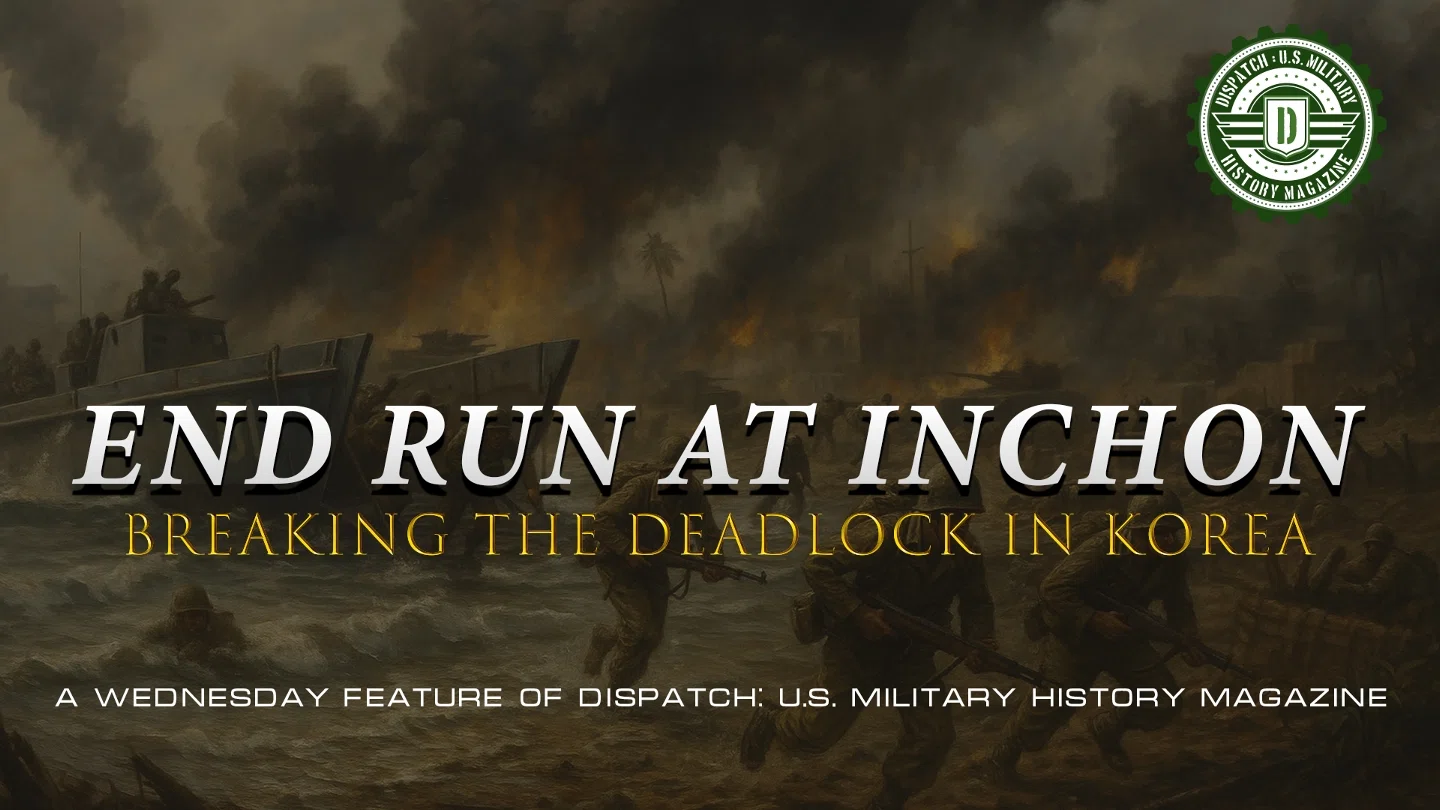
Late on 15 September 1950, the gray hulls off Inchon sat almost absurdly high above a strip of Korean shoreline that did not look like a beach at all. Instead of broad sand, there were slick mudflats, stone seawalls, and a harbor that rose and fell on some of the most extreme tides in the world. Landing craft bucked in the chop as they circled, engines straining, while Marines packed inside checked weapons, adjusted life belts, and stared at the looming wall they were supposed to cross. The smell of tidal mud mixed with cordite and diesel fumes as supporting ships threw shells and rockets into warehouses and ridgelines overlooking the port.
Green flares and orange fire reflected in the water as the first waves closed in on the Inchon seawall. Pilots overhead could see the landing craft fan out toward tight slots in the harbor front, timing their approach to a narrow slice of high tide when there was just enough depth to get in and just enough daylight to see the targets. On the wall itself, North Korean defenders who had shrugged off earlier bombardments now scrambled back to firing positions, trying to pick out silhouettes in the spray. For the men crouched in those boats, the plan hinged on steel ladders, demolition charges, and a few violent minutes of climbing under fire.
When the ramps slammed down and Marines splashed into the shallows, the landing felt less like a classic beach assault and more like storming a fortified dockyard. Grappling hooks bit into concrete, ladders rattled, and small units fought in alleys, courtyards, and along the wharves as the tide began to ebb again beneath them. Inchon’s harbor, with its narrow channels and towering tidal range, had been the main reason many planners thought this operation was impossible. Yet in these first chaotic hours, as boots found purchase on wet stone and flags went up over key piers, it became clear that this strange, risky harbor landing was the opening move in something far larger than a single port raid.
A Gamble With a War on the Line
To understand the stakes at Inchon, you have to pull back to the grim map of Korea in the summer of 1950. North Korean forces had driven the Republic of Korea and United Nations troops into a shrinking pocket around Pusan, a desperate defensive line on the southeastern tip of the peninsula. Supply routes were strained, units were exhausted, and many outside observers doubted whether the coalition could hold much longer. In that context, General Douglas MacArthur’s insistence on a bold amphibious strike far behind enemy lines was not just imaginative; it was a high-risk answer to the possibility of outright defeat.
Inchon sat on the west coast, close enough to Seoul that seizing the port offered a direct path toward the capital and, more importantly, a chance to cut the main North Korean supply routes running south. If X Corps, built around the 1st Marine Division and supporting Army units, could land, secure the harbor, and drive inland, they could threaten to trap large enemy formations between Inchon and the Pusan Perimeter. Success promised more than a tactical gain. It could flip the entire campaign from a fighting retreat to an encirclement.
But the factors that made Inchon strategically attractive also made it operationally terrifying. The harbor’s extreme tides, narrow approaches, and urban waterfront meant only a tiny window each day for large ships and landing craft to move. If the landing faltered, thousands of troops could be stranded against seawalls with no way to withdraw once the water receded. Failure would not just cost a corps-sized force. It could shatter confidence in amphibious operations, weaken political resolve in Washington and allied capitals, and hand Pyongyang a powerful victory narrative. The decision to go ahead at Inchon was, in every sense, a tide-bound gamble with the future of the Korean War at stake.
From Collapse to a Daring Idea
The landing at Inchon did not appear out of thin air. It was born out of a summer of bad news and shrinking ground on which to stand. In late June 1950, North Korean forces surged across the 38th parallel, driving south with tanks, artillery, and infantry that had been quietly prepared for exactly this offensive. Republic of Korea units fell back in disorder, United States and other United Nations elements rushed in piecemeal, and still the line bent and bent again. By August, most friendly forces and their supplies were squeezed into the Pusan Perimeter, a rough defensive arc anchored on a few vital ports and road nets in the southeast.
From his headquarters in Tokyo, General Douglas MacArthur saw that simply reinforcing the perimeter might not change the trajectory of the war. He had spent a career thinking about islands, sea control, and flanking movements. Now he argued that the best way to relieve pressure on Pusan was not just to hold the line but to leap behind the attacking army. The west coast port of Inchon, with its access to the Han River and the road to Seoul, offered exactly that. If a strike force could land there, seize the harbor, and block key routes, North Korean units far to the south could suddenly find themselves with enemy troops both in front and behind.
Many professional planners thought the concept was reckless. Navy officers pointed to hydrographic charts showing mudflats, narrow channels, and a tidal range so high that ships would be left sitting in the mud for hours if they misjudged their timing. Amphibious veterans noted how hard it would be to land against urban seawalls instead of open beaches. Intelligence on enemy defenses in and around Inchon was uneven, and the 1st Marine Division had been scattered across peacetime billets and had to be rapidly reassembled. Yet reconnaissance teams moved in to survey beach conditions, gunners rehearsed fire plans, and staff officers turned MacArthur’s brief into detailed orders under the codename Chromite. By early September, as the Pusan Perimeter held under brutal fighting, the gamble to strike at Inchon was no longer just an idea on a map. It was a scheduled operation.
Up the Seawall and Into the City
The fight for Inchon unfolded in stages, each one threaded through the tight schedule imposed by the tides. Before the main landings even began, United States Navy cruisers and destroyers spent days battering Wolmi-do, a small island that sat like a gate in the harbor approaches. At first light on 15 September, Marines from the 3rd Battalion, 5th Marines rode in under that cover toward what was designated Green Beach on Wolmi-do’s shore. Rockets streaked in ahead of them, blasting gun positions and warehouses, while naval guns walked their fire up the ridgeline. When the Marines came ashore, they fought up steep ground and through prepared positions, clearing the island in a sharp, brutal action that secured artillery and observation points over the inner harbor.
With Wolmi-do in friendly hands, the next phase depended on the tide. There was a pause while the water dropped away from the mudflats and then slowly climbed again toward the afternoon high. Out at sea, the larger transports and their landing craft circled and formed up, waiting for the narrow window when they could get close enough to Inchon’s seawall without grounding. Smoke from burning fuel tanks and buildings on Wolmi-do drifted across the water, mixing with the haze from naval gunfire falling on the city’s waterfront. In the holds of those ships, Marines tightened packs, checked ladders and explosives, and listened to last-minute reminders about the exact sections of the wall they would have to hit.
As evening approached, the main assault waves lined up for Red and Blue Beaches along Inchon’s waterfront. The landing craft churned forward through channels marked by buoys and navigation boats, climbing and falling in the swell thrown up by the flooding tide. Overhead, aircraft strafed and bombed suspected strongpoints to keep defenders’ heads down. When the first craft reached the seawall, ramps went down into shallow water and men splashed toward concrete that towered above them. Engineers and assault teams threw hooks and ladders into place, while covering fire cracked from boat guns and from troops who found scraps of cover along the wall. Small gaps in the harbor front became deadly funnels of grenades, rifle fire, and shouted orders.
Once on top of the wall, the landing forces discovered that Inchon was less a single unified objective and more a maze of narrow streets, railroad tracks, and industrial yards. Platoons pushed inland toward designated crossroads, warehouses, and high ground that overlooked the port. Some companies fought block by block, clearing buildings that had already been pounded by shells, while others moved faster through areas where defenders had pulled back or been stunned by the bombardment. The fading light and thick smoke made coordination difficult, and radios crackled with reports of pockets of resistance, misdirected fire, and units trying to link up in the dark. By nightfall, Marines and supporting troops held a firm foothold in the city, but the inland roads, rail lines, and the approaches to Seoul were still uncertain. The next day’s push would determine whether Inchon became a true turning point or just a hard-won toehold on a dangerous shore.
Tides, Timing, and a Narrow Window
The Inchon operation turned not on a single dramatic charge but on a chain of narrow margins that happened to line up. The bombardment of Wolmi-do had neutralized many of the heaviest guns that could have swept the inner harbor, but smaller weapons and hidden positions still threatened any force that dared come close. The decision to land in two distinct phases, one on Wolmi-do and one later in the day against the main seawall, spread risk but also demanded very precise timing. Had the first assault taken longer, the window for the second could have vanished under receding water, leaving Marines exposed along a sheer wall with no way to bring in reinforcements or supplies.
Several factors combined to tilt that balance in favor of the attackers. The defenders around Inchon and Seoul had not expected such a bold landing at that particular point on the coast and were oriented more toward controlling ground further south. Their forces were spread across a broad front, committed to driving on Pusan, and they lacked the naval and air power needed to contest the approaches in depth. At the same time, the landing force brought together experienced amphibious planners, well-trained Marine infantry, and United States Navy fire support that could adjust quickly as resistance appeared. When small units stalled at a chokepoint or a strong position held up a company, destroyers and aircraft could hammer those obstacles, allowing the advance to restart before the tide or darkness robbed them of momentum.
Another turning point came immediately after the harbor was secured, when forces moved quickly to seize key ground beyond the waterfront. The capture of Kimpo Airfield and the drive on the roads leading to Seoul were not guaranteed. They depended on units that had already fought hard at the seawall pushing inland without a long pause, exploiting the confusion that the landing had created. At the same time, the Pusan Perimeter forces began their own offensive, putting North Korean units under pressure from two directions. By the time defenders fully understood the scale of the Inchon threat, their supply lines and retreat routes were already being threatened. What began as a dangerous bet on tides and ladders had become a coordinated squeeze that shifted the entire campaign’s balance.
From Harbor Gamble to Hard Lessons
In the days after the landing, the success at Inchon reshaped the map of Korea with startling speed. United Nations forces drove from the harbor through the ruins and outskirts of Seoul, fighting street by street to clear the capital while North Korean units tried to regroup or escape. The port became a funnel for reinforcements and supplies flowing in behind the attackers, turning a risky foothold into a solid base. At the same time, the breakout from the Pusan Perimeter gathered strength. Columns moving north from the southeast met units driving inland from Inchon, trapping and destroying portions of the invading army that had seemed poised for victory only weeks earlier.
By early autumn, what had been a desperate defense looked like a sweeping counteroffensive. Seoul returned to South Korean control, and the North Korean advance collapsed into a hurried retreat toward the 38th parallel and beyond. In headquarters and capitals, Inchon became a symbol of bold operational maneuver, proof that amphibious forces and joint planning could still produce decisive results in the age of tanks, jets, and modern artillery. For MacArthur and his supporters, the harbor landing stood as validation of his insistence that a single well-chosen stroke could change the course of a war. The temptation to read Inchon as a final turning point, rather than one phase in a longer conflict, was strong.
Yet the wider war soon reminded everyone that even brilliant operations have limits. As United Nations forces pushed deep into North Korea, Chinese intervention would later turn apparent victory into another brutal, extended struggle. In that light, Inchon is remembered both as a masterclass in amphibious surprise and as a caution against assuming that one dramatic success will neatly close a campaign. Modern planners still study its charts, timing tables, and command decisions for lessons about tides, urban littoral terrain, and the value of striking where the enemy does not expect you. For veterans, students of military history, and staff ride groups walking harbor edges or city streets today, the Inchon story offers a clear reminder that courage, preparation, and risk all collide in real operations—and that even when a gamble pays off, the long work of war continues.